


Style Neo-gothic / Ref.10928
Jean-François-Théodore GECHTER (1795–1844) & Nicolas-Germain CHARPENTIER (1807–1864), Ensemble comprising a chandelier and a pair of wall sconces with standard and trophy holders
Dimensions
Height: 132 cm / 52''
diameter: 100 cm / 39'' ⅜
Origin:
French, 19th century
Jean-François-Théodore GECHTER (1795–1844)
Nicolas-Germain CHARPENTIER (1807–1864)
A set comprising a chandelier and a pair of wall sconces with standard and trophy holders
This exceptional thirty-six-light chandelier was made in gilt bronze during the second half of the 19th century. A work of great originality, it illustrates the Troubadour style, which characterized 19th-century artistic production. Too often equated with the Neo-Gothic style, Troubadour emerged in the 18th century and is not limited to the rediscovery of the Middle Ages. It blends various artistic trends from the past and promotes a national style while also incorporating numerous foreign influences, particularly English and Spanish.
Blending styles and periods, and with little regard for stylistic and chronological accuracy, the Troubadour genre initially designated a style of painting before extending to other artistic fields, particularly the decorative arts. It celebrates great historical moments and figures but also encompasses works of anecdotal genre, which, unlike history paintings depicting major historical events, describe the private and emotional lives of characters from both the Middle Ages and the Renaissance.
Often perceived as a reaction against the Neoclassical and Empire styles, the Troubadour style was part of the first form of Romanticism, a rejection of revolutionary anarchy. Romanticism notably gave rise to a new genre of novel: the historical novel, of which Walter Scott is often considered the leading figure. The heyday of this new genre occurred in France between 1815 and 1830, during the Restoration period. Artists drew inspiration from these trends, focusing on the exaltation of passions, the chivalric spirit, great historical figures, and a whole world of wondrous medieval imagery comprised of fantastic animals, esotericism, and sorcery. Our chandelier depicts three standard-bearers in armor, each holding a banner in one hand while the other rests on the pommel of the sword at their waist. Their standards are adorned with heraldic symbols, notably a coat of arms bearing a Christian cross evoking the Crusades, as well as armored knights armed with lances, the artist undoubtedly intending to allude to medieval jousts.
The details of the armor worn by our three figures, particularly their chainmail, provide a beautiful demonstration of the sculptor's skill and dexterity, while their faces display a vindictive air, the rendering of human expressions betraying his Romantic influences.
The themes of war and victory are explored in various ways by the artist: in addition to the soldiers, pieces of armor adorn different parts of the chandelier, especially the lower section, covered by finely chiseled breastplates and menacing-looking helmets. Strange lion-headed helmets decorate the highest candelabra arms, while shields protect different parts of the chandelier.
Numerous weapons adorn the chandelier: standard-bearers encircle long, finely chiseled war axes, whose tips match those of the spears surrounding them; shorter spears are grouped in the center of the chandelier and appear to be held in place by skillfully sculpted fabric ties. Smaller war axes are also arranged between the light arms, along with swords in their richly ornamented scabbards, whose pommels depict a lion's head.
Finally, flails without handles lend lightness, balance, and density to the chandelier, through a clever arrangement of chains. An imposing sphere studded with spikes conceals the opening separating the breastplates from the lower section, in which various weapons are intertwined and protrude here and there.
The themes of war and triumph are also evoked by more symbolic elements such as stylized oliphants (war and hunting horns), torches, the previously mentioned banners, and the numerous olive branches described as "fruity," symbols of wisdom, glory, and victory. The three armored men stand proudly atop a capital adorned with egg-and-dart molding, a Greek frieze, and architectural volutes. The medieval bestiary is evoked by griffin heads holding rings in their beaks, from which chains are suspended.
A pair of wall sconces on the same theme accompanies our chandelier. This set is similar to a mantelpiece set held at the Louvre Museum. Cast by Nicolas-Germain Charpentier after a model by Gechter, it depicts the Battle of Charles Martel and Abd al-Rahman, King of the Saracens, exhibited at the Salon of 1833.
Several stylistic elements of the candelabra in this set are identifiable on our chandelier: the warriors are quite similar and the light arms are adorned with the same shields, feature the same branches but are surmounted by an axe, an element that is also found on our chandelier, but not in the same position, this one being reserved for an additional light arm.
Jean-François-Théodore Gechter (1795-1844)
Born in Paris in 1795, Théodore Gechter trained at the École des Beaux-Arts where his teachers included the sculptor François-Joseph Bosio and the painter Antoine-Jean Gros. Like Barye, he frequented their studios and then, around 1820, specialized in sculpture; he exhibited regularly at the Salon from 1824 to 1840.
His first public commission was for the casting of the group of Charles Martel. In 1834, he received a second-class medal for his group depicting the Battle of Aboukir. At the Salon of 1835, he exhibited a statue of Mary Magdalene meditating on the Holy Scriptures, which he later executed in marble for the Church of the Madeleine. He also participated in the construction of the Arc de Triomphe, where he created a bas-relief depicting the Battle of Austerlitz. Following this commission, he was awarded the Legion of Honour on April 2, 1837. He is also responsible for the two statues of the Rhine and the Rhône for the North Fountain in the Place de la Concorde, completed in 1839. That same year, in response to a royal commission, he created a large marble statue of Louis-Philippe in his coronation robes, intended for the Council of State chamber at the Quai d'Orsay, and later placed in the Chamber of Peers at the Luxembourg Palace. This sculpture is now on display at the Palace of Versailles; The Musée des Arts Décoratifs in Paris holds a bronze version of this work. Gechter also executed a statue of Saint John Chrysostom in 1840, which was placed under the colonnade of the Madeleine Church. The sculptor created numerous small bronze groups, revealing his predilection for battles between horsemen, captured in spirited movements, as in the group of Joan of Arc. Gechter was particularly fond of this type of dynamic composition, in which one rider seeks to unseat another. These battles provided opportunities for studies of horses, movement, and contortions, so dear to Romantic artists. The depiction of the climax of combat is also characteristic of sculptors of this movement, and especially of Gechter's art. Gechter seems to have sold few of his models to publishing houses. From 1841 onwards, he appears in the Trade Directory as a bronze caster and sculptor. He would therefore have personally made and signed the molds necessary for the sand casting of his own editions. It seems that he single-handedly organized the casting and sale of his models, depositing them in galleries in Paris, London, Berlin, and Dresden. These limited-edition statuettes thus allowed him to disseminate his art. These sculptures, reduced to the dimensions of an interior decorative object, are quite typical of the July Monarchy.
Bibliography
- Stanislas Lami, Dictionary of Sculptors of the French School in the 19th Century, 3 vols., Paris, 1919.
- The Romantics to Rodin, French Nineteenth-Century Sculpture from North American Collection, Los Angeles County Museum of Art, 1980.
Note: Nicolas-Germain Charpentier, after Jean-François-Théodore Gechter, fireplace mantel, circa 1849 (Paris), silvered and gilt bronze, 76 x 55 x 32.20 cm, Paris, Musée du Louvre (OA 11337, OA 11338 and OA 11339).
Informations
Price: on request
Recommended for you :
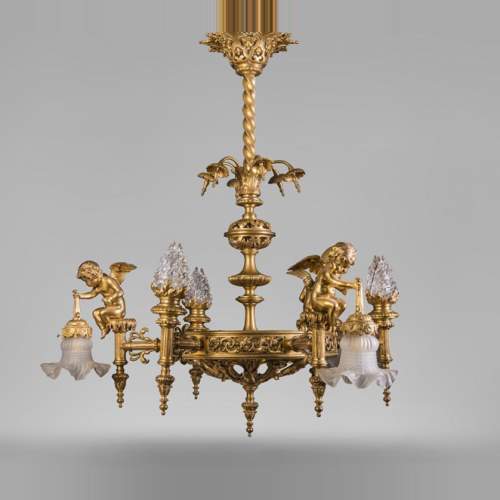
Dimensions:
Width: 82
Height: 93
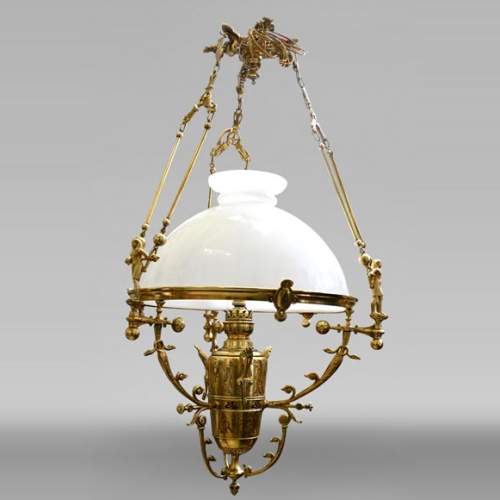
Dimensions:
Height: 95
Diameter: 55
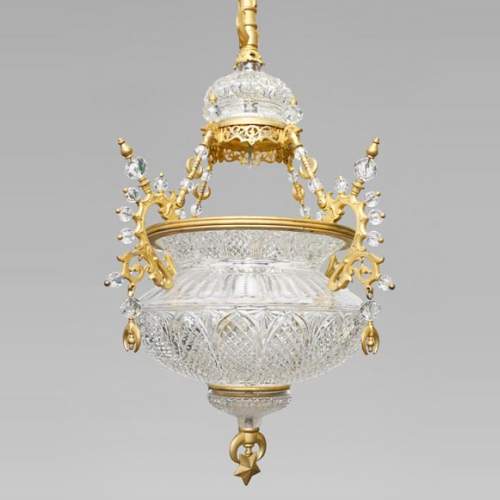
Dimensions:
Width: 47
Height: 78
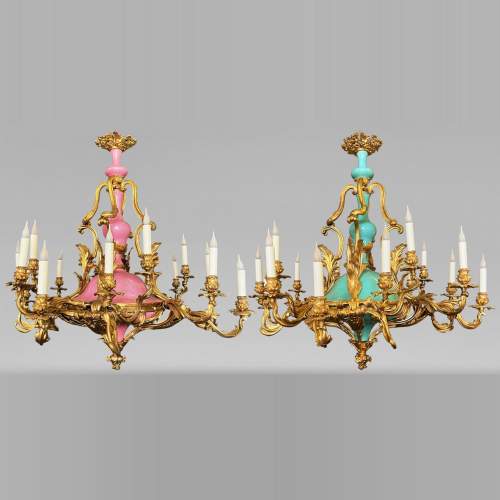
Dimensions:
Height: 110
Diameter: 118
Dimensions:
Width: 57
Height: 88
Depth: 52
Dimensions:
Height: 143
Diameter: 84
Dimensions:
Height: 57
Diameter: 67
Dimensions:
Width: 67
Height: 105
Depth: 67
Dimensions:
Width: 180
Height: 95
Depth: 99
Dimensions:
Width: 100
Height: 135
Dimensions:
Height: 87
Diameter: 82