Maison Boin-Taburet
Download PDFGeorges Boin was born in 1849 into a family of antique dealers and jewelers. His father and his grandfather, Jacques Boin, had managed Mme Desarnaud’s “L’Escalier de Cristal” (The Crystal Staircase) starting in 1804. They became well-known for their crystal objects mounted in bronze. His uncles, Caillot and Peck, were jewelers in Paris until 1877.
Georges Boin began his career as a goldsmith and dealer in antique objects, later entering into a partnership with the jeweler Emile Taburet in 1860. The firm, established under both their names, distinguished itself in the fields of jewelry and decorative cabinet pieces. It exhibited for the first time at the 1878 Universal Exposition, where it was awarded a bronze medal for a toilette set inspired by the work of Pierre Germain.
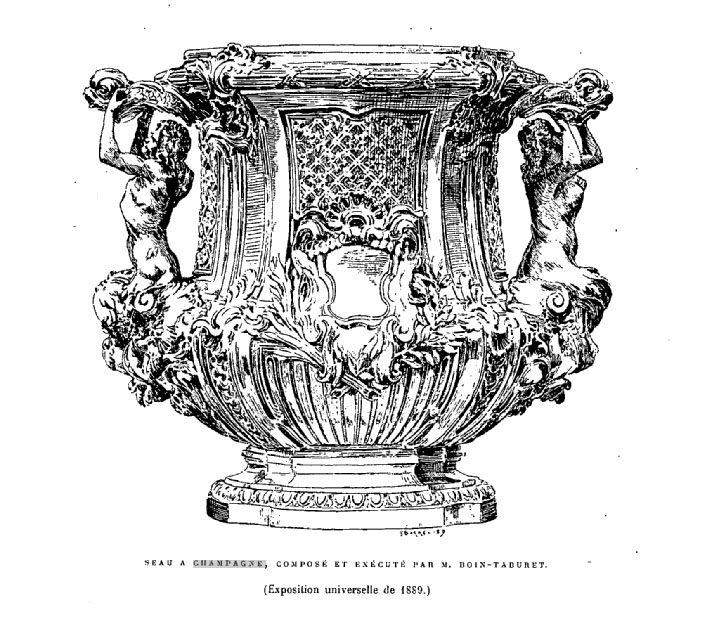
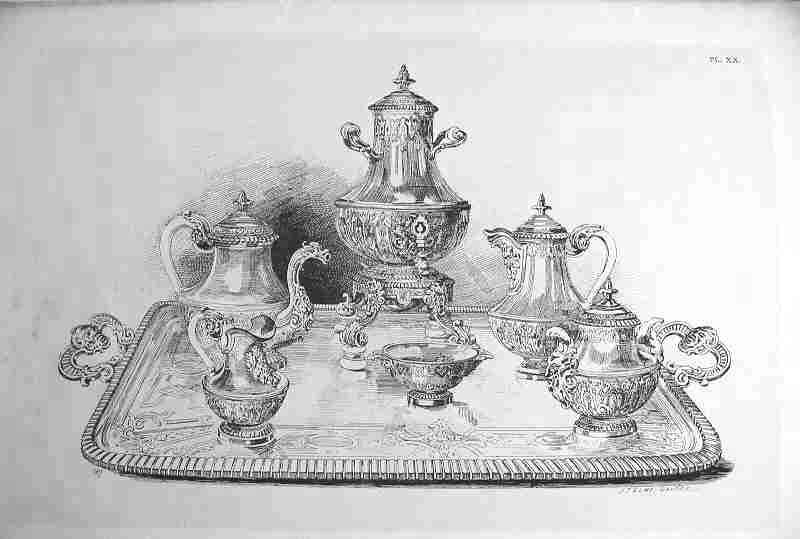
For the 1889 Universal Exposition, the firm presented several surtouts de table (centerpieces)—notably inspired by Juste-Aurèle Meissonnier (1695–1750), for which they received a gold medal—as well as tea services in the Louis XIV and Louis XVI styles. Also on display was a large soup tureen with its own stand, crafted in 1888 for the Jockey Club.
In the periodical Le Temps on January 11, 1889, the Boin-Taburet firm was described as follows:
The Taburet firm is exhibiting silverware in the purest style of the seventeenth and eighteenth centuries. Among these pieces, we might highlight a *surtout de table* (table centerpiece) with candelabra from the Louis XIV period, as well as a Louis XV-style tureen, crafted for the Jockey Club, which awarded it as a prize in 1888. Regarding this exhibition, M. Falize—the rapporteur for Class 24—wrote in an article on the goldsmith’s art, published in the *Gazette des Beaux-Arts*:
“It is perhaps M. Boin-Taburet who, more than any other goldsmith, has contributed to this return to the Louis XV style. This is not an accusation on my part; on the contrary, I observe that, with a very personal taste and genuine tact, he understood, intuited, and sensed what his clientele desired—hastening to offer them exactly what they were about to request. Boin-Taburet was awarded a gold medal—an honor the government evidently deemed insufficient to recognize the true merit of such a remarkably talented goldsmith, as they have since conferred upon him the rank of Knight of the Legion of Honor.”
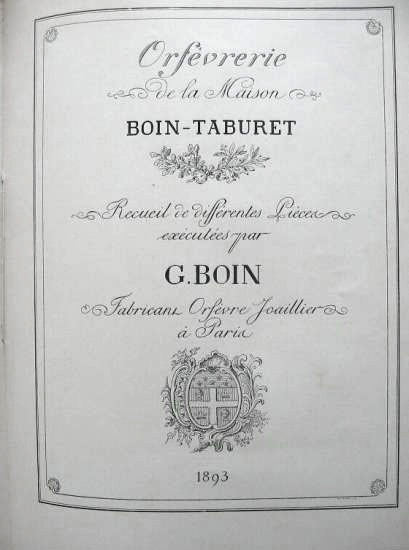
These objects attest to the popularity of the *rocaille* (Rococo) style in 19th-century France—a style that Boin-Taburet not only revived but further developed by proposing a multitude of new combinations. Indeed, in 1893, the firm—much like the 18th-century master Germain—published a collection of its own works. On December 4, 1893, *Le Temps* explained:
*Drawing inspiration from the masters does not preclude originality; as we observed while examining various pieces of goldsmith’s work by M. Boin-Taburet, an object conceived strictly within a specific style can nonetheless retain a modern touch and a personal character.*
Emile Taburet and Georges Boin collaborated until 1900, at which point Boin entered into a partnership with the goldsmith Henry under the firm name **"Boin et Henry orfèvres."**
In 1906, at the International Exhibition in Milan, the firm appeared under the name "Henry Frères et Cie," located at 3 rue Pasquier in Paris. In 1936, the firm became "Henry et Fils."
See also
François-Désiré Froment-Meurice — The 1889 World's Fair — The rocaille ornament and the Rococo style — Louis XV style — Ferdinand Barbedienne — The Denière house