menu
Menu
account_box
Categories
Contact
email Send us a message

Contact

phone By phone

+33 (0)1 42 25 12 79
Tue.-Sat., from 10am to 6pm
+33 (0)6 60 62 61 90
Everyday from 9am to 7pm.

email by Email

Adress: contact@marcmaison.com

share Let's get social

Languages
And also...
My selection
(103 Objects)

My selection (103 Objects)


Winter garden by Loebnitz and Sédille

Ref.9050
Winter garden by Loebnitz and Sédille

The Website Discover Loebnitz's work. Artist as much as an industrial, he gave a new impetus to the ceramic manufacture See the Website The Virtual Visit Find these woks of art in our virtual visit of our Paul Bert Serpette booth in the Saint-Ouen flea market. See the Exhibition .am-parent-card{ display: flex; width: 100%; gap: 5%; } .am-child-card{ display: flex; flex-direction: column; border-radius: 5px; background-color: white; box-shadow: 2px 2px 5px #8080807d; width: 50%; overflow: hidden; } .ref-img1 { border-radius: 5px; box-shadow: 0px 0px 5px grey; width: 100%; } .ref-img2 { border-radius: 5px; box-shadow: 0px 0px 5px grey; width: 400px; } .ref-img3 { border-radius: 5px; box-shadow: 0px 0px 5px grey; width: 400px; } .ref-img4 { border-radius: 5px; box-shadow: 0px 0px 5px grey; width: 400px; max-height: 600px } .ref-img5 { border-radius: 5px; box-shadow: 0px 0px 5px grey; width: 350px; } .ref-img6 { border-radius: 5px; box-shadow: 0px 0px 5px grey; width: 300px; } .ref-img7 { border-radius: 5px; box-shadow: 0px 0px 5px grey; width: 300px; } .ref-img8 { border-radius: 5px; box-shadow: 0px 0px 5px grey; width: 200px; } .ref-img9 { border-radius: 5px; box-shadow: 0px 0px 5px grey; width: 300px; } .ref-sect { display: flex; flex-direction: row; align-items: center; gap: 30px } @media screen and (max-width: 640px) { .am-parent-card{ display: flex; flex-direction:column; width: 100%; } .am-child-card{ width: 100%; } .ref-img2 { width: 100%; } .ref-img3 { width: 100%; } .ref-img4 { width: 100%; max-height: auto !important; } .ref-img5 { width: 100%; } .ref-img6 { width: 100%; } .ref-img7 { width: 100%; } .ref-img8 { width: 100%; } .ref-img9 { width: 100%; } .ref-sect { display: flex; flex-direction: column; align-items: center; gap: 30px } } This winter garden demonstrates in a spectacular manner Paul Sédille and Jules Lœbnitz’s collaboration as well as the appearance, at the end of the 19th century, of Orient-inspired decorations. The signature on the back of the tiles, « Maison Pichenot, J. Lœbnitz successeur, Rue des Trois-Bornes n°7 et Rue Pierre Levée n°4 Paris », allows us to date it between 1872 and 1878. The Moorish inspiration The ceramic adornment covering the walls of this panelling reveals bright colours, blue shades enhanced with yellow, red and black. The monumental chimney, made out of scagliola, ceramic tiles and cloisonné enamels over brass, is also adorned with muqarnas. The sumptuousness of the architectural decoration is just as stunning as the brightness of the colours, made possible by the use of ceramics. The floor is composed by a mosaic which goes along with Lœbnitz’s ceramics. The winter garden also presents several wrought-iron pieces, particularly for the French windows and the rotunda. Jules Lœbnitz’s ceramic decoration comes with a profusion of colours, enhancing the architectural lines of this unique piece. The top of the chimney is adorned with a splendid floral composition, inspired by patterns from the south of Spain, particularly alluding to the Alhambra in Granada, and the decoration of the Barca Door. On the chimney’s right side is a rotunda made of wooden panels and with a ceiling decorated by wooden lattice. The arcatures at the entrance of the rotunda bring us back to the beautiful ones in Córdoba’s Maqsurah, which were drawn by Paul Sédille in 1871 during his journey to Spain. The Maquet-Nicolle family This Moorish winter garden used to be the extension of one of the living rooms of the Maquet-Nicolle’s ancient private mansion, located at the 35 boulevard Vauban in Lille and edificated in 1868 – as written on the facade. Alfred Maquet (1836-1882), a merchant in the thread and linen market, lived there with his young spouse Pauline Nicolle (1850-1931), related to an important family in the spinning mill herself. The couple, married on the 22nd of November 1869, lived boulevard Vauban starting from 1873 – the year their son Emile was born – and became owner of the place in May 1882. Pauline Nicolle lived there until her death in 1931. Alfred and Pauline Maquet come from Lille’s bourgeoisie of textile industry and spinning market. The textile industry, and more specifically the spinning market, became Lille’s speciality during the 19th century. The Maquet family, established in Lille since the 18th century, is not an « industrial » dynasty of employers, but a merchant family who specialised in the linen trade. The merchant families are close to the textile industry and the manufacturing field, with who they contract alliances throught business and marriage, but at the same time they stay focused on sales instead of production, even if they rule true firms. Starting from the second half of the 19th century, many important families of merchants get access to industry and production. Maquet, nevertheless, remain essentially a merchant family. Alfred Maquet’s father, Henri Maquet (1801-1867), was a great merchant of Lille who married Stéphanie Verstraete, sister of the Verstraete brothers, spinning industrials in Lille and Lomme. The Maquet-Nicolle’s sons, Émile (1873-1960) and Henri (1876-1943), would too remain merchants in Lille. Sédille's journey to Spain In 1871, Paul Sédille goes on a journey to Spain, to discover the Moorish art in Granada, Seville and Córdoba. He is highly impressed by the polychromatic monuments presenting an abstract, floral ornamentation, in a simplificated range of tones. The winter garden is probably influenced by this founding journey. We can notice similarities between the decoration on the bottom parts of the walls and the adornment in the Alhambra palace in Granada, especially in some details : the niche’s ornamentation of the Barca Door, the muqarnas of the chimney’s lintel. The entrance of the winter garden’s rotunda, with its arcatures, reminds us of the horseshoe polylobed arches of Córdoba’s Maqsurah, which can be encountered in Paul Sédille’s sketches. Indeed, Sédille came home from his Spanish journey with notebooks full of sketches. These were entrusted to Lœbnitz, who created a range of patterns which could be declined on his ceramics. Considering this, it is undeniable that the Alhambra’s decorations have been a major inspiration in the ornamentation of our winter garden. Córdoba’s Maqsurah, sketch by Paul Sédille Sédille, architect of the Au Printemps department store Sédille, architect of the Au Printemps department store After the 1881’s fire which burned the Printemps, edificated in 1863, his founder Jules Jalouzot (1834-1916) chose the architect Paul Sédille to reconstruct it. The architect deployed treasures of cleverness and modernity using steel in particular for the building’s structures. Au Printemps quickly turned into the absolute model for department stores. Art and architecture historians aknowledge it now as the department store prototype as well as the one of the modern industrial building. The Sédille and Loebnitz collaboration In Sédille’s opinion, architectural decoration had to be colourful and polychromatic architecture inherent to the building, that is to say polychromy had to last as long as the building. This is the reason why he perceives ceramics as the best material for architectural decoration. The method of production of faience tiles resistant to chapping, originated by the Pichenot-Lœbnitz manufacture, allowed to solve the problem of the enamel’s chapping by changing the composition of the pottery itself rather than the one of the enamel. So, at the beginning of the 1870 decade, Lœbnitz oriented himself towards the production of architectural ceramics. In addition, the great, « unchappable » faience tiles could receive a painted decoration made of glazed, shiny and lasting colours. These innovations in architectural ceramics by Lœbnitz permitted to Sédille to satisfy his will of a polychromatic architecture. In 1889, in a letter regarding the Parisian World’s Fair, Sédille gives advice to his good friend Lœbnitz, then says : « Therefore, I am ending by wishing with you the generalisation of our shared dream, the one of a true, coloured and sustainable decoration, by the earthenware and by the enamels which came inalterable from the fire. » The winter garden, one amongst many collaborations between the architect Paul Sédille and the ceramicist Jules-Paul Lœbnitz, is a great example of polychromatic architecture and of the orientalist taste of the time. Facade of Jules Loebnitz’s workshop on 4, rue de la Pierre Levée made by the ceramicist and Paul Sédille Mosaïque sur le sol du jardin d’hiver, attribuée à Facchina The mosaic floor attributed to G. Facchina Giandomenico Facchina (1826-1903) was an Italian mosaicist, as well as an ancient mosaic restorer in Friuli and then in Venezia. When he realised that Italy’s artistic politics were to lead the art of mosaic to decadence, he decided to leave for France. After settling in Montpellier, where he did patent a method to assemble and disassemble ancient mosaics, he is chosen by Charles Garnier to execute the mosaics of the Parisian Opera. He developped a new process, allowing him to earn time and reduct some costs : instead of executing the mosaics in situ, he produced them confortably on a table, and then transported and arranged them by blocks. He received a golden medal at the third Paris World’s Fair (1878), before being designated Chevalier de la Légion d’Honneur. Facchina worked with many architects in the last decades of the 19th century, to contribute, with his ornamentations of mosaic, to polychromatic architecture. Amongst those architects we can mention Sédille, with who he collaborates in 1875 for the mosaics of the Printemps’s facade or at the ornamentation of M. Brot’s familial tombstone in the Père Lachaise. He is also the author of the great mosaic floor in the galerie Vivienne in Paris, of the one in the Petit Palais, and of many others. Thus, it is most certain that Sédille would call on him for the execution of our winter garden’s mosaic floor. Orientalism To defend polychromatic architecture, Sédille often uses references to oriental art, really fashionable in Occident since the beginnings of the 19th century. « Orientalism » is an artistic movement of this time, derived from the « Romanticism » and provoked by Napoleon’s invasion of Egypt in 1798. Many artists travelled to the Middle-East and gave about it a luxurious and fantasised interpretation. We can encounter this artistic movement in paintings but also in architecture and decorative arts. Many pieces of work gave an insight on polychromatic oriental architecture, which was a great inspiration for Paul Sédille. Inspired by the orientalist movement of his time and by his own journey to discover the Moorish art in Spain, Paul Sédille delivers to us a magnificent winter garden, dazzling with bright turquoise tiles, thanks to the architectural ceramics of Jules Lœbnitz. Its rarity, its beauty grants to this piece its uniqueness, and make it a major work of art for the 19th century history of architecture, and for the appearance of architectural ceramics in France. Palais du Gouverneur à Alger

Dimensions:
Width: 980 cm
Height: 420 cm
Depth: 480 cm

Rare pair of cast iron andirons shaped as a laying dog, Wallonia, 16th century

Ref.12745
Rare pair of cast iron andirons shaped as a laying dog, Wallonia, 16th century

Product of the popular figurative art of Wallonia, this pair of andirons made in the 16th century in cast iron shows a naive beauty but is also a testimony of some kind of aesthetic concerns. Made in a zoomorphic shape, the Musée Gaumais, where a similar pair is preserved, describes them as a representation of laying dogs. However, our andirons shows distinctly the representation of hair all around the neck suggesting a mane. Furthermore the representation of the head can also lets us think that a lion is represented instead of a dog. The author of those andirons didn't only give a shape to their visible parts. Indeed the back shows as much precised details with the add of a relief scroll on each side, in which we can see a stylization of the back legs. Also, a small ornamental bolection was added on the andiron's body. It's a very certain inventive spirit, a dexterity but also a sensitivity that the popular art in Wallonia expresses through this pair of andirons. The Wallonia is a French speaking region of the Belgium's south. It is famous for its medieval cities and its Renaissance architecture. Nevertheless, we can't find a real stylistic unity in the region because of the neighbors variety and sometimes the different influences from the outside, without saying the individualism. In olden days, we could count simultaneously and on a very small area, subjects of the Liège Prince-Archbishop, Limbourg or Luxembourg Duke, Prince-Abbot of Stavelot-Malmedy, Namur or Hainaut Count, either independent or under the Burgundian, Spanish, Austrian or French tutelage. This historic past that has divided the actual Wallonia into divided political territories, sometimes rivals, can also explains this dispersal.

Dimensions:
Width: 8 cm
Height: 18 cm
Depth: 43 cm

Ernest LEVEILLE - Exceptional cracked glass vase with polychrome and gilt insert decor on a gilt bronze mount, circa1890

Ref.12691
Ernest LEVEILLE - Exceptional cracked glass vase with polychrome and gilt insert decor on a gilt bronze mount, circa1890

This exceptional cracked glass vase mounted in gilt bronze is a typical work of the late 1890’s production of Eugène Rousseau (1827 -1890) and Ernest-Baptiste Léveillé (1841-1913). Eugène Rousseau (1827 - 1890) merchant editor of porcelain and crystals established since 1855 on the 43 rue de la Coquillière à Paris, was a pioneer by going further that everybody else in the renewal of the glass art. Indeed, at the end of his life he starts to study the glasses coloration and obtains unexpected decorations by superposing colored and shady layers inspired bu the old Venetian techniques from the 16th century and practiced by the Chinese people during the 18th century. In 1884, he’s the first to exhibit cracked glass during the Exposition de l’Union centrale des arts décoratifs. Thus, he creates glasses with the aspect of gemstones. The following year in 1885, he gives his stock to his old student Ernest-Baptiste Léveillé, then also merchant editor of porcelains and crystals who had opened on the 74 boulevard Haussmann in Paris in 1869 la Maison Léveillé. Renamed « Maison Rousseau-Léveillé réunies », the production keeps the developed technical characteristics until the death of the master in 1890. The models then become more bold and the decors follow the trend of the curved line. Named again « Maison E. Léveillé », the store is moved nine years later on the 140 Faubourg Saint-Honoré in Paris. In 1902, Ernest Léveillé merges with the maison Toy, also a crystals and porcelains stores, under the name « Maisons Toy et Léveillé réunies ». The establishment is then located on the 10 rue de la Paix. He participates to many Parisian Salons between 1892 and 1897 and also to the World’s Fairs of 1889 and 1900 in which he wins the gold medal. Our slender shape vase takes all the characteristics of the technique developed by Eugène Rousseau then exploited by Ernest Léveillé. Indeed, the cracked glass is decorated with an inclusion decoration of red, blue and gold powder, forming beautiful marbled mottled effects. Louis Vauxcelles speaks in these words about these characteristic on his book Histoire de l’art français de la Révolution à nos jours, published betweent 1922 and 1925 : « Without overloading the crystal with gold motifs as many others, without daubing it randomly with bright colors, without trying to assign a role for which it is not made for, or making it look like marble, porcelain, lacquer, bronze, he has for ambition to only create effects that are conform to its nature and to let it be enough by itself, and giving elements of its own decoration. Under the localized action of the oxides, he succeeds to mottle it and braids a net of blazing cracks thanks to a projection of cold water between two fires. Léveillé had the art of the unexpected projections, vigorous reliefs and capricious details. » Our vase also shows an impressive Napoleon III style gilt bronze mount with a remarkable quality of carving. The circular base rests on four feet, it is adorned with a round roses frieze and a torus of coiling acanthus leaves surmounted by flutes. A beautiful decor composed of small flowers bouquets and intertwined acanthus leaves comes to lightened up the lower part of the vase. The neck is encircled by a splendid knotted cord in gilt bronze falling on each side. This mount seems to have been made by the sculptor and bronze maker Paul Louchet (1854-1936) old student of Jules Lefebvre and Henri Harpignies. He signs by the mark « Louchet Fondeur Paris » a certain number of his Art Nouveau creations that he makes in his workshop located on the 3, rue Auber in Paris and that he exhibits in the Parisian Salons. The attribution of our mount to the work of this bronze maker was made thanks to a comparison with a similar mount on another vase signed by the artist.

Dimensions:
Width: 18 cm
Height: 73 cm

Art Nouveau style mahogany woodwork with fireplace

Dimensions:
Width: 550 cm
Height: 229 cm
Depth: 480 cm

Louis XVI style wood mantel decorated with a mythological scene

Dimensions:
Width: 128 cm
Height: 249 cm
Depth: 12 cm
Inner width: 45 cm
Inner height: 54 cm

Empire style onyx mantel with detached columns and ormolu capitals

Dimensions:
Width: 145 cm
Height: 110 cm
Depth: 39 cm
Inner width: 112 cm
Inner height: 92 cm

Mathurin Moreau for the Val d’Osne foundry, The Flower Fairy, late 19th century

Ref.14982
Mathurin Moreau for the Val d’Osne foundry, The Flower Fairy, late 19th century

This cast-iron sculpture was created by Mathurin Moreau for the Val d'Osne foundry, with which he collaborated, at the end of the 19th century. It depicts a winged young girl being led by a cherub. The composition of the sculpture is complex: the woman is seated in the form of an Amazon; her naked body forms a circular arc, her arm raised above her intertwining with long garlands of flowers. These link her to the cherub, who seems to be dragging the fairy through them, setting the whole composition in motion. The sculptor paid great attention to detail: the simple headband on the woman's head, the modest drape over her thigh and falling over the base, and the cherub's hair pulled back by the wind give the composition its liveliness. The sculpture's imposing pedestal is in harmony with it. It is divided into several compartments, the inside of which is decorated with floral motifs and various symbolic objects: two recorders forming an aulos (ancient wind instrument) accompanied by small birds, embodying harmonious music; a panpipes associated with grapes evoking the world of Dionysus; a sheaf of wheat and tools symbolising agriculture; a theatrical mask and a fool's hat with a tambourine and a curtain representing the performing arts. The sculpture of the Flower Fairy is shown in the catalogue of the Val d'Osne foundry (on plate 583), as is its pedestal, independently (on plate 570 bis). The combination of the two works was therefore the result of a desire on the part of the patron, who imposed his own taste on the commission. The Museum of Fine Arts in Houston owns a copy of the Flower Fairy identical to our own. Mathurin Moreau also created another Flower Fairy, a statuette. This one is a young woman in a dancing posture, whose nudity is emphasised rather than concealed by a wet drape around her body. This very delicate figurine echoes the larger but no less elegant bronze sculpture.

Dimensions:
Height: 265 cm

Louis XVI style trumeau decorated with a woman's profile

Dimensions:
Width: 118 cm
Height: 181 cm
Depth: 5 cm

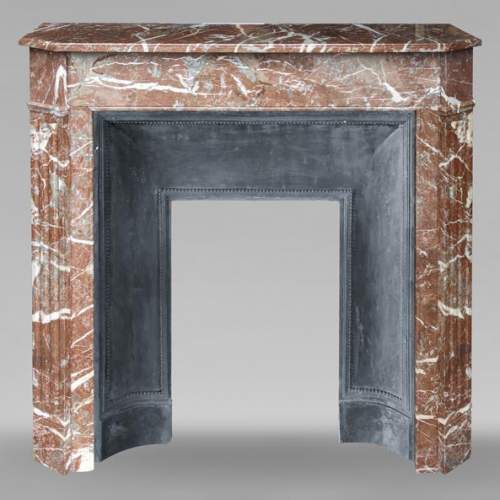
Louis XVI period mantel in Rouge Royal marble

Dimensions:
Width: 147 cm
Height: 112 cm
Depth: 34 cm
Inner width: 93 cm
Inner height: 111 cm

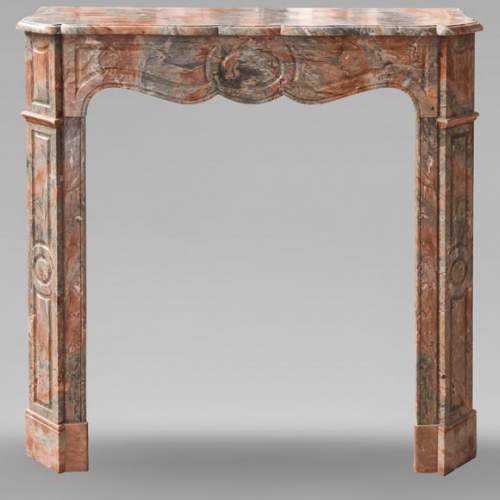
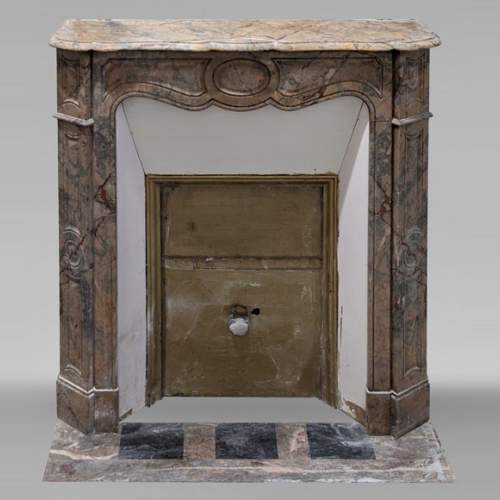
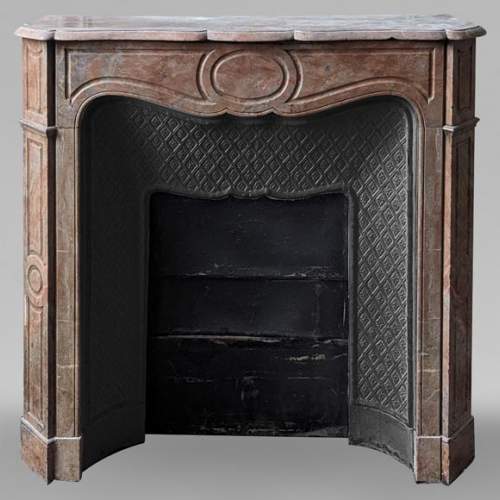
Louis XV style Pompadour mantel in Rouge du Nord marble

Dimensions:
Width: 116 cm
Height: 99 cm
Depth: 35 cm
Inner width: 81 cm
Inner height: 82 cm

Gallé Establishments, Seagull Plate, between 1918 and 1936

Ref.15161
Gallé Establishments, Seagull Plate, between 1918 and 1936

This Seagull Plate in triple-layered glass was produced by the Gallé Establishments between 1918 and 1936. Considered the founding father of Art Nouveau, Émile Gallé (Nancy, 1846-1904) took over the workshop established by his father and gave it a significant artistic direction, which he maintained throughout his life with his ever-renewed creativity. After his death, the Gallé Establishments continued production under the management of his widow, Henriette, with the privilege of signing the pieces they created with his name. Upon her death, the Establishments were taken over by her son-in-law, Paul Perdrizet, until 1936, when the Gallé factory closed. The signature on the Seagull Plate corresponds to the one used during this final period. The animal-themed decoration in triple-layered glass of this plate fits perfectly within the production of Gallé’s later years. The first layer, in a rich yellow, brightens the rim of the plate as well as the beaks and feet of the seagulls; the second layer, white and misty, enhances the transparency in the depiction of the waves, foam, and birds; the final layer, in a deep blue characteristic of Gallé’s work, represents the sky. The decoration of this plate is reminiscent of a vase sold at auction by Tajan in 2017. This vase also featured several seagulls in flight over a stormy sea. However, the color subtleties are less refined in the vase, primarily due to the absence of a third layer.

Dimensions:
Height: 4 cm

Louis XIV style mantel with acroterion in Rouge du Nord marble

Dimensions:
Width: 146 cm
Height: 115 cm
Depth: 35 cm
Inner width: 115 cm
Inner height: 87 cm

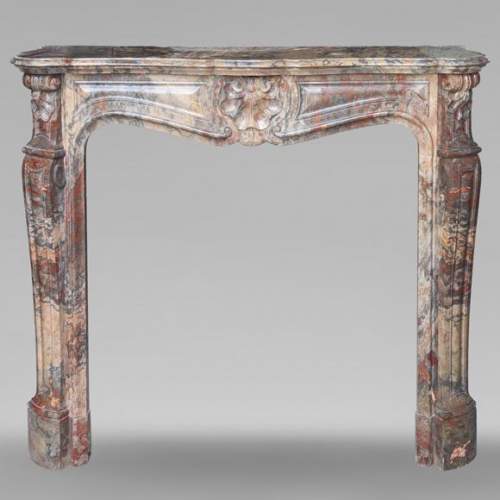
Louis XV period mantel in Rouge du Nord marble

Dimensions:
Width: 163 cm
Height: 108 cm
Depth: 30 cm
Inner width: 131 cm
Inner height: 86 cm

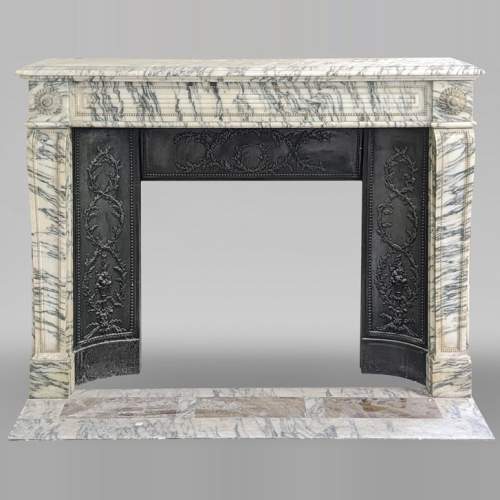
Curved Louis XVI style mantel in Arabescato marble decorated with a laurel wreath

Dimensions:
Width: 146 cm
Height: 108 cm
Depth: 36 cm
Inner width: 100 cm
Inner height: 84 cm

Louis XIV style mantel in Rouge de Rance marble adorned with bronze ornaments

Dimensions:
Width: 135 cm
Height: 120 cm
Depth: 36 cm
Inner width: 93 cm
Inner height: 85 cm

Louis XVI style mantel in Carrara marble adorned with a sunflower flower

Dimensions:
Width: 126 cm
Height: 104 cm
Depth: 32 cm
Inner width: 87 cm
Inner height: 88 cm

Louis XVI style mantel with rounded corners and carved sunflower in cristaline marble

Dimensions:
Width: 125 cm
Height: 103 cm
Depth: 36 cm
Inner width: 88 cm
Inner height: 84 cm

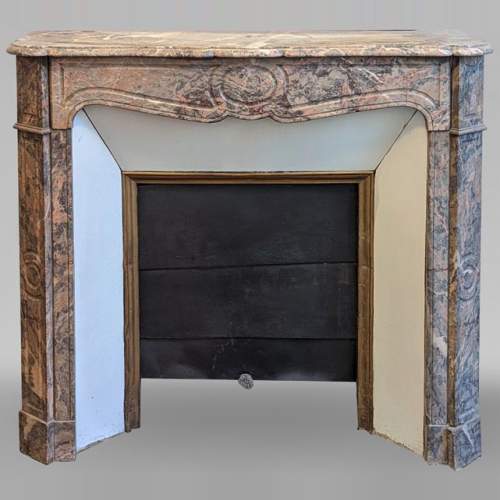
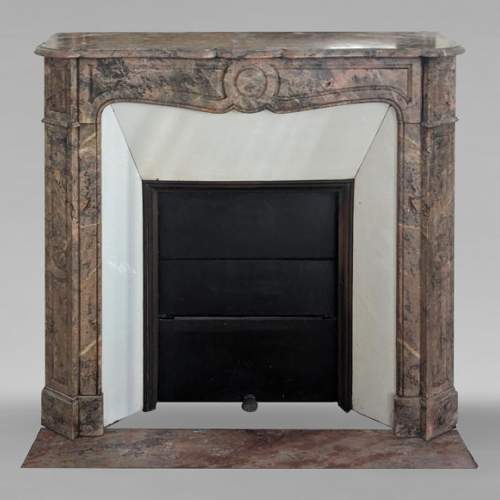
Louis XV style Pompadour mantel carved in Bois Jourdan marble

Dimensions:
Width: 112 cm
Height: 100 cm
Depth: 34 cm
Inner width: 76 cm
Inner height: 81 cm

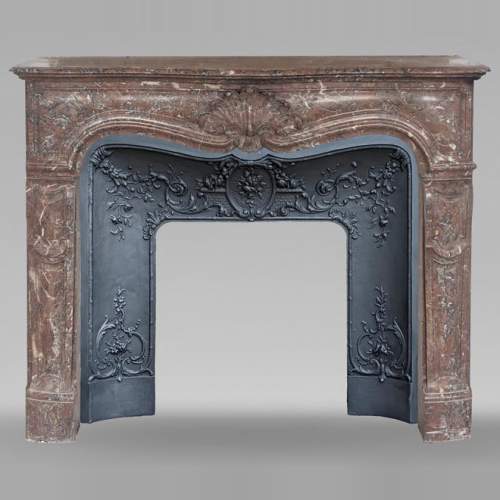
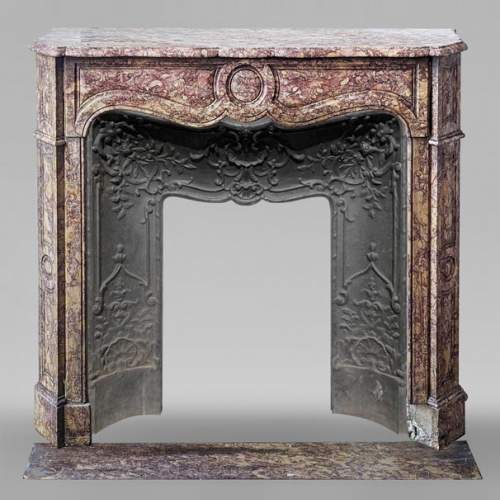
Louis XV style mantel in Red of the North marble with curved shells

Dimensions:
Width: 148 cm
Height: 109 cm
Depth: 42 cm
Inner width: 104 cm
Inner height: 84 cm

Louis XVI style molded mantel in veined Carrara marble

Dimensions:
Width: 135 cm
Height: 106 cm
Depth: 35 cm
Inner width: 96 cm
Inner height: 83 cm

Louis XIV style mantel with acroterion in Rouge du Nord marble

Dimensions:
Width: 145 cm
Height: 126 cm
Inner width: 111 cm
Inner height: 94 cm

Napoleon III style trumeau surmounted by a woman's mask

Dimensions:
Width: 130 cm
Height: 162 cm
Depth: 13 cm

Louis XVI style trumeau with scrolled acanthus leaves

Dimensions:
Width: 141 cm
Height: 174 cm
Depth: 13 cm

Louis XVI style trumeau with plant garlands

Dimensions:
Width: 141 cm
Height: 173 cm
Depth: 6 cm

Louis XVI style fireplace with acanthus leaves, in Carrara marble

Dimensions:
Width: 156 cm
Height: 110 cm
Inner width: 111 cm
Inner height: 83 cm

Curved Louis XVI style fireplace in Arabescato marble, decorated with a laurel wreath

Dimensions:
Width: 129 cm
Height: 110 cm
Inner width: 87 cm
Inner height: 83 cm

Louis XVI style trumeau decorated with a laurel wreath

Dimensions:
Width: 111 cm
Height: 190 cm
Depth: 4 cm

Louis XVI style gilded trumeau with plant decoration

Dimensions:
Width: 107 cm
Height: 179 cm
Depth: 6 cm