Clément Massier (1844-1917)
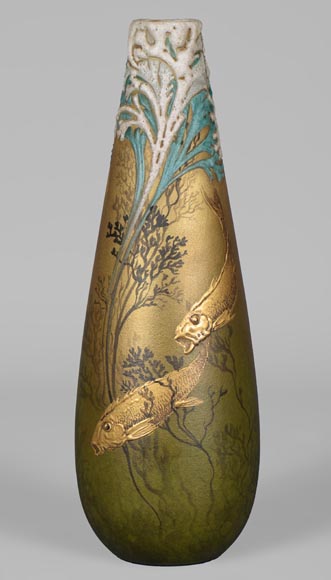
Download PDFClément Massier is the best known of the ceramists of the Vallauris dynasty and one of the major artists of Art Nouveau pottery. To him is owed the rediscovery of metallic lustre, the iridescent glaze with shifting reflections that made the reputation of his Golfe-Juan factory and had a lasting influence on European ceramics. He is regarded as the founder of the modern ceramic industry of Vallauris.
His father's workshop
Clément Massier was born at Vallauris in 1844, into a family of potters settled in the town since the seventeenth century. His father, Jacques Massier (1806-1871), ran a factory that he gradually turned towards decorative wares. Clément entered it as a workman in 1856, at the age of twelve.
His training owed much to the Bolognese ceramist Gandolfo Gaetano, employed in the workshop and the inventor of several earthenware techniques, who passed on to the Massier sons the processes of enamelled faience. On their father's death in 1871, Clément first went into partnership with his brother Delphin; their two factories, together with that of their cousin Jérôme, then accounted for most of Vallauris's output.
Golfe-Juan
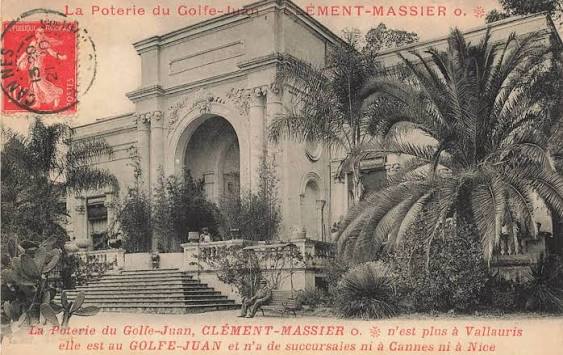
In 1883 Clément Massier took the decision that would shape his career: he left Vallauris and founded his own factory at Golfe-Juan. The choice was that of an entrepreneur as much as an artist. The site, on the road linking Monaco, Nice and Cannes, placed him in direct contact with the wealthy cosmopolitan clientele that wintered on the Riviera; the proximity of the railway allowed him to ship his wares across Europe.
The firm circulated its models through detailed catalogues, opened outlets in France and Germany, and in 1887 became an official supplier to the English Crown.
Metallic lustre
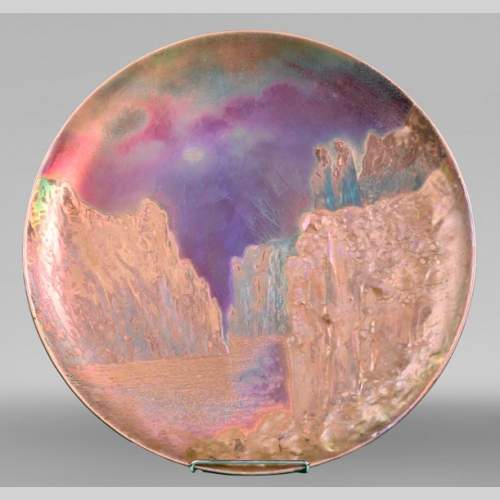
It was between 1886 and 1887 that Clément Massier perfected the process that would make his name. Metallic lustre consists in applying to the glazed piece a preparation based on salts of copper, gold or silver, then firing it in a reducing atmosphere: the metal is deposited as an infinitely thin film and produces an iridescence that shifts with the angle of the light.
The technique was not an invention but a resurrection: it had been practised by the Hispano-Moresque potters of the Middle Ages, whose iridescent wares fascinated collectors at the end of the nineteenth century. Massier recovered the secret through obstinate chemical research, then applied it to an entirely modern repertoire.
At the 1889 Universal Exhibition, his turquoise ceramics with metallic lustre earned him a gold medal and an international reputation.
Lucien Lévy-Dhurmer
The decisive encounter was with the painter Lucien Lévy-Dhurmer (1865-1953), who became artistic director of the factory from 1887 to 1895. Lévy-Dhurmer collected precisely those Hispano-Moresque ceramics with iridescent glazes, and his influence is immediately legible in the pieces he designed for Massier.
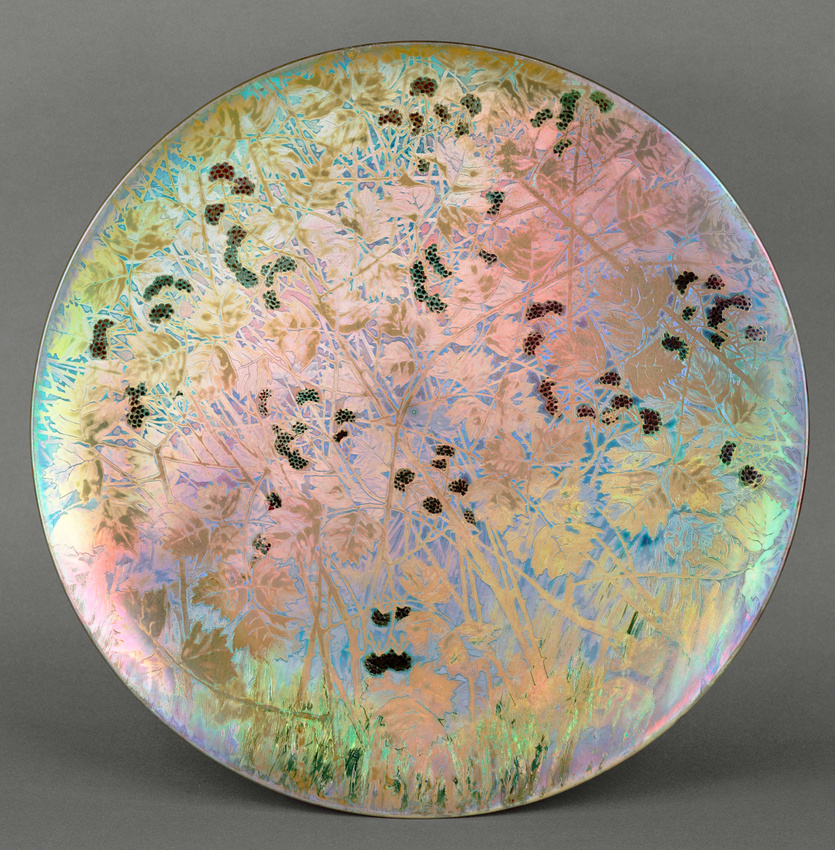
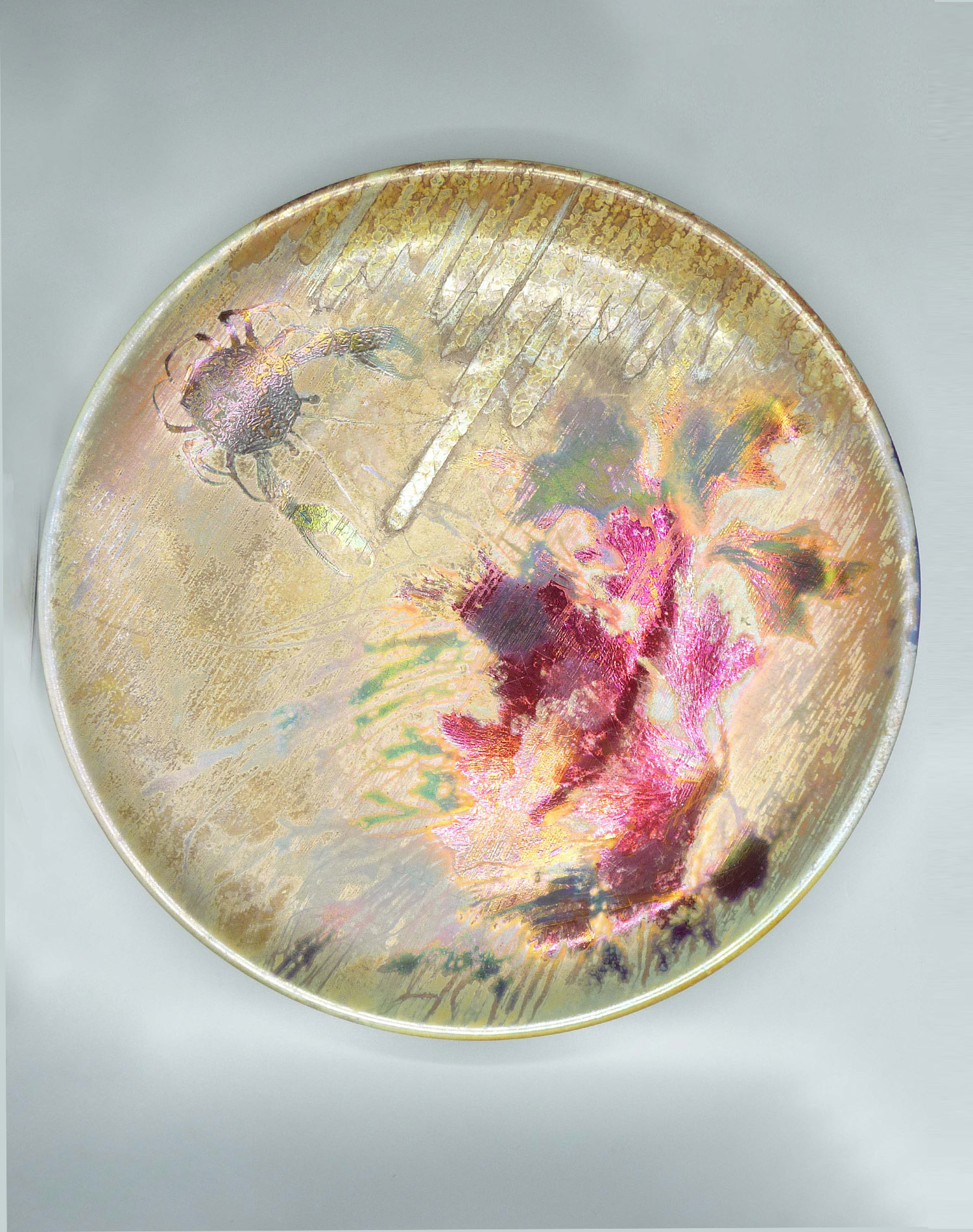
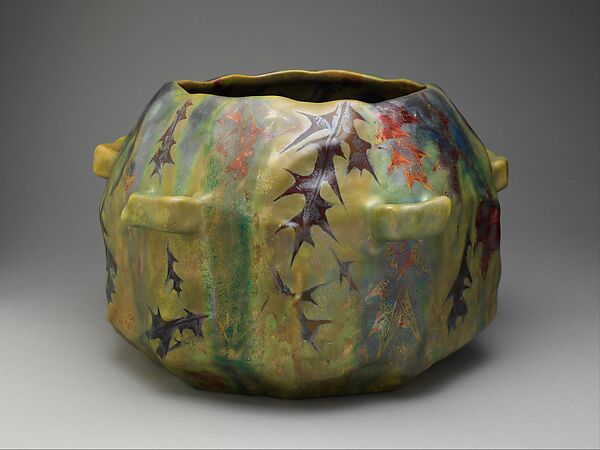
From this collaboration came the most sought-after works of the factory: dishes and vases decorated with thistles, irises, oak leaves, crabs and seaweed, in which coppery, golden or purplish iridescence stands out against mottled grounds and creates a depth impossible to achieve with ordinary glazes. Lévy-Dhurmer left Golfe-Juan to devote himself to Symbolist painting; Massier would continue his research into lustre alone for more than twenty years.
The factory
Production at Golfe-Juan was not confined to exceptional pieces. Vases, cachepots, jardinières, dishes and decorative sets were made there in enamelled faience, monochrome, marbled or lustred. From 1905 Massier further extended his range to luxury culinary pottery and utilitarian wares.
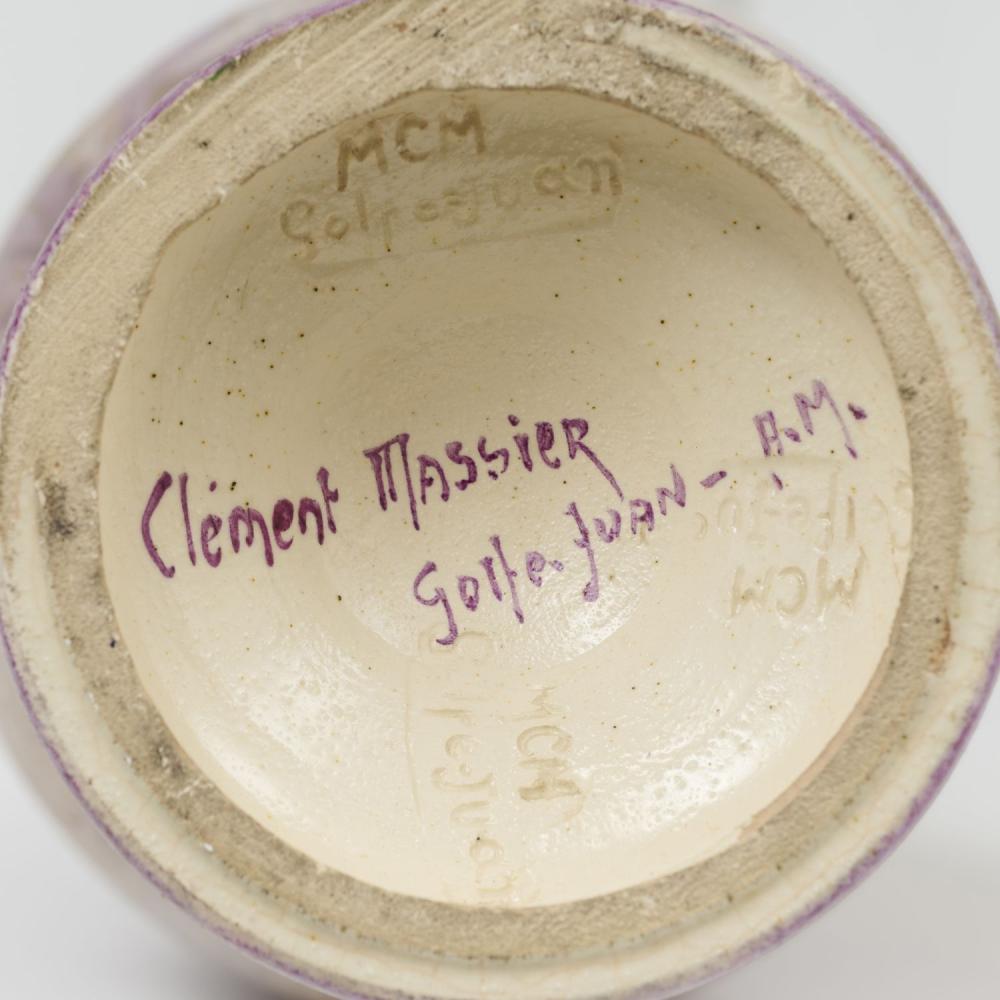
Pieces generally carry, under the base, an impressed mark reading CLÉMENT MASSIER / GOLFE JUAN / (AM) — the initials standing for the Alpes-Maritimes department — or a signature painted in lustre. Where Lévy-Dhurmer worked on the decoration, his name or monogram accompanies that of the ceramist.
Legacy
Clément Massier died at Golfe-Juan on 14 March 1917. The business passed to his daughters, who reissued their father's models, and the activity continued until the middle of the twentieth century.
His work is held at the Musée d'Orsay, the Metropolitan Museum of Art in New York, the museums of Reims and the Musée de la Céramique in Vallauris. His influence on Art Nouveau ceramics was considerable: the metallic lustre he had brought back to light was taken up by numerous European workshops, and it remains attached to his name.
See also
Vallauris — Delphin Massier — Jérôme Massier fils — Art Nouveau — The 1889 Universal Exhibition — The Gréber family — Émile Müller
See our ceramics, earthenware and porcelain
Bibliography
Exhibition catalogues
Autour de Lévy-Dhurmer, visionnaires et intimistes en 1900, exhibition catalogue, Paris, Grand Palais, 1973 — pieces by Clément Massier made under the artistic direction of Lucien Lévy-Dhurmer.
Public collections
Musée d'Orsay, Paris — Dish in faience with metallic lustre, between 1890 and 1895, 59 cm in diameter, room 61.
Metropolitan Museum of Art, New York — jardinière by Lucien Lévy-Dhurmer and Clément Massier, about 1893.
Musées de Reims — Vase à oreilles, faience with metallic lustre, late nineteenth century.
Musée de la Céramique, Vallauris Golfe-Juan — collections of Vallauris ceramics and pieces by the Massier family.
Documentary resources
Town of Vallauris Golfe-Juan, heritage department — notes on the Massier family and the introduction of art pottery.