menu
Menu
account_box
Categories
Contact
email Send us a message

Contact

phone By phone

+33 (0)1 42 25 12 79
Tue.-Sat., from 10am to 6pm
+33 (0)6 60 62 61 90
Everyday from 9am to 7pm.

email by Email

Adress: contact@marcmaison.com

share Let's get social

Languages
And also...
My selection
(35 Objects)

My selection (35 Objects)


Pair of Renaissance style vases in patinated bronze from the Mouchy-le-Châtel castle,  second half of the 19th century

Ref.13001
Pair of Renaissance style vases in patinated bronze from the Mouchy-le-Châtel castle, second half of the 19th century

This pair of patinated bronze vases were made during the second half of the 19th century to decorate a door on the facade of the Mouchy-le-Châtel Castle, in the Parisian region. This castle was built in the 16th century by the Maricourt Family, then it was taken during the second half of the 18th century by the first dukes de Noailles, before being occupied by the dukes of Mouchy, younger branch of the Noailles family. It's the dukes of Mouchy that started the work of restoration and extension during the Second Empire, entrusted to the architect Hyppolite Destailleur (1822 – 1893), to whom we also owe the restoration of Courances and Vaux le Vicomte castles. Helped by the sculptor and drawer Michel Lienard (1810 – 1870) and sculptor Mathurin Moreau (1822 – 1912), the three of theme redefined the castle Mouchy-le-Châtel keeping the Renaissance decorative repertoire of the first castle. Our pair of bronze vases is an example of the reinterpretation of the shapes inspired by the Renaissance. Put on a flaring fluted foot, they're adorned on the belly with four lion's heads in relief. The lid and the long neck are decorated with friezes of acanthus leaves and flowers. The long neck is joined to the belly by two handles in a S shape of which the scrolls are occupied by flowers. Our two vases were made during one the different restoration's phases of the castle during the second half of the 19th century to adorn the door of one of the castle's facades as show the archive picture.

Dimensions:
Height: 78 cm

Maison GIROUX and Ferdinand DUVINAGE - Exceptional and rare cup with waders with iridescent glass and electroplated decor, circa 1870-1880

Ref.12893
Maison GIROUX and Ferdinand DUVINAGE - Exceptional and rare cup with waders with iridescent glass and electroplated decor, circa 1870-1880

This cup made in the 1870-1880’s by the maison Giroux, as indicates the signature on the mount, is a piece extremely rare because of the material used. Indeed, few models with iridescent glass are known today. The Japanese inspiration of the decor and the model of our cup indicate that it is a creation of Ferdinand Duvinage who takes the direction of the maison Giroux between 1867 and 1876, then taken by his widow when he dies. This store which was originally selling all kind of supplies and small objects such as paints, varnishes, albums, writing-papers, fans, toys, boxes and souvenirs, but also lithographs, drawings and watercolors, considerably developed in the first decades of the 19th century. First, because they count among the clients, important persons such as the Duchesse de Berry, Louis XVIII or even Charles X, then by the drive given by Alphonse Giroux’s sons who joined the firm in 1833. Thus, Alphonse-Gustave Giroux, the eldest son, had the idea to sell small furniture. Even though he was an artist himself, he worked like furniture dealers of the 18th century, with artists who did not have the right to put their signature and exerted a hold over the design of the creation that he chose. He also decided to move the store in the new Opera district on the corner of the 43 boulevard des Capucines and the 24 rue Neuve des Capucines in 1855. On this same year, the company which had already won medals for the quality of its production during previous events, sells during the World Fair, to the Impress Eugénie, a bonheur du jour, conserved today in the château de Compiègne. In 1867, the store direction is given to Ferdinand Duvinage, Harinkouck and Brune. Little things are known about Harinkouck and Brune who seem to have been associated for a short period of time as Duvinage remains the only one in 1874. Ferdinand Duvinage (1813-1876) who seems to be cousin with Alphonse-Gustave Giroux, joins the company during a few years before taking its direction, without changing the name. He files in 1874, 1876 and 1877 patents for a marquetry technique of mosaic with metallic partitioning for furniture and art objects. His method is really original because it involves the combined union of ivory as a base, wood for the designs or ornaments, and copper or other metal to partitioning the ivory fragments. The firm continues to participate to World Fairs where they win many medals, even though they are not that much mentioned by the critics, we know that the productions with the Japanese vocabulary created under the direction of Duvinage were also very appreciated and were a real commercial success.

Dimensions:
Width: 27 cm
Height: 17 cm
Depth: 23 cm

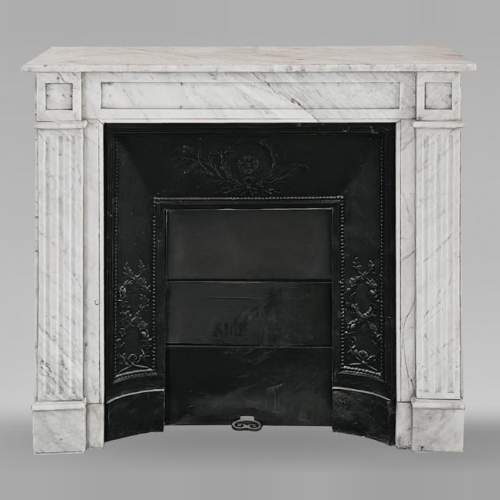
Louis XVI style mantel in veined Carrara marble with pearl entablature

Dimensions:
Width: 135 cm
Height: 107 cm
Depth: 41 cm
Inner width: 93 cm
Inner height: 82 cm

Louis XVI period mantel with pearls and carved ribbon

Dimensions:
Width: 182 cm
Height: 114 cm
Depth: 34 cm
Inner width: 143 cm
Inner height: 95 cm

Louis XV style fireplace in Carrara marble richly carved with plant motifs

Ref.6122
Louis XV style fireplace in Carrara marble richly carved with plant motifs

This Louis XV–style fireplace was crafted in Carrara marble, a material prized for its soft whiteness. This light tone enhances the richness of the carving and the fluidity of the lines characteristic of the Rocaille style. The structure follows the typical movement of the Louis XV style, with a serpentine frieze in the shape of a basket handle and a sinuously profiled mantel shelf. The jambs, slightly curved, widen toward the base and rest on simple plinths. The overall effect is one of balanced elegance, where the rounded volumes contrast with the precision of the marble. The finely carved ornamentation is particularly refined. The centre of the entablature features a large acanthus leaf motif framed by volutes and foliage, from which flower bouquets emerge. On either side, branches adorned with flowers and fruits spread in relief across the full width of the frieze. The jambs echo this decorative vocabulary: each console is adorned with an upper scroll surmounting a cascade of flowers, leaves, and stylised acanthus, ending in a plinth carved with an upright vegetal motif. All these elements are executed with great finesse, highlighting the lightness characteristic of the Louis XV style. The cast iron interior is also decorated. It displays a large central shell motif surrounded by leafy scrolls, repeated on the sides with arabesques and floral ornaments in relief. These details recall the vegetal forms of the marble and create continuity between the sculpted frame and the hearth.

Dimensions:
Width: 153 cm
Height: 98 cm
Depth: 43 cm
Inner width: 105 cm
Inner height: 78 cm