menu
Menu
account_box
Categories
Contact
email Send us a message

Contact

phone By phone

+33 (0)1 42 25 12 79
Tue.-Sat., from 10am to 6pm
+33 (0)6 60 62 61 90
Everyday from 9am to 7pm.

email by Email

Adress: contact@marcmaison.com

share Let's get social

Languages
And also...
My selection
(5 Objects)

My selection (5 Objects)


Jean-François GECHTER (Att. to) - "Bonaparte crossing the Great Saint Bernard", important patinated bronze sculpture

Ref.10841
Jean-François GECHTER (Att. to) - "Bonaparte crossing the Great Saint Bernard", important patinated bronze sculpture

This important patinated bronze sculpture, representing General Bonaparte crossing the Great-Saint-Bernard, is attributed to the romantic sculptor Théodore Gechter (1796-1844). The general is represented according to tradition, « calme on a fiery horse », although he had crossed the pass on a mule. The prancing animal confers a dynamism to the composition, which is reinforced by the grandiloquent gesture of Bonaparte draped in a loose cloak. The victorious general, with an idealized face, looks at the spectator and shows him the direction to follow, this third political way which he sought to impose between the royalists and the republicans . This beautiful sculpture was executed after the famous painting by Jacques-Louis David (1748-1825). This representation commemorates the victorious passage, in May 1800, of the Great-Saint-Bernard pass by the reserve army under the direction of the First Consul, the first stage of his triumphal reconquest of Italy. With great audacity, Bonaparte played the surprise by crossing a pass, deemed impratical in the spring. He returned to the feat of great captains of the past : Hannibal, passing through the Alps with his elephants in 218 during the Second Punic War, and Charlemagne, in 773, in his fight against Lomabards. Even before the Napoleonic victories, Austerlitz, Jena, Friedland, Wagram, the painting inscribed the name of Bonaparte among those of the greatest conquerors of History. The composition of David, taken up by Théodore Gechter, is an absolute icon, archetype of the representation of the hero of the Revolution, probably the most famous portrait of Napoleon around the world. There are several bronzes edition of this model. The representation of Gechter differs in several points from that of the painter J. L. David. General Bonaparte, realized by Gechter does not look at the spectator but at the ground. This rocky and eventful base underscores the obstacles that General Bonaparte has had to face and thus reinforces his heroic action. It should also be noted that Gechter did not go so far as to inscribe the names of victorious conquerors on the rock, as in the case of David’s painting. We find the fiery movement of the characters in Charles Martel and Abdérame, King of the Saracens, plaster group presented by Gechter at the Salon of 1833. A bronze model, commissionned by the Ministry of Commerce and Industry, melted by Gonon is now preserved in the Louvre. The sculptor represents Charles Martel in armor slaying his enemy. The representation of the rider is a pretext for the study of the movement and contortions of the horse. The expression of the warriors pride and this victorious feeling is the sign of a romanticism peculiar of Gechter. The artist has taken great care with the modeling of theses faces, perfectly catching the light. The precision in rendering the details is obvious (the helmet, the crafted brigantine, the chainmails). In addition, Gechter alternates in his compositions rough surfaces, smooth or chiseled throughout the sculpture, precisely as in the Bonaparte crossing the Great-Saint-Bernard. The extraordinary quality of our sculpture, the composition in movement, the precision in the rendering of the details suggest that it is indeed a model of Gechter, executed around 1840. This bronze sculpture is of high quality, by the delicacy of carving, the quality of the details and ornaments, the fiery movement, which are characteristic of Théodore Gechter, a romantic sculptor who particularly liked the modeling of horses.

Dimensions:
Width: 53 cm
Height: 63 cm
Depth: 25 cm

André-Fernand THESMAR (1843-1912) and Ferdinand BARBEDIENNE (1810-1892) - Ornamental japanese style plate

Ref.11266
André-Fernand THESMAR (1843-1912) and Ferdinand BARBEDIENNE (1810-1892) - Ornamental japanese style plate

Plate in gilded bronze and cloisonné enamel decorated with cockatoo on a blue background. Following the example of the enamel workshops of the factory of Sevres, Ferdinand Barbedienne (1810 - 1892) introduced enamel in its making of art works: “byzantine” champlevé enamels from the end of the 1850s, then neo-Renaissance painted enamels and cloissone enamels with Far-Eastern influence. No other company managed to integrate with such success the use of enamel in an industrial production. After some attempts with independent enamelers, , Barbedienne ensured the exclusive collaboration of remarkable practitioners: Alfred Serre for the painted enamel (before 1872) and Fernand Thesmar for clossoine enamel (after 1872). This plate is a beautiful example of the important production that Barbedienne developed in the years 1870 - 1880, at a time when luxury enamel on precious metals was experience a real craze. The motifs of flowers, birds and insects is again found in a series of similar pieces, combining classic shapes and designs of oriental taste, including a glass kept at the Orsay Museum in Paris and another kept at the Walters Art Gallery, in Baltimore. Andre-Fernand Thesmar, born March 4 1843 in Chalon-sur-Saone, first devoted himself to oil painting and was known as a painter of flowers. He was educated in drawing in a factory for printed-fabric in Mulhouse where he had been placed at fourteen years old to learn the trade of a draftsman. His teacher was a painter of flowers: he “drew and dissected the plant with fury, requiring an anatomical analysis of shapes and a meticulous copy of nature.” He left this industrial environment to go to Paris in 1860 and engaged in various activities (workshop of industrial drawing and studio decoration for Cambon’s theater.) It was probably for his talent as a painter that Thesmar was noticed in 1872 by Ferdinand Barbedienne. With Barbedienne, later Thesmar succeeded to the management of the production of enamels. The productions of Thesmar and Barbedienne reflected the interest that they had for the decorative techniques and compositions of Japanese enamel. It was as “co-operator of the Barbedienne company” that Thesmar exhibited at the Exhibition of Decorative Arts in 1874, A cock pheasant from China and Floral Bouquets from greenhouse where they admired his talent as a painter of flowers. At the exposition in 1875, Thesmar exhibited two large enamel compositions on leather, one of which displayed a wader with water lilies and bright yellow iris, completely in the style of our plate and showing the style of the return to nature. In 1891, Thesmar turned to the decoration of porcelain and introduced himself to Charles Lauth who, since 1879, led the Factory de Sèvres. Its at this time that the collaboration with the Barbedienne company ended. Afterwards, he would be especially known for having invented the “plique à jour” technique, which numerous pieces of are kept in public collections.

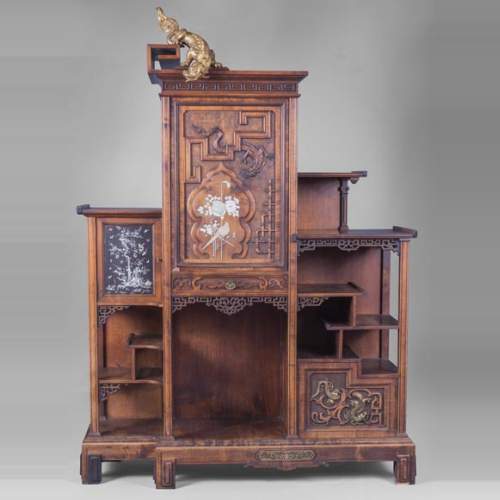
Gabriel VIARDOT, Japanese-Style Shelf Cabinet, late 19th Century

Ref.15090
Gabriel VIARDOT, Japanese-Style Shelf Cabinet, late 19th Century

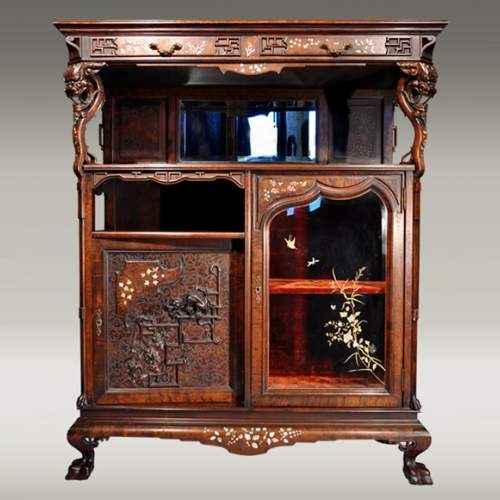
This shelf cabinet was crafted by Gabriel Viardot in the late 19th century. A talented wood sculptor, Gabriel Viardot opened a furniture workshop and store in Paris in 1853. In the 1870s, he decided to focus on “Chinese-Japanese style furniture”. He received prestigious awards at the Universal Exhibitions in Paris in 1878, 1889, and 1900, as well as a gold medal at the International Exhibition in Antwerp in 1884. This piece, serving as both a cabinet and a display stand, belongs to Viardot’s Sino-Japanese style production. Its four legs, shaped as stylized scrolls, support an asymmetrical structure. The lower left section features shelves inspired by Japanese “cha’dansu” (tea cabinets). It is adorned with a dragon seemingly weaving through a panel at the bottom, a recurring motif in Viardot’s work. At the top, the last shelf is supported by a delicate sculpture of a crane perched on a turtle. The right section consists of a cabinet on a stand, decorated with a panel showcasing rich low-relief carvings. Stylized flames and smoke swirls intertwine with highly realistic flowers. A Japanese panel from the Meiji era (1868-1912), depicting a basket of flowers, was included after a delicate cutting process. The small left side is adorned with Japanese maple leaves, while the right side features a flower. Gabriel Viardot’s signature can be found just below, on the lower crosspiece. A very similar version of this cabinet is depicted in an old sketchbook by the artist. Notably, the crane supporting the shelf and the tiered supports above the dragon on the left are present, although their orientation is reversed.

Dimensions:
Width: 102 cm
Height: 180 cm
Depth: 41 cm