menu
Menu
account_box
Categories
Contact
email Send us a message

Contact

phone By phone

+33 (0)1 42 25 12 79
Tue.-Sat., from 10am to 6pm
+33 (0)6 60 62 61 90
Everyday from 9am to 7pm.

email by Email

Adress: contact@marcmaison.com

share Let's get social

Languages
And also...
My selection
(17 Objects)

My selection (17 Objects)


VAL D’OSNE Foundry - Exceptional Renaissance style fountain  Model presented in the 1851 World Fair

Ref.12400
VAL D’OSNE Foundry - Exceptional Renaissance style fountain Model presented in the 1851 World Fair

This exceptional painted cast iron fountain in the Neo-Renaissance style was crafted at the Val d’Osne foundry for the inaugural Universal Exhibition of 1851 in London, where it was prominently displayed. Hubert Lavigne created the model for our monumental Neo-Renaissance-style fountain for the Val d’Osne foundry. Resting on an octagonal pedestal adorned with shells and reeds in slight relief, the fountain consists of a first broad basin with small lampposts encircling it, punctuated by fleurons with pierced openings from which water can flow and be adorned with arabesques. In the center of this basin, a beautiful decoration of reeds has been sculpted, where a heron, a turtle, a frog, and a duck flourish in a very realistic manner. It supports a second basin with undulating contours and exterior striations reminiscent of a seashell's characteristics. This last basin features a sculpture in its center representing a woman draped in ancient attire around her waist and brandishing a cup with her left arm. Children seated on dolphins, blowing into a conch shell, have been placed all around the base to animate it. The sculptor's artistry is particularly evident in their modeling, reminiscent of the children sculpted on the facade of the Louvre. In the context of the industrial revolution and the flourishing of free trade, industrial exhibitions, initially national in scope, provided a platform for sharing inventions that opened up future horizons. Thus, the first Universal Exhibition took place in London from May 1 to October 15, 1851, at the Crystal Palace. Queen Victoria's reign demonstrated its modernity and adherence to a liberal philosophy, where international trade would be a guarantor of peace and the flourishing of human genius. The Crystal Palace, conceived for the occasion by Joseph Paxton and executed by Owen Jones, was a giant structure of iron and glass covering 8 hectares, erected swiftly through modern prefabrication methods, showcasing the progress of industry. Unfortunately, this architectural masterpiece was permanently destroyed in a fire on November 30, 1936. Functioning as a demonstrative showcase of Great Britain's supremacy in the global economy and industry, the Exhibition was designed as a presentation of the products of art and industry on a grand scale from each country. The interior was segmented into four sections, later adopted for subsequent Universal Exhibitions: raw materials, machinery, manufactured goods, and works of art. For each section, national pavilions served as showcases for their best productions and innovations. The color illustrations by Dickinson and Matthew Digby Wyatt are valuable testimonies to this event, capturing the beauty of the venue and the precious art objects on display. Infused with pedagogical intent and national affirmation, the 1851 Universal Exhibition inaugurated a highly successful practice, creating an artistic and technical dialogue beyond borders. The participation of the Val d’Osne foundry in this first Universal Exhibition, notably featuring the presentation of our fountain in the vast glass nave, bestowed upon it international recognition. Its frequent participation in such events, coupled with the accolades it received each time, quickly elevated the foundry to the foremost position in France during the second half of the 19th century. Established in 1836 at the initiative of Jean-Pierre-Victor André, founder of the "J.-P.-V. André" house and considered the pioneer of ornamental cast iron in place of wrought iron, the foundry offered urban furniture and decorative cast iron. Thriving over the years, the establishment changed hands without compromising its quality until 1986, absorbing several competing establishments including Barbezat and Ducel, thus enriching its catalog with over 40,000 different models. This included balconies, urban furniture, lighting, as well as monumental fountains, animal groups, statues, and large cast iron groups inspired by ancient or classical models. To achieve this, the foundry collaborated with numerous significant artists such as Albert Ernest Carrier-Belleuse, Mathurin Moreau (a shareholder in the company), James Pradier, and Hubert Lavigne, the sculptor of our fountain. Hubert Lavigne, born in Moselle, specifically in Cons-la-Grandville, in 1818 and deceased in Paris in 1882, studied at the Beaux-Arts in Paris under the guidance of sculptors Ramey and M.A. Dumont. A remarkable sculptor, he won the Third Prize in Rome in 1843 with a plaster bas-relief depicting the Death of Epaminondas, now housed in the Museum of Fine Arts in Nancy. He also won two medals at the Salons of 1861 and 1863, to which he was a dedicated participant between 1849 and 1881. He received commissions for Parisian buildings, including the Palais Royal at the Louvre, where his sculptures adorn the facade of the Turgot wing, as well as the Sorbonne church and the Saint-Michel Fountain. He also created numerous works in cast iron for the Val d’Osne foundry, such as agricultural representations, eagles, tritons, children blowing into a conch shell, and more. A prolific and talented sculptor, Théodore Véron Hubert, lamented in his 1877 work, Dictionnaire Véron, ou mémorial de l'art et des artistes de mon temps, that our sculptor was not duly recognized for his merits: "And to think that after so much study and conscientiousness, so many superior productions marked by an aesthetic worthy of a Dumont, this eminent artist, and at the same time a noble character whom we have followed since 1841 when we drew together (at the Lapin Academy), and whose superior creations we see every year; to say that this truly distinguished sculptor is not yet decorated or recognized! Truly, it's enough to discourage modesty and conscience!" Featured in the foundry's catalog, our fountain was commissioned by numerous cities to adorn their squares. Notably, a model can be found in Cirey-sur-Vezouve in eastern France, another in Saint-Pierre de la Réunion, and yet another on the island of Sao-Miguel in Portugal.

Dimensions:
Width: 260 cm
Height: 430 cm

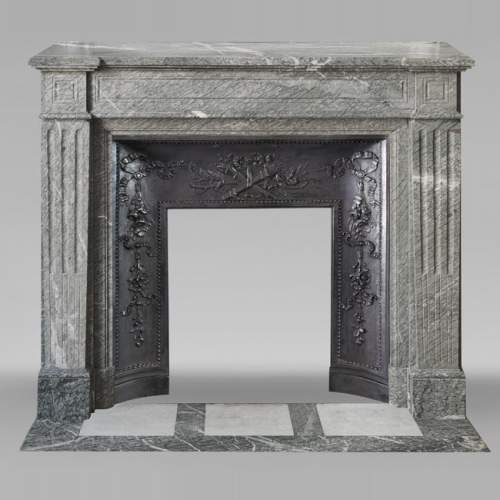
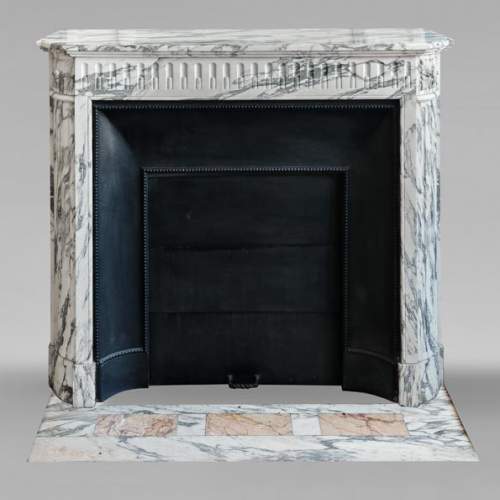
Louis XVI period fireplace in gray Ardennes marble

Dimensions:
Width: 143 cm
Height: 100 cm
Depth: 33 cm
Inner width: 112 cm
Inner height: 82 cm

Exceptional panelled rooms by Victor HORTA

Ref.15000
Exceptional panelled rooms by Victor HORTA

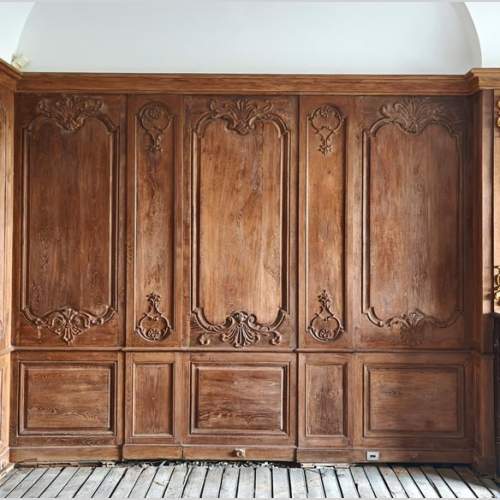
Victor Horta designed these extraordinary panelled rooms in 1903, in order to furnish and decorate the ground floor of the building located at number 22 Voorstraat in Kortrijk (Belgium). The rooms, a living room, a dining room and a smoking room or a library, were arranged in a row and covered an area of approximately 80 m². 1903 Although the architect's archives were destroyed, three elements allow us to date these panelled rooms with certainty to 1903, the year which corresponds to the peak of his career. First of all, the facade of the building for which the decor was created was modified on this date, following the obtaining of a building permit signed on December 13, 1902; the woodwork includes precisely the third window which was then created. Besides, the sideboards include statuettes executed by the sculptor Pierre Braecke which were only documented once, during the Exhibition of Decorative Arts in Turin in 1902. Finally, a label found on the back of a mirror bearing the mark of the company which designed it is marked with a stamp bearing the date 1903. Horta's style The woodwork from Kortrijk presents many stylistic characteristics of the art of Victor Horta. Light horizontal curves alternate with slender straight lines. The naturalist inspiration that marks Art Nouveau and its work is reflected in the details of the ornamentation, which feature foliage patterns. Horta's idea of light is reflected in the use of glass, as well as in the flower-shaped light fixtures. This play of correspondences between natural light and electric light is characteristic of his work. Finally, the staircase of the Voorstraat building is a very beautiful testimony to both the “whiplash” line, invented and developed by him and which became the distinctive mark of Art Nouveau. The living room: the woodwork The woodwork in the living room is Congo mahogany. Their lines arrange flexibly around each other and blossom into diverse and stylized plant patterns. Identical shapes unfold at the top of the door to the dining room of the Van Eetvelde hotel (1895-1899). The alternating shades and grain of the wood bear witness to the architect's taste for detail. The woodwork was covered with green silk damask, the original of which was found in the window bases. It was reconstituted by the Prelle Factory in Lyon. This fabric was subsequently used by Horta, for the decor of the Max Hallé hotel (1904-1906), in a salmon shade. The living room: light With a unique design, the American glass roof extends above the woodwork. In its patterns and colors, it is similar to that of the rotunda of the Van Eetvelde hotel (1895-1899). Its ornamental border in various shades of pink surrounds a large central space allowing light to pass through. Light plays a particular role for Horta: he wants it abundant and varied. Natural light is joined by electric light, highlighted by Horta's wall lights, with plant stems and golden or glass corollas in the shape of flowers, as in the majority of Horta's creations. The living room: heating The architect also thinks of the heating of his rooms as a whole. A bronze fireplace which heated the living room has a base and a crowning in Belgian red Griotte marble. Its curves imitating plant stems rise along the jambs and end in short, budding shoots. Added to this is a pair of bronze radiator covers whose highly original shapes are reminiscent of those chosen by Horta for the fireplace: therefore, they complete it harmoniously. The removable partition The living room and dining room are separated by a removable partition of exceptional quality workmanship. In fact, it was made in two different types of wood depending on the room from which they were visible: on the living room side, it is in mahogany, while on the dining room side, it is in oak. These woodworks frame an original fabric. Stretched in a single thickness, it can be visible in the same way on one side and the other of the woodwork. Horta thus created a spatial unity between the two rooms despite their physical separation, while maintaining the harmony specific to each thanks to the adaptation of the species. In its upper part, the partition is decorated with pink American glass panels. The dining room: the sideboards The woodwork in the dining room was made of oak and curly maple. This room housed a pair of the most beautiful Art Nouveau sideboards. These are particularly close to the one that Victor Horta created for the Van Eetvelde Hotel around 1895-1897 and which he presented at the Salon de la Libre Esthétique in Brussels in 1897. They respond to practical and comfort requirements; indeed, the space separating the two pieces of furniture closed by a hinged door led to the kitchen side. At the level of the passage thus created, on the side wall of the sideboards, it is possible to create an opening, which probably served as a passing-through. In order to avoid any inconvenience for the owners and their guests, a curtain, suspended under the arch, was probably drawn during the meal, making the operation imperceptible to them. The invention of this very modern system, which in no way sacrifices the aesthetics of the whole, shows Horta's concern for the comfort of the inhabitants of his creations. The dining room: the statuettes The sideboards are topped with four gilded plaster statuettes due to Pierre Braecke (1858-1938), sculptor and friend of Horta who collaborated on many of the architect's projects. These statuettes were only documented once, on the occasion of Horta's participation in the Exhibition of Decorative Arts in Turin in 1902. Indeed, a photograph from 1902 shows that the two statuettes which topped the central uprights of the library during this event are identical to two of those which were found with the sideboards of the Voorstraat building. Victor Horta will therefore have used some of these figurines for the setting after the Turin Exhibition. The dining room: heating The dining room was heated by a gas fireplace made to imitate a mantelpiece, initially completed by a metallic interior. The fireplace integrates perfectly with the other parts of the rooms, taking up in the lower part the shape of the openings of the shelves of the dining room sideboards. The cloakroom This oak and curly maple coat rack is a final testimony to the attention that Victor Horta paid to both the utilitarian dimension of his creations and their aesthetic aspect. It has a tripartite structure, each having a very specific function. In the center, a large mirror allowing you to inspect your outfit; on the left, a first coat rack associated with brass bars to accommodate hats; on the right, a second coat rack, formerly supplemented by a drip tray used to hold umbrellas. The cloakroom at the Solvay Hotel has an identical structure to this one. The staircase The staircase railing which connected the first floor of the building to the second, also designed by Victor Horta, is a very good example of his implementation of the “whiplash” line. The elm balusters lining the steps are coupled; they exceed the lower rail and are fixed on the stringer, perpendicularly to the floor. This shape reveals the influence of Japonism on the art of Victor Horta. This setting, whose origin and dating are certain, is therefore an exceptional example of the art of Victor Horta in the first years of the 20th century. Art Nouveau was then at its peak, and the architect experienced the richest years of his career. The presentation of a decorative setting of this scale and value on the market is unique. Finally, the richness of the materials used and the attention to detail that runs through Victor Horta's career place this masterpiece among his finest works, alongside the Hôtel Solvay, his own studio and his house.

Dimensions:
Width: 493 cm
Depth: 488 cm

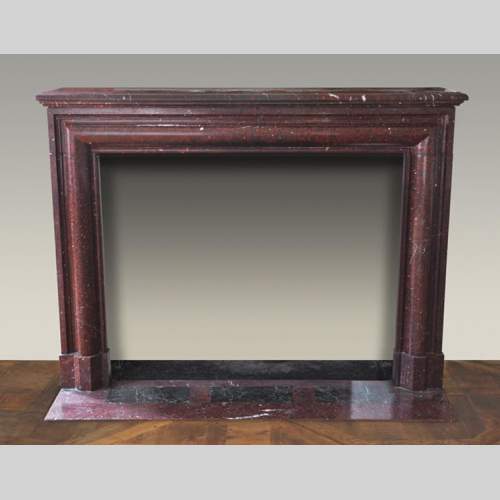
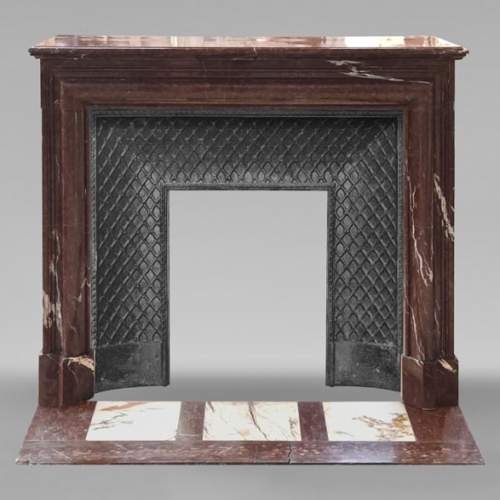
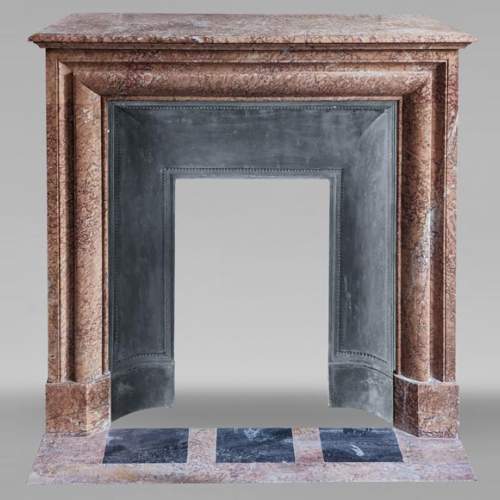
Louis XIV style Bolection mantel carved in Griotte marble

Dimensions:
Width: 156 cm
Height: 110 cm
Depth: 40 cm
Inner width: 78 cm
Inner height: 90 cm

Louis XVI style mantel in Carrara marble adorned with a sunflower

Dimensions:
Width: 126 cm
Height: 105 cm
Depth: 35 cm
Inner width: 84 cm
Inner height: 87 cm

Napoleon III style gilded trumeau with plant decoration

Dimensions:
Width: 105 cm
Height: 175 cm
Depth: 6 cm

Napoleon III style trumeau with palmette motif

Dimensions:
Width: 131 cm
Height: 155 cm
Depth: 6 cm

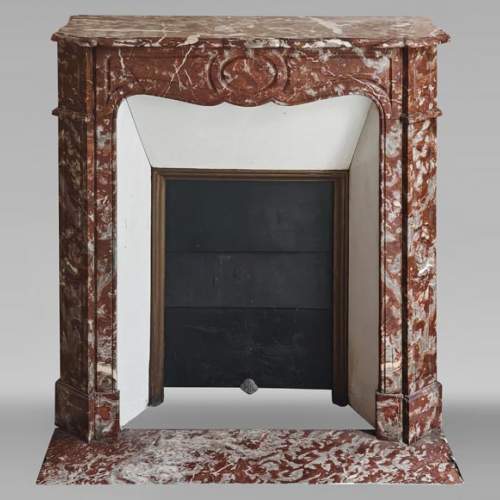
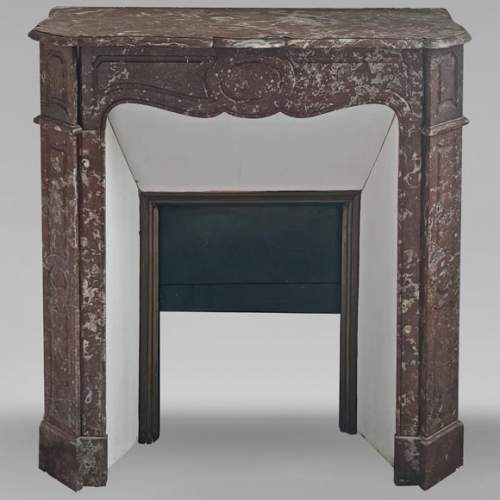
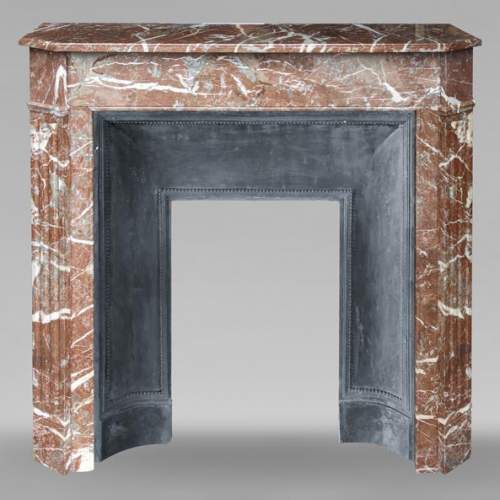
Louis XV period fireplace in red Rance marble

Dimensions:
Width: 156 cm
Height: 113 cm
Depth: 52 cm
Inner width: 112 cm
Inner height: 96 cm