menu
Menu
account_box
Categories
Contact
email Send us a message

Contact

phone By phone

+33 (0)1 42 25 12 79
Tue.-Sat., from 10am to 6pm
+33 (0)6 60 62 61 90
Everyday from 9am to 7pm.

email by Email

Adress: contact@marcmaison.com

share Let's get social

Languages
And also...
My selection
(19 Objects)

My selection (19 Objects)


A monumental Display Cabinet coming from an exceptional furniture set realized by Moses Michelangelo Guggenheim for the Palazzo Papadopoli in Venice, Italy

Ref.03172
A monumental Display Cabinet coming from an exceptional furniture set realized by Moses Michelangelo Guggenheim for the Palazzo Papadopoli in Venice, Italy

This monumental display cabinet is composed of three windows, designed to exhibit fine china and other sophisticated crockery, a custom revealed by the period photographs. The high society of the time collects objects of art and priceless tableware, and enjoys to show them to the guests while preserving them in this precious and imposing case. A true ceremonial piece, this opulent dresser was arranged in the reception hall that once was the Salone delle Quattro Porte in Palazzo Papadopoli . The smaller surface of this piece is pretext for an abundance of carvings that confirm the prestigious nature of it. The numerous sculptures are the work of an extremely skilled sculptor. The vertical uprights are decorated with images of old sheathed bearded men. The sheath is the support for a foliage frieze that ends with a scroll. The protruding cornice rests on corbels, representing a vocabulary of ornamental architecture. It supports four vases with lids and an armorial pediment flanked by two griffins and crowned with a cardinal's hat: it is a hat with a flat, wide-brimmed shape and from which hang large silk cords. Between the cornice and the window, a carved frieze of festoons alternates with monsters. Shells are arranged above the festoons. The extreme quality of the sculpture and the much-sought decor is indicative of the work of an exceptional sculptor, whose mastery was unrivaled. The coat of arms on this dresser is the Aldobrandini's, whose most famous member was Pope Clement VIII, between 1592 and 1605. Having his nephews quickly appointed cardinal in order to enlarge the Aldobrandini's power, we owe this very Pope the concept of « nepotism », « nepote » being the Italian for nephew. The Aldobrandini, from Florence, increased their wealth during the Middle Ages and adopted the coat of arms azure per bend embattled or and six stars or. Since 16th century it is framed with the cardinals symbols, just like it is on this amazing dresser : a broad brimmed hat with tassels, the galero. Agostino Caracci, brother of considerable Anibal Caracci, designs this exact coat of arms for the cardinal Cinzio Aldobrandini. The Aldobrandini heraldy is sculped on many Italian buildings, it is for example carved with the galero in the Aldobrandini Chapel of Ravenna's Duomo. Used by Clement VIII, it is often seen with the papal keys, like in Santa Maria Maggiore where his gravestone was designed by the illustrious sculptor Bernino, and on the coins minted with his blazon. An Aldobrandini descent from his mother Maria Maddalena, Nicolo Aldobrandini-Papadopoli wished to preserve the memory of this lineage in the Palazzo Papadopoli decoration.

Dimensions:
Width: 210 cm
Height: 346 cm
Depth: 62 cm

The seats  coming from an exceptional furniture set realized by Moses Michelangelo Guggenheim for the Palazzo Papadopoli in Venice, Italy

Ref.03168
The seats coming from an exceptional furniture set realized by Moses Michelangelo Guggenheim for the Palazzo Papadopoli in Venice, Italy

Two armchairs and four chairs in carved walnut wood. This set is coming from the Palazzo Papadopoli, Venice, Italy, "Salone delle Quattro Porte" which was totally refurnished between 1874 and 1881 by Moses Michelangelo Guggenheim . The armchairs and the chairs of this set are produced in the same way with the difference that the armchairs are fitted with sculpted armrests. The base is made of four legs resting on round feet. The two front feet are tapered and fluted in their middle part, similar to columns. The architectural language here adopts an ornamental theme. The two back legs are from a square section. The feet are connected to each other by a spacer in the shape of an H, decorated in its center with an image of acanthus leaves. The frame of the seat is carved from a frieze of small flowers taking place in flowery containers. The main surface is decorated with a plant motif hanging from this frame. In the center of this motif is a crown of a duke. The uprights of the back are represented in an identical manner on all the chairs. The upper part shows the busts of sheathed women carved in very high relief and ending with an acanthus leaf. They rest on a console which again depicts the crown of the duke.The handles of the two chairs are a beautiful work of sculpture, notably through the back attachment where a winding acanthus leaf is represented. The grips protrude from the arms and show the heads women with extravagantly made up hair.

Dimensions:
Width: 63 cm
Height: 107 cm
Depth: 61 cm

Julien-Nicolas RIVART (1802-1867) - Louis XV style Rosewood Table with decor of porcelain marquetry

Ref.10718
Julien-Nicolas RIVART (1802-1867) - Louis XV style Rosewood Table with decor of porcelain marquetry

Bibliography : Marc Maison and Emmanuelle Arnauld, Masterpieces of Marquetry in the 19th Century. Patents. Rivart, Cremer, Fourdinois, Kayser Sohn and Duvinage, Dijon, Faton, 2012, p. 5 and 46. Characteristic of Julien-Nicolas Rivart 's production, this Louis XV style table is adorned with inlays of porcelain flowers, a technique he patented in 1849. Inspired by both porcelain slabs inserted in wood panels, into fashion in the 18th century, as well as Florentine mosaics in hard stone, Julien-Nicolas Rivart succeeded to develop an original technique, totally renewing the use of porcelain by inlaying it like a true marquetry, where each element is independent. The naturalism of peonies flush on the wood surface gives this piece of furniture a great elegance, demonstrating all the skill of the artist, who resorts to a virtuoso technique of ornamentation, of extremely delicate implementation. The finest foliage, made of dyed resin, ensures an elegant connection between the different pieces of porcelain. Rivart 's favorite theme, the floral motifs can be seen on other tables, notably that purchased in 1861 by the Count of Manneville on the occasion of his wedding and preserved today at the Cité de la Ceramique of Sèvres. Like our table, it is decorated with a garland of flowers, shut by a bronze border running all the way along the shelf. The painting of the inlaid flowers is not signed; we can however attribute it to Pierre-Joseph Guérou , painter of the Manufacture de porcelaine de Sèvres in 1847 and 1848 whose signature appears on several pieces of furniture by Rivart , like the Jewel case of the Empress Eugénie at the Château de Compiègne. A specialist in porcelain flower paintings, he also participated several times at the Salon between 1836 and 1866. The treatment of the petals in pink and white shades is characteristic of his style, which is easily recognizable. Much appreciated by the critics for the charm of its porcelain marquetry, the Rivart technique was noticed at the World's Fairs he attended in 1851, 1855 and 1867. It is called a "delicious process", "still more beautiful than the beautiful", and is the subject of praiseworthy comments from the Emperor Napoleon III.

Dimensions:
Width: 126 cm
Height: 74 cm
Depth: 36 cm

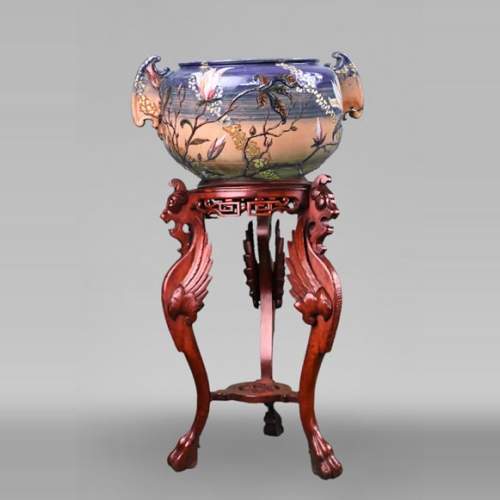
Albert DAMMOUSE and MANUFACTURE DE SEVRES - Important antique exhibition vase, "vase potiche  allongée" model, with ibis on its golden wooden pedestal

Ref.10647
Albert DAMMOUSE and MANUFACTURE DE SEVRES - Important antique exhibition vase, "vase potiche allongée" model, with ibis on its golden wooden pedestal

This important antique vase with an ibis on its golden wooden pedestal was made by the renowned French ceramist Albert Dammouse in 1873. There is the Manufacture de Sèvres’s seal. This vase is both emblematic of the period’s decorative arts and of Albert Dammouse’s works who was known for his dexterity in the material treatment as well as his qualities as decorator. Albert Dammouse, whose father was sculptor at the Manufacture de Sèvres, joins the École nationale des Arts décoratifs in 1863 before study from 1868 Milès Solon’s lessons, also decorator at the Manufacture de Sèvres, at the School of Fine Arts. In 1871, he moved to his own workshop in the city of Sèvres, next to the Manufacture, until his death in 1926. Albert Dammouse is interested in all the ceramics, but his porcelains have made first his reputation. In 1874, at the Union centrale des Arts Décoratifs, he exhibits porcelains and gets the gold medal. He won then a gold medal at the third Paris World’s Fair in 1878 and built ovens and workshops in Sèvres in order to produce more works. Although Dammouse has his own workshop some of his works, such as our vase, are the result of collaboration between Dammouse and the Manufacture de Sèvres. This is the model "elongated ovoid porcelaine vase" invented by Jules Peyre and used by many artists with sometimes some variations such as this Chinese Vase No. 1 entitled "Pécher", made around 1860 and decorated by Marc Emmanuel Louis Solon. Renowned throughout Europe, the Sèvres factory, where this vase was decorated, remains at the end of the century renowed for its technical and artistic savoir-faire even if industrialisation was growing.Notably, thanks to the discovery, in 1768, of the first kaolin field in France by Pierre-Joseph Macquer and Robert Millot, two researchers at the Manufacture de Sèvres, hard-paste porcelain (made up of nearly 75% of kaolin), whose manufacturing secret was kept by Saxony, is finally developed in France. With this discovery, the Manufacture de Sèvres is developing, particularly from the beginning of the 19th century. The productions are characterized by their modernity and the diversity of styles. While the pedestal is representative of the 19th century richness of ornamentation and eclectic revival of historic styles, the vase is characterized by a certain lightness and purity, aesthetic appeared with Japonism. Nature is one of the favorite themes of Japanese art, and the vase is decorated with an ibis and a shrub around wich birds are flying. Indeed, Japonism, which inspires Europeans arts in the second half of the century, is one of the principal inspiration in Dammouse’s works. With the various exchanges that took place between France and Japan from 1858, the year of the signing of a commercial treaty, and the contribution of the World's Fairs, true international encounters, the West discovers the Japanese art that provides to the artists some new patterns and a new and refine aesthetic. In 1873, year of the creation of this vase, takes place the first Japanese exhibition in Paris. The art dealer Siegfried Bing opens the store "Art Nouveau", rue de Provence, around 1872 and where Dammouse will be exposed. Later, Albert Dammouse, who was inspired especially by flora, will be one of the first, concerning ceramic, to create Art Nouveau style works of art . This vase, with its decorative and sophisticated look, belongs to the trends of its time. In the same vein, Ferdinand Mérigot is at the origin of the Japanese decoration that adorns this pair of vases made in 1868 and whose model is also Chinese Vase No. 1, variant of our form. The pedestal in golden wood, inspired by Napoléon III style, is ornated with rococo bows and acanthus leaves. This very elaborate pedestal was specially created to highlight the porcelain. The vase does not have a bottom: the bottom is pierced, and thanks to a system it is possible to fit the vase to the base. Thus deprived of any practical function but destined primarily to the decor, it seems certain that this vase participated in an exhibition. Although Dammouse was one of the artistes of the great trends of his time, Roger Marx, in his Paris World's Fair’s report in 1900, wrote with relevance : « no material that he treated with a sovereign skill, no trend that made him lose the notion of composed decor », qualities by which he was renowed. « Dammouse is a skilled ceramist, but is above all an artist », wrote the critic Georges Vogt in his Paris World's Fair’s report in 1900.

Dimensions:
Width: 43 cm
Height: 158 cm
Depth: 43 cm

Édouard LIÈVRE (Author of the model, 1829 – 1886), Paul SORMANI (cabinetmaker, 1817 – 1874 or 1875) Neo-Renaissance ceremonial sideboard and buffet

Ref.10917
Édouard LIÈVRE (Author of the model, 1829 – 1886), Paul SORMANI (cabinetmaker, 1817 – 1874 or 1875) Neo-Renaissance ceremonial sideboard and buffet

This exceptional set of neo-Renaissance furniture designed by Édouard Lièvre was crafted by Paul Sormani, a renowned Italian cabinetmaker based in Paris. Enhanced with gilded bronze, marble inserts, and enamel plaques, this ceremonial sideboard and buffet are extremely refined and erudite. The pieces are signed with the initials “EL” and bear the Sormani workshop plaque. After the cabinetmaker's death, the company took the name “Veuve Sormani et Fils,” whose furniture bears the signature from 1877-1880 onwards. Signed “Paul Sormani,” our set would therefore predate 1877. The sideboard rests on two fluted Corinthian columns with rings. A series of drawers frames a sea green marble top. The imposing top is made of marble and the molded backrest features gilded bronze inserts. The popularity of troubadour painting and romantic subjects certainly explains the choice of characters for the gilt bronze medallions depicting the profiles of Charles VII and his mistress Agnès Sorel. The medallions are framed by bronze appliqués decorated with candelabra scrollwork. In the center of the composition, a diamond shape displays its gilt bronze scrollwork. The ceremonial sideboard is also richly decorated and full of references to Renaissance art. The lower section is organized around three central semicircular niches composed of rare bulging columns; the spandrels are decorated with sea green marble inserts. The doors feature two superb gilt bronze medallions depicting the profiles of Henry IV and his mistress Gabrielle d'Estrée: the Renaissance period and the theme of passionate love are once again mythologized and elevated to romantic ideals. The pilasters feature marble diamond motifs, typical of 16th-century ornamentation. Édouard Lièvre combines different artistic media by inserting decorative enameled plaques into the upper register doors. These are directly inspired by the bas-reliefs of the Fontaine des Innocents created in 1548 by Jean Goujon, a famous sculptor at the court of Henry II. They are flanked by gilded bronze appliqués in the Renaissance style (festoons, mascaron, foliage, volutes). The upper register is organized around two semicircular niches composed of fluted and ringed Corinthian columns. The projections of the cornice feature a frieze of Greek waves and sea green marble plaques. The ensemble is crowned with coats of arms supported by gilded bronze acanthus leaves. The sideboard and its buffet are fine examples of Édouard Lièvre's talent for reinterpreting antique styles using modern techniques (electroplating) and his collaborations with the greatest cabinetmakers of the period. As well as reflecting the popularity of the Neo-Renaissance style in France during the 19th century, this set once again demonstrates the archaeological interest and immense erudition of its designer, who found inspiration in the streets of Paris and the capital's museums. In a similar style, Lièvre created a mirror for Sarah Bernhardt around 1875 and several Neo-Renaissance cabinets, some of which are decorated with decorative enamel plaques. In addition, the catalog of the dispersal of Édouard Lièvre's estate (Drouot sale, March 21-24, 1887) lists nearly fifteen Neo-Renaissance pieces of furniture.

Dimensions:
Width: 230 cm
Height: 262 cm
Depth: 66 cm

Julien-Nicolas Rivart (1802-1867) – Photo album with porcelain marquetry decoration on leather

Ref.16057
Julien-Nicolas Rivart (1802-1867) – Photo album with porcelain marquetry decoration on leather

The porcelain decoration on the cover was created using a technique patented by Julien-Nicolas Rivart. The painted design depicts three winged Cupids within a frame outlined in gold leaf. The black leather cover contrasts with and highlights the vibrancy of the porcelain. Most works using Rivart's patented technique are executed on a wood or stone support; leather support for porcelain marquetry is therefore particularly rare. When he developed this technique, Rivart drew inspiration from both Florentine hardstone mosaics and the 18th-century vogue for porcelain plaques set into panels. In doing so, he perfected an original technique, revolutionizing the use of porcelain in the decorative arts. Having won numerous awards at World's Fairs, Rivart's creations were highly acclaimed. His ingenious technique is considered one of the most important innovations for furniture decoration at the time and was unanimously praised by critics. Patenting his invention in 1849, Rivart secured a unique, but rare, production of furniture and small decorative items of exceptional quality and refinement. This rare photo album testifies to the preciousness of the technique: the endpapers and flyleaf are adorned with royal blue velvet, and the page edges are gilded with gold leaf. This album undoubtedly belonged to a very devout person, as it contained photographs (now missing) captioned with biblical passages or portraits of religious figures. It is secured with a brass lock.

Dimensions:
Width: 19 cm
Height: 22 cm
Depth: 6 cm