menu
Menu
account_box
Categories
Contact
email Send us a message

Contact

phone By phone

+33 (0)1 42 25 12 79
Tue.-Sat., from 10am to 6pm
+33 (0)6 60 62 61 90
Everyday from 9am to 7pm.

email by Email

Adress: contact@marcmaison.com

share Let's get social

Languages
And also...
My selection
(20 Objects)

My selection (20 Objects)


Maison TAHAN and Julien-Nicolas RIVART (1802-1867) - Perfume box decorated  with porcelain marquetry

Ref.16684
Maison TAHAN and Julien-Nicolas RIVART (1802-1867) - Perfume box decorated with porcelain marquetry

Bibliography: Marc Maison and Emmanuelle Arnauld, Masterpices of Marquetry in the 19th century, Patents. Rivart, Cremer, Fourdinois, Kayser Sohn et Duvinage, Dijon, Faton, 2012, p. 45. This elegant perfume box, signed by the Maison Tahan , is a rare example of their collaboration with an artist outside the company. Decorated with gilt-bronze ornaments and porcelain marquetry panels, this piece is a fine example of the new technique of inlaid porcelain that Julien-Nicolas Rivart patented in 1849. In this process, each piece of porcelain is used as true marquetry where each element is independent. Rivart 's patent allowed him to retain exclusivity on this type of work and he was obviously closely involved with the box's fabrication. Rivart won awards for his porcelain marquetry on several occasions at international exhibitions, as this technique was highly esteemed for its great naturalism in reproducing flowers. In this example, the roses that decorate the lid of the box are executed in a range of elegant pastel tones that depict each petal with great precision while conveying the fragile quality of the flowers. The use of green-tinted resin for the delicate stems adds to the refinement and realistic look of the bouquet of flowers. The four small panels decorating the side panels continue the floral theme, a favorite device used by Rivart . Pansies, lilacs and rose leaves cover the surface of the wood, painted in delicate, monochrome tones of white and mauve. This technique, patented by Rivart in 1849, was described as a "delicious process" and won immediate and unanimous praise for the charming quality of these decorations in porcelain marquetry, as well as for the originality of his technique. Rivart was critically acclaimed at the World's Fairs where he won several medals, thus leading him to further develop this type of ornamentation until his death, in 1867. For more than twenty years, Rivart was the only one to create works using this technique, a fact that explains the rarity of this type of production. There is no signature of the painted inlaid flowers; however, it is possible to attribute the work to Pierre-Joseph Guérou , a painter who worked at the Sèvres factory in 1847 and 1848 and whose signature appears on several pieces of furniture made by Rivart , such as the jewel cabinet at the Château de Compiègne. When looking at the delicacy and naturalism of porcelain marquetry, we too can experience the feelings described by the commentators at the International Exhibition when they enthusiastically wrote: "one cannot help but admire the graceful richness of these inlaid painted porcelain flowers" (Paris en 1855, journal de l'exposition générale…, May 27, 1855). The origins of the Maison Tahan go back to Belgium at the beginning of the 19th century when Pierre Lambert Tahan founded a workshop that produced small tabletry objects using wood from the resort town of Spa, the small village in the Ardennes. Pierre Lambert decided to leave Spa shortly before 1806 to set up shop in the Temple area of Paris. He worked there as a cabinetmaker and also produced nécessaire boxes. In 1825, Pierre Lambert and his son, Jean Pierre Alexandre, ran two factories producing these same types of wares. In 1844, Pierre Lambert Tahan retired and left the direction of the company to his son who would completely reorganize the business by separating the factory from the shop, located at number 32 rue de la Paix. A year later, he was already known as a "Supplier to the King and Princes". In 1855, he held the title of "Supplier to the Emperor" which allows us to date this perfume box to after that time. The Court gave him a great number of commissions for bookcases, tables, pedestal tables and nécessaires. Pierre Alexandre Tahan participated in the great international exhibitions of his time. It was at the International Exhibition of 1855, in Paris, that he showed an extraordinary aviary in walnut sculpted with leaves and birds in flight.

Dimensions:
Width: 43 cm
Height: 24 cm
Depth: 33 cm

Léon MESSAGÉ (1842-1901) (att. to) -  Clock with Cupidon

Ref.15705
Léon MESSAGÉ (1842-1901) (att. to) - Clock with Cupidon

Gilded bronze, enameled face.  This exceptional Louis XV style clock is attributed to the sculptor and decorator, Leon Message, active in the last quarter of the nineteenth century. Made of gilded bronze, this piece adopts the forms of the eighteenth century. Indeed, the arabesques, and decorative vocabulary, are characteristic of the rococo style and of a Juste-Aurele Meissonier, leader of this movement. The clock stands on four winding feet, that suppor themselves on a shelf, in the style of Louis XV decorative clocks. The decorative motifs consist of an inverted shell, foliage and coils, are also specific to the rococo style through their asymmetric treatment, the abundance and decorative character somewhat extravagant. Moreover, the term 'rococo' means, originally, artificial caves, which contained imitations of shells. The abundance of curved lines and the relatively pronounced fantasy of the ensemble are from the eighteenth century. Similarly, the rockery used a lot of grotesques, which is well illustrated here by the presence of a mask of a bearded man crowned with laurel, beneath the clock face. From both sides of this grotesque are dolphins, a motif which one often finds in the works of Léon Messagé. The clock face is surrounded by garlands of leaves lined with flowers, which bloom in the upper part of the clock, giving birth to a small horn on which sits a Cupid, holding his bow in his left hand and wearing his quiver on his back. LÉON MESSAGÉ(March 8, 1842 - May 16, 1901?)Léon Messagé was born March 8, 1842 in Sens, Yonne. At 20 years old, he lived in Paris at 23 rue de Rivoli and was then referred to as 'stone carver.' Around 1885, he began collaborating with François Linke, important cabinetmaker of the Belle Epoque,  providing him models for furniture and ornamental bronzes. They collaborated until the death of Messagé, who lived until the age of 58 and died May, 16 1901. It is through this collaboration with François Linke, that Messagé would be successful during the last decades of the nineteenth century. In fact, Messagé was awarded a gold medal at the 1889 World Fair and it was he who designed all the important furniture for the stand of François Linke for the Universal Exhibition in 1900. Even though he worked hard for Linke, Messagé still remained an independent craftsman, working on his own account. In his studio at 40 rue Sedaine, in the 11th arrondissement of Paris, he was the designer and creator of its models. The fundamental principle of the designs by Messagé is a light rococo, a characteristic asymmetry of rock that Parisian artisans developed in the 1720s. This clock is a good testimony of this lively design and the unique style of Leon Messagé.Although this clock is not signed by him, there is no doubt that it was made by his hand. Indeed, in his notebook drawings and sketches Style Louis XV, published in 1890, there are two drawings of pendulums, very similar to the one presented here. ? ?Moreover, in a book on Francois Linke, a clock very similar to it is illustrated (Christopher Payne, Francois Linke 1855-1946. The Belle Epoque of French Furniture, p. 93). We find the same decorative vocabulary, the same overall composition crowned by a cherub and a similar work of sculpture. On the dial is the signature of Emile Colin et Co, art foundry located at 29 rue Sevigne in Paris, starting in 1843. The latter has participated in numerous expositions, notably that of Chicago in 1893 where she presented a bronze clock mounted on a column of white marble. Everything was completed by a female figure made of bronze according to a work by Piat et Steiner. Like the clock, Emile Colin worked regularly for many renowned artists, such as Carrier-Belleuse Feuchère, Charpentier or Mathurin Moreau. Around 1900, we know that she was making parts based on the models of Léon Messagé, which leads us to date this clock to that time. Colin's company was also present at the Exposition Universelle in Paris in 1900. 

Dimensions:
Width: 34 cm
Height: 60 cm
Depth: 23 cm

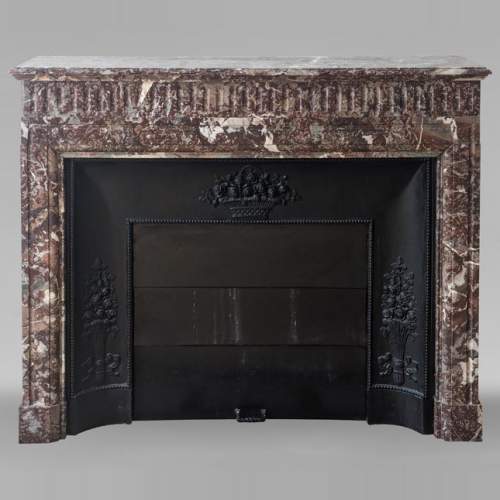
Louis XVI period two-tone Turquin marble mantel decorated with acanthus leaves

Dimensions:
Width: 24 cm
Height: 90 cm
Depth: 110 cm
Inner width: 74 cm
Inner height: 71 cm

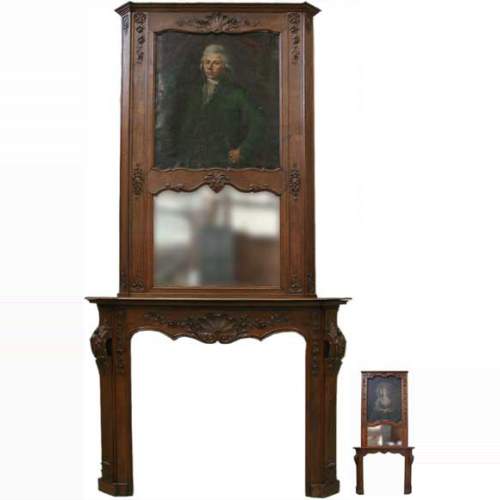
Louis XVI style gilded trumeau, decorated with a coat of arms

Dimensions:
Width: 113 cm
Height: 192 cm
Depth: 17 cm
Inner height: 182 cm

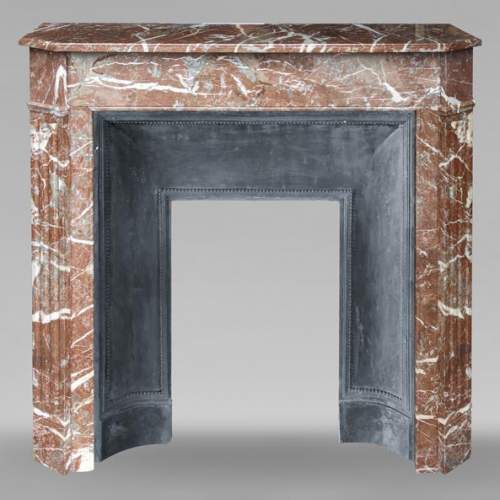
Napoleon III period fireplace with lion's paw feet, in Carrara marble

Dimensions:
Width: 158 cm
Height: 110 cm
Depth: 50 cm
Inner width: 116 cm
Inner height: 81 cm

Gabriel VIARDOT (1830–1904), (attributed to) – Rare japoniste crescent-moon mirror with bronze dragon

Ref.16075
Gabriel VIARDOT (1830–1904), (attributed to) – Rare japoniste crescent-moon mirror with bronze dragon

This japoniste mirror in bronze and walnut was made circa 1880–1890. Its Sino-Japanese inspiration, together with the presence of a characteristic prowling bronze dragon, allows this mirror to be attributed to the prolific cabinetmaker Gabriel Viardot (1830–1904), renowned for his production of japoniste furniture and works of art. The bronze dragon coils elegantly around the wooden frame, shaped like a crescent moon. The ornamental details are exceptionally fine: the scales along the flank and tail, and the pronounced musculature of the twisting body enhance the creature’s dynamic movement. With its mouth slightly open, the beast seems to threaten whoever gazes into the mirror. The restrained design of the frame sets off the striking presence of this superb bronze dragon, a recurring motif in Gabriel Viardot’s oeuvre. Born in Paris in 1830, Gabriel Viardot began his career alongside his brother Louis before founding his own workshop in 1860 and taking over the family business. The 1867 Exposition Universelle gave Western audiences the opportunity to discover the Chinese and Japanese pavilions, which drew fascination for the novelty of their motifs and techniques. In an artistic climate shaped by eclecticism and Orientalism, enthusiasm for Asian art grew steadily, prompting Viardot to devote himself to the creation of furniture inspired by Japanese and Chinese art. His work earned him several medals at the Expositions Universelles (1867, 1878, 1885, 1889 and 1900), as well as at the Union Centrale des Arts Décoratifs exhibition in 1884.

Dimensions:
Width: 73 cm
Height: 75 cm
Depth: 13 cm