menu
Menu
account_box
Categories
Contact
email Send us a message

Contact

phone By phone

+33 (0)1 42 25 12 79
Tue.-Sat., from 10am to 6pm
+33 (0)6 60 62 61 90
Everyday from 9am to 7pm.

email by Email

Adress: contact@marcmaison.com

share Let's get social

Languages
And also...
My selection
(35 Objects)

My selection (35 Objects)


The table coming from an exceptional furniture set realized by Moses Michelangelo Guggenheim for the Palazzo Papadopoli in Venice,  Italy

Ref.03165
The table coming from an exceptional furniture set realized by Moses Michelangelo Guggenheim for the Palazzo Papadopoli in Venice, Italy

Also presented in the Salone delle Quattro Porte, this table was made in the same style as the other pieces, that is to say respecting the style of sixteenth century Venice. Also presented in the Salone delle Quattro Porte, this table was made in the same style as the other pieces, that is to say respecting the style of sixteenth century Venice. It is made of carved wood and the shelf, in marble, is embedded in the wood, considerably enriching the whole. Again, this is a real showpiece for the quality and fineness of the sculpture. All four legs are connected by a X-shaped spacer whose center shows the representation of a kind of amphora with a lid in encrusted enamel. The pedestal, delicately fluted, echoes the lower part of the body of the vase that is fluted. Below, a frieze of interlaced foliage is set against a texturized background. This background, produced thanks to a special hammer with small spikes called a bush hammer, does not catch the light in the same way as the smoother parts of the wood. In this way one can perceive the extreme attention given to this sculpture. The vase is topped by a cover whose primary element is a blooming flower. The cover is in turn covered with scales. The handles, in their upper parts appear to be true plants. In the lower bracket, they are of masks of men who take their place. The four feet balusters are also a very nice quality. Based on a round foot, their central part is represented by a kind of vase mounted on a pedestal. These elements are delicately carved with festoons and monsters: Pan heads are connected by interlaced ribbons. Again, the bottom is textured, keeping the attention and the light on the carved elements on the smooth surface. The four feet are completed in their upper part by elements winding on themselves and carved with interlacing. The shelf rests on corbels, an architectural element that is normally used to support the cornices. The modillion differs from the corbel because it is a sculpted part, as we see in this table. Here they are covered with acanthus leaves ending in a coil. On the recesses, the masks of bearded men are displayed on winding leather motifs.

Dimensions:
Width: 150 cm
Height: 88 cm
Depth: 80 cm

A monumental Display Cabinet coming from an exceptional furniture set realized by Moses Michelangelo Guggenheim for the Palazzo Papadopoli in Venice, Italy

Ref.03172
A monumental Display Cabinet coming from an exceptional furniture set realized by Moses Michelangelo Guggenheim for the Palazzo Papadopoli in Venice, Italy

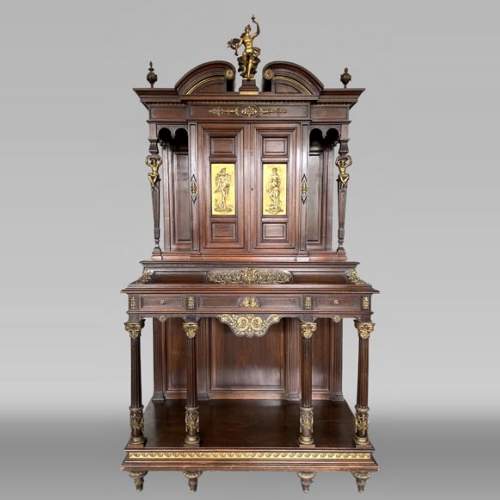
This monumental display cabinet is composed of three windows, designed to exhibit fine china and other sophisticated crockery, a custom revealed by the period photographs. The high society of the time collects objects of art and priceless tableware, and enjoys to show them to the guests while preserving them in this precious and imposing case. A true ceremonial piece, this opulent dresser was arranged in the reception hall that once was the Salone delle Quattro Porte in Palazzo Papadopoli . The smaller surface of this piece is pretext for an abundance of carvings that confirm the prestigious nature of it. The numerous sculptures are the work of an extremely skilled sculptor. The vertical uprights are decorated with images of old sheathed bearded men. The sheath is the support for a foliage frieze that ends with a scroll. The protruding cornice rests on corbels, representing a vocabulary of ornamental architecture. It supports four vases with lids and an armorial pediment flanked by two griffins and crowned with a cardinal's hat: it is a hat with a flat, wide-brimmed shape and from which hang large silk cords. Between the cornice and the window, a carved frieze of festoons alternates with monsters. Shells are arranged above the festoons. The extreme quality of the sculpture and the much-sought decor is indicative of the work of an exceptional sculptor, whose mastery was unrivaled. The coat of arms on this dresser is the Aldobrandini's, whose most famous member was Pope Clement VIII, between 1592 and 1605. Having his nephews quickly appointed cardinal in order to enlarge the Aldobrandini's power, we owe this very Pope the concept of « nepotism », « nepote » being the Italian for nephew. The Aldobrandini, from Florence, increased their wealth during the Middle Ages and adopted the coat of arms azure per bend embattled or and six stars or. Since 16th century it is framed with the cardinals symbols, just like it is on this amazing dresser : a broad brimmed hat with tassels, the galero. Agostino Caracci, brother of considerable Anibal Caracci, designs this exact coat of arms for the cardinal Cinzio Aldobrandini. The Aldobrandini heraldy is sculped on many Italian buildings, it is for example carved with the galero in the Aldobrandini Chapel of Ravenna's Duomo. Used by Clement VIII, it is often seen with the papal keys, like in Santa Maria Maggiore where his gravestone was designed by the illustrious sculptor Bernino, and on the coins minted with his blazon. An Aldobrandini descent from his mother Maria Maddalena, Nicolo Aldobrandini-Papadopoli wished to preserve the memory of this lineage in the Palazzo Papadopoli decoration.

Dimensions:
Width: 210 cm
Height: 346 cm
Depth: 62 cm

The seats  coming from an exceptional furniture set realized by Moses Michelangelo Guggenheim for the Palazzo Papadopoli in Venice, Italy

Ref.03168
The seats coming from an exceptional furniture set realized by Moses Michelangelo Guggenheim for the Palazzo Papadopoli in Venice, Italy

Two armchairs and four chairs in carved walnut wood. This set is coming from the Palazzo Papadopoli, Venice, Italy, "Salone delle Quattro Porte" which was totally refurnished between 1874 and 1881 by Moses Michelangelo Guggenheim . The armchairs and the chairs of this set are produced in the same way with the difference that the armchairs are fitted with sculpted armrests. The base is made of four legs resting on round feet. The two front feet are tapered and fluted in their middle part, similar to columns. The architectural language here adopts an ornamental theme. The two back legs are from a square section. The feet are connected to each other by a spacer in the shape of an H, decorated in its center with an image of acanthus leaves. The frame of the seat is carved from a frieze of small flowers taking place in flowery containers. The main surface is decorated with a plant motif hanging from this frame. In the center of this motif is a crown of a duke. The uprights of the back are represented in an identical manner on all the chairs. The upper part shows the busts of sheathed women carved in very high relief and ending with an acanthus leaf. They rest on a console which again depicts the crown of the duke.The handles of the two chairs are a beautiful work of sculpture, notably through the back attachment where a winding acanthus leaf is represented. The grips protrude from the arms and show the heads women with extravagantly made up hair.

Dimensions:
Width: 63 cm
Height: 107 cm
Depth: 61 cm

Julien-Nicolas RIVART (1802-1867) - Curved writing desk with lozenges marquetry And flowers bouquet in porcelain inlay

Ref.10704
Julien-Nicolas RIVART (1802-1867) - Curved writing desk with lozenges marquetry And flowers bouquet in porcelain inlay

This charming writing desk is designed in curves : the rounded feet follows a movement that also curves the sides of the chest. On this one, the rosewood has been plaited in a nice work of marquetry in lozenges. The elegant sobriety of black and gold highlights the luminosity of the rosewood veneer, the false marble, and the vivid colors of the porcelain flowers. Auguste Luchet evoked with lyricism "the magic that comes from a bouquet in kaolin on a black background" like on our desk. The chest is indeed graciously decorated with Julien-Nicolas Rivart 's porcelains. He is the inventor of the porcelain marquetry technique, a unique process, searched for a long time and patented in 1849, he was the only one to master. We have here a beautiful example of these rare decorations with a bouquet of roses, white campanulas, pansies, tulip and forget-me-nots. The shelf is adorned as well by a beautiful frieze of wild flowers. Rivart , a skillful artist, achieved an aesthetic synthesis between the Florentine hard stone marquetry and the decoration of porcelain slabs from 18th century. He can hence combine the lightness of marquetry and its sophisticated contrasts effects, with the charm of painting on porcelain. The marquetry invented by Rivart enables these sophisticated hues to contrast directly with the wood, and prevents to hide the veins and the cabinetmaker's beautiful work. For that reason, at the World's Fairs of 1851, 1855 and 1867, this technique is described as "a delicious process", "yet more beautiful than beautiful", and receives the Emperor Napoleon III's congratulations. Open, the desk offers its beautiful rose wood veneers and its mahogany lozenges marquetry. The chest includes two shelves and five drawers equipped with gilt bronze vegetable shaped handles. At last, the shelf is embellished by an embossed and gilt leather blotter.

Dimensions:
Width: 70 cm
Height: 106 cm
Depth: 45 cm

Julien-Nicolas RIVART (1802-1867) - Elegant emblazoned sewing table with decoration of porcelain marquetry

Ref.10720
Julien-Nicolas RIVART (1802-1867) - Elegant emblazoned sewing table with decoration of porcelain marquetry

This graceful sewing table supports a rare porcelain marquetry by Julien-Nicolas Rivart , inventor of this sought after technique he was the only one to master. The mahogany shelf displays a twig of roses and blue daisies, whose vibrant colors are mutually enhancing. Porcelain inlay was not possible until 1849, when Rivart registered the patent for his unique process. Porcelain has the advantage of enabling painting, offering a range of subtle and illusionist hues, but until then, it could only decorate furniture in the form of plaques hiding the wood. Rivart's invention thus quickly found its rank in prestige furniture. The veins of the rosewood have been skilfully arranged here on the work's exterior, while the interior is veneered with a beautiful, more intimate, shade of mahogany. The wood is also sheathed with gilt bronze laces for this elegant and feminine piece of furniture wearing wedding coat of arms. The blazons side by side, surmounted by a ducal crown and supported by a unicorn and a griffin, demonstrate an aristocratic commission. Several pieces of furniture inlaid by Rivart porcelain were in fact decorated with the coat of arms of their purchasers, as soon as the World's Fair of 1851 , when the Duke de Caumont de la Force acquired the cabinet exhibited by Rivart and Victor Paillard and had his blazon applied to it. It is also the case of the table preserved in the Sèvres Museum of the Cité de la Céramique, having belonged to the Count of Manneville. Here we can recognize the coat of arms of the family Martin du Tyrac de Marcellus on the right shield "à la tour donjonnée à dextre" (with a dungeon on the right side of the tower). The most famous member of this ancient family was perhaps Lodoïs de Martin du Tyrac de Marcellus (1795-1861), a diplomat and defender of the ancient heritage who worked to have the Venus of Milo in France. The presence of the arms of his family next to another coat of arms indicates a union of two families ; thus, we have here a sewing table offered to the bride. For this reason, it is a particularly elegant piece of furniture with a sophisticated design. Its general form recalls the period of the Regency, and the aristocracy's joyful coquetry in 18th century. The porcelain flowers, immortalizing their ephemeral freshness, are particularly adapted to decorate this type of beauty accessory. Their naturalistic precision is characteristic of Rivart 's porcelain, which was signed several times between 1852 and 1855 by Pierre-Jospeh Guérou , a flower painter formerly employed by the Sèvres Manufactory. The latter paints in the vein of Pierre-Joseph Redouté and Simon Saint-Jean, two artists celebrated for their precision that does not however suffocate the lightness of their subjects. Guérou sent his flowers on porcelain and watercolors to the Salon from 1836 to 1866, but in all likelihood, he did not always sign his decorations for Rivart.

Dimensions:
Width: 55 cm
Height: 76 cm
Depth: 40 cm

TAHAN Manufactory, Julien-Nicolas RIVART (1802-1867) and Pierre-Joseph GUEROU - Exceptional Louis XV style violin-shaped Desk Decorated with porcelain marquetry And gilt bronze espagnolettes

Ref.10711
TAHAN Manufactory, Julien-Nicolas RIVART (1802-1867) and Pierre-Joseph GUEROU - Exceptional Louis XV style violin-shaped Desk Decorated with porcelain marquetry And gilt bronze espagnolettes

Of exceptional manufacture, this Louis XV style desk is a "bureau plat de milieu", designed to be arranged in the center of a room. It is the fruit of a collaboration between the cabinetmaker Tahan and the audacious Julien-Nicolas Rivart , supported by the painter Pierre-Joseph Guérou . Lavishly decorated on all sides and mounted in a sumptuous decor of gilt bronze, four espagnolettes decorate its curved legs, and four beaded shells, enliven by foliage, adorn the four "violin" shaped crosspieces. The presence of the three signatures allows us without hesitation to determine the part of each one in the elaboration of this work of exception. We know that Julien-Nicolas Rivart registered a patent for a porcelain inlay technique in September 1849, and that he joined in 1850 with Paul-Joseph Andrieux, a native of Limoges, under the name "Rivart et Andrieux", being then the only ones to fully master this meticulous and eminently delicate technique of marquetry. Rivart achieved here a synthesis between the Florentine hard stone marquetry and the decoration of porcelain slabs from 18th century. Rivart's invention enables sophisticated hues to contrast directly with the wood, and prevents to hide the veins and the cabinetmaker's beautiful work. For that reason, at the World's Fairs of 1851, 1855 and 1867, this technique is described as "a delicious process", "yet more beautiful than beautiful", and receives the Emperor Napoleon III's congratulations. He can hence combine the lightness of marquetry and its sophisticated contrasts effects, with the charm of painting on porcelain. The flower crown adorning the shelf was thus painted with a great range of hues and the freshness of porcelain painting. Pierre-Joseph Guérou , painter of flowers and former painter of the Sèvres Manufactory in the years 1847-1848, realizes here a gorgeous painted decoration of naturalistic flowers, that he signs and dates of 1853. He unfolds here a complete palette of complementary tints, with purple campanulas and a yellow tulip for example, that create a remarkable luminosity. Presently, very rare furniture pieces bearing Guérou's signature are known, which makes our desk all the more rare. Guérou signed as well in 1852 a table preserved in the Museum of Murska Sobota (Slovenia) and originating from the Beltinci residence, which decoration is slightly different, being composed of four flower bouquets. The table itself proposes a more simple decoration, the four sides displaying a wood marquetry and the gilt bronze being notably reduced. Once the shelf of our desk was realized, one of the privileged collaborators of Rivart entered on stage, the renowned Tahan . Signing and dating 1856 on the drawer's lock, the "Patented Cabinetmaker of the Emperor" used his exceptional mastering for the realization of this desk and probably for its gilt bronze decoration. The desk presented here is hence a fine witness of Tahan's favorable disposition towards the "Rivart process". Pierre Lambert Tahan , a Belgian cabinetmaker, settled in Paris shortly before 1806, in the district of the Temple. In 1844, he ceased all activity and left the direction of his shop to his son, Jean-Pierre Tahan . The latter will then completely revolutionize the organization of the company by separating manufactory and store, installed at 32 rue de la Paix. A year later, he is already reported as "Supplier of the King and Princes". In 1855, he bears the title of "Supplier of the Emperor", a reference of the highest importance which he takes care to recall on our table the following year. At that time, the Court commissioned him a large range of furniture pieces, libraries, tables, pedestals and toiletry cases. Then, Tahan will participate in the great World's Fairs of his time. On the occasion of the World's Fair of 1855 in Paris, he presents an extraordinary aviary in walnut carved with foliage and flying birds. Executed by Tahan , our desk is a true luxurious work, suitable to the decoration of a princely interior. The comparison can easily be established with the table bought by the Count of Manneville on the occasion of his marriage in 1861 and now preserved in the Sèvres Museum of the Cité de la Céramique. On this table we observe a very similar crown of flowers, knotted with four sky-blue ribbons, although the colors are paler. There is no mention of Guérou for the painting of these flowers, which is hardly surprising given the late date of realization for this table, almost ten years after the realization of our desk.

Dimensions:
Width: 159 cm
Height: 80 cm
Depth: 98 cm

Georges Alphonse MONBRO (attributed to), Pair of low bookcases with bronze espagnolettes

Ref.10638
Georges Alphonse MONBRO (attributed to), Pair of low bookcases with bronze espagnolettes

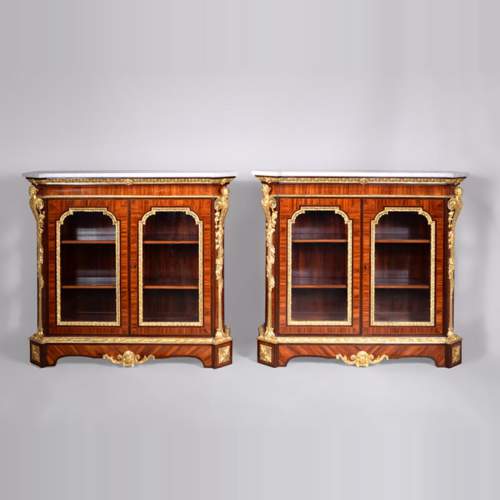
This pair of cabinets with rosewood and amaranth veneer was made during the 19th century. Attributed to Georges Alphonse Bonifacio Monbro, these two pieces of furniture are characteristic of his work because of the delicacy and the profusion of the gilt and finely chiseled bronze decoration. The abundance of Monbro's production and his predilection for eclectic furniture enhanced the belief that Monbro made this cabinets. Monbro, whose father was an antique dealer and a cabinetmaker, was born in 1807 in Paris, where he died in 1884. He took over the family business from 1838 with the name "Monbro aîné" and whose the shop was situated at 18, Rue Basse-du-Rempart. During Haussmann’s renovation of Paris, he had to move and set up in Rue du Helder, in the hôtel Dudon, which will also be demolished. Monbro sold curiosities, furnitures, bronzes, porcelains, tapestries, sculptures and was also cabinetmaker. He acquired a great renown and opened a branch in London around 1850. While his shop was compared by his contemporaries to a real antiquities museum, the furniture he created were famous thanks to their historicism and their eclecticism, in vogue, as this pair of cabinets. The rosewood and amaranth veneer is very fine. The amaranth frames the rosewood parcels whose the streaks add ornamentation and relief, even a certain geometric aesthetic. Richly adorned with carved and gilt bronze, this cabinets each support a Carrara marble top subtly veined. On both sides, bronze and high relief espagnolettes adorn the corners. These espagnolettes, decorated with detailed leaves and draperies, are taken from the Regence style and are become, during Napoleon III, a recurring pattern in the decorative arts. Leaves and bunches of grapes surround the bronze borders as a vine stock. The furniture legs are inspired both by Louis XV and Louis XVI styles : they are ornated with square rosettes which are overhung by rococo curves and shells. A half-lion and half-human face is at the centre and is wrapped with foliage. The bronze is very fine and elaborated, especially on the edgings with rococo decorations which structure each piece of wood or on the edgings finely decorated with oak leaves which frame the two windows. Both restorer and cabinetmaker renowned for his skill as connoisseur about bronzes and antique furnitures, Monbro specialized in historical styles and in antique furnitures reproduction, at a time when copies were most appreciated than originals. Constance Aubert tells in the review L'Opéra in 1842 his journeys through France, Switzerland and Italy for visiting all the castles to find antique furnitures in order to resell or to copy it for his creations. However, if Monbro was a real historic styles expert – Marc Fournier, a critic, writes in the review La Grande ville, that he was "the only curiosities merchant with [...] a great reputation and genuinely versed in the science of archeology" - he did not imitate originals, but he reinterpreted historic styles, according to the trend of the period, and this pair of cabinets is a perfect example : Louis XV, Louis XVI and Napoleon III styles are mixed.Georges Alphonse Bonifacio Monbro is especially known for his ebony and gilt bronze furnitures decorated with enamel such as the one currently exhibited at the Musée d'Orsay. Two caryatids also adorn the angles and the figure in the center is reminiscent of those at the bottom of our cabinets. This furniture with many inspirations - rigor and egyptomania are taken from the Napoleon I style, shells and curves from the Louis XV style, square rosettes from the Louis XVI style - is also characteristic of the furniture of the time.Antiques merchant, with whom "all the precious remains of past ages are," Monbro made bronze furnitures with eclectic decor his specialty, symptomatic of the aestethic of the second half of the 19th century and his taste for curiosities.

Dimensions:
Width: 128 cm
Height: 110 cm
Depth: 34 cm

André-Fernand THESMAR (1843-1912) and Ferdinand BARBEDIENNE (1810-1892) - Ornamental japanese style plate

Ref.11266
André-Fernand THESMAR (1843-1912) and Ferdinand BARBEDIENNE (1810-1892) - Ornamental japanese style plate

Plate in gilded bronze and cloisonné enamel decorated with cockatoo on a blue background. Following the example of the enamel workshops of the factory of Sevres, Ferdinand Barbedienne (1810 - 1892) introduced enamel in its making of art works: “byzantine” champlevé enamels from the end of the 1850s, then neo-Renaissance painted enamels and cloissone enamels with Far-Eastern influence. No other company managed to integrate with such success the use of enamel in an industrial production. After some attempts with independent enamelers, , Barbedienne ensured the exclusive collaboration of remarkable practitioners: Alfred Serre for the painted enamel (before 1872) and Fernand Thesmar for clossoine enamel (after 1872). This plate is a beautiful example of the important production that Barbedienne developed in the years 1870 - 1880, at a time when luxury enamel on precious metals was experience a real craze. The motifs of flowers, birds and insects is again found in a series of similar pieces, combining classic shapes and designs of oriental taste, including a glass kept at the Orsay Museum in Paris and another kept at the Walters Art Gallery, in Baltimore. Andre-Fernand Thesmar, born March 4 1843 in Chalon-sur-Saone, first devoted himself to oil painting and was known as a painter of flowers. He was educated in drawing in a factory for printed-fabric in Mulhouse where he had been placed at fourteen years old to learn the trade of a draftsman. His teacher was a painter of flowers: he “drew and dissected the plant with fury, requiring an anatomical analysis of shapes and a meticulous copy of nature.” He left this industrial environment to go to Paris in 1860 and engaged in various activities (workshop of industrial drawing and studio decoration for Cambon’s theater.) It was probably for his talent as a painter that Thesmar was noticed in 1872 by Ferdinand Barbedienne. With Barbedienne, later Thesmar succeeded to the management of the production of enamels. The productions of Thesmar and Barbedienne reflected the interest that they had for the decorative techniques and compositions of Japanese enamel. It was as “co-operator of the Barbedienne company” that Thesmar exhibited at the Exhibition of Decorative Arts in 1874, A cock pheasant from China and Floral Bouquets from greenhouse where they admired his talent as a painter of flowers. At the exposition in 1875, Thesmar exhibited two large enamel compositions on leather, one of which displayed a wader with water lilies and bright yellow iris, completely in the style of our plate and showing the style of the return to nature. In 1891, Thesmar turned to the decoration of porcelain and introduced himself to Charles Lauth who, since 1879, led the Factory de Sèvres. Its at this time that the collaboration with the Barbedienne company ended. Afterwards, he would be especially known for having invented the “plique à jour” technique, which numerous pieces of are kept in public collections.

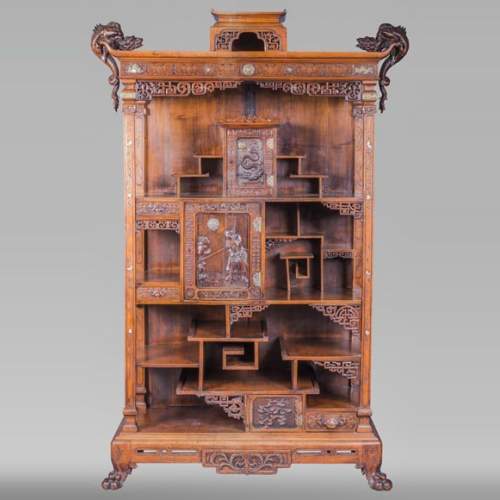
Gabriel VIARDOT, Shelving unit with dragon decoration and mother of pearl marquetry, circa 1880-1890

Ref.12792
Gabriel VIARDOT, Shelving unit with dragon decoration and mother of pearl marquetry, circa 1880-1890

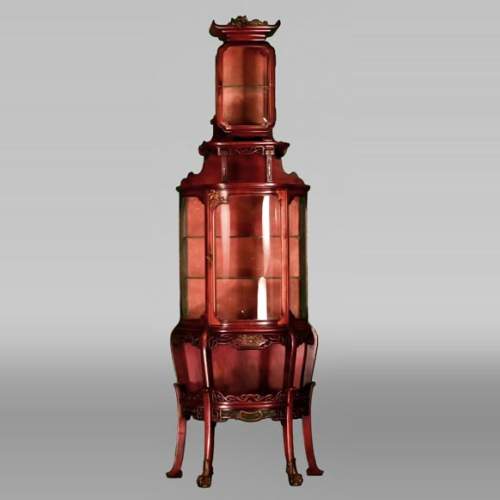
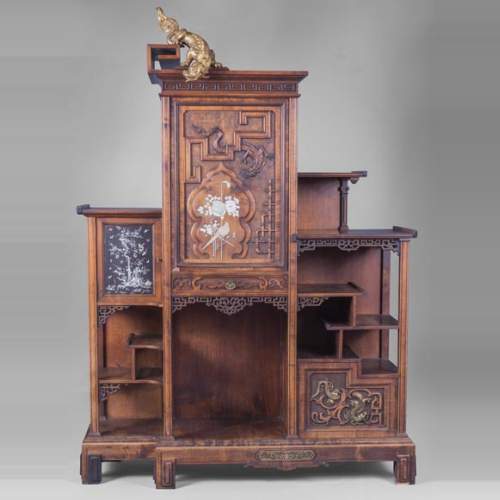
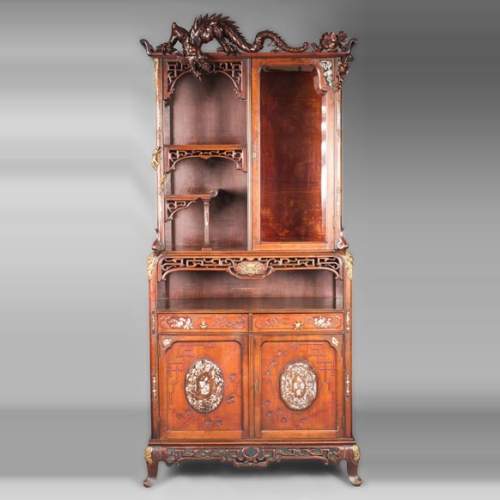
This Japanese shelving unit was made of tainted sycamore by the French furniture maker Gabriel Viardot (1830-1906) in the last decades of the 19th century as indicates the signature "G. VIARDOT" on one of the feet. It's during the 1867 World Fairn where he discovered the Japanese Art, the Gabriel Viardot decided to devote himself to “Chinese-Japanese style furniture”. It’s with this production that he was awarded a silver medal at the World's Fair of 1878. His furniture was produced thanks to lacquered and carved panels sent directly from China or Japan and decorated with mother of pearl inlays from Tonkin. He enlivened his furniture with bronze decorations, of which he made all the designs by hand. In 1885, he participated in the World Exhibition of Antwerp where he obtained a gold medal. At this time, the shop employed 90 – 100 workers, sculptors or cabinetmakers, a lot of who were educated directly by Gabriel Viardot. Following this exhibition, Gabriel Viardot was promoted to the rank of Knight in the Legion of Honor (December 29 1885). In 1889, he was at the World Exhibition that took place in Paris and awarded a gold medal. He obtained the same award at the World's Fair of 1900. The furniture maker creates here an asymetrical shelving unit of which the shape and decoration are inspired by the Far-East esthetic. The top of the furniture reminds indeed of the pagoda roof, while we find here and there the dragon motif in polished varnished bronze and the geometric scrolls decoration. On each of the three doors, Gabriel Viardot chose to inlay a decor made of Tonkin mother of pearls. We can especially see on the superior door, an exceptional reproduction of a typical village, or a branch of cherry tree with flowers on one of the lower door. The detail precision goes to the sides of the furniture which present an elegant chiseled decoration depicting bamboo leaves.

Dimensions:
Width: 120 cm
Height: 197 cm
Depth: 45 cm

Exceptional Charles X billiard by Maison Chéreau in mahogany and gilt bronze

Ref.14023
Exceptional Charles X billiard by Maison Chéreau in mahogany and gilt bronze

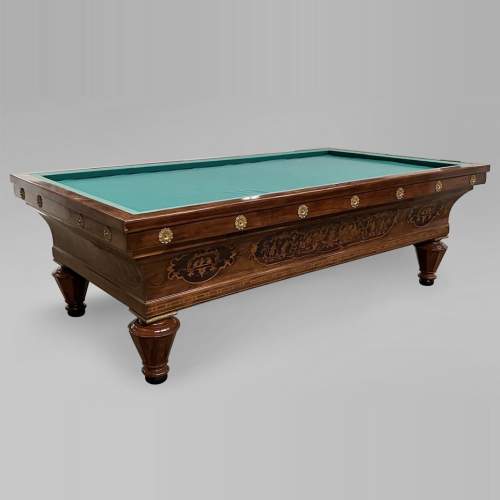
.noticeclient.container { display:flex; flex-direction:column; gap:0px; width: 100%; } .noticeclient img { border-radius: 5px; box-shadow: 0px 0px 5px grey; } .noticeclient-section { display: flex; flex-direction: row; gap: 0px } .noticeclient figcaption { text-align: center; } .noticeclient figure { width: none; text-align: center; } @media screen and (max-width: 640px) { /* .noticeclient figure { width: none; text-align: center; } */ .noticeclient img { width: none;} .noticeclient-section { flex-direction: column; } } Billiards were first created in 1469 in France and have their origin in croquet, which was played outdoors at that time. A version of the game adapted to indoor play was then introduced, and then on a table. The billiard table underwent a slow evolution, propelled by the creativity of the French style which influenced the design of tables around the world, until it reached its apogee in the 1800s. According to "The Billiard Encyclopedia. An Illustrated History of the Sport", tables from this period became masterpieces of carving, inlay and marquetry, some of which, like our exceptional table, are of the highest quality. The Maison Chéreau was founded in 1816 and settled in the heart of Paris, at 307 rue Saint Denis and 18 rue du faubourg du Temple. It specializes in the creation of exceptional billiard tables, especially with music, and was patented by the king for 5 years from 1828. It acquired an unprecedented notoriety in 1816, by the creation of one of the most beautiful and original tables in the history of billiards. The Maison P. Charles Chéreau, manufacturer of billiards, designed a table equipped, under its bed, with an organ that played a different note depending on the pocket in which a ball landed. It was unique and was presented at the Louvre Exhibition in 1827. The specialty of the Chéreau firm was to supply particularly elaborate tables to high society and royalty, such as our six-legged solid bronze table. Typical of French billiards, also called carom billiards, or three-ball billiards, our billiard is played on a pocketless table (without holes), decorated with a green carpet, and is generally played by two players with three balls. The drawing "Ladies and gentlemen playing billiards" of 1756, by Johan Esaias Nilson (1721-1788), shows that at this date, the pin (probably replaced by a ball) and the hoop disappeared and that the ladies still used a crosier while the men already used a cue. The "blouses" (holes), clearly visible on the drawing, will start to be removed from the tables around 1850 in order to be able to play the game with three balls. In addition to the improvements of the tables, the "pockets" of these were removed in France around 1850, and then in other countries. This allowed for better series, to the great pleasure of the players. The consequence was the opening of several new cafés, as well as very large billard rooms, notably in Paris, Vienna, Amsterdam and New York. The French three-ball game on a pocketless table became one of the most popular billiard games in the world. Some billiard tables are sometimes inspired by the style of furniture of a particular period, such as the Louis XV style table with six legs and marquetry, similar to ours. Our six-legged billiard table in solid bronze with lion's heads and mahogany veneer, was made by the Maison Chéreau, Blanchet & Co and then transformed by the award-winning craftsman E. Gueret (Gold Medal 1889). This exceptional piece was during decades in the magnificent Renaissance-style Château de la Cordelière. This impressive castle was built by the owner of Moët & Chandon in 1892, in Chaource (near Troyes), in a Louis XII, Gothic and Renaissance style. The second floor had vast and luminous rooms with high ceilings, and housed our large and exceptional billiard table, a pair of wrought iron sconces and iron lanterns and stained glass windows (currently presented around the billiard table in our stand 2 & 2 bis of the Paul Bert market). Above is an example of the opening of the gowns on another model from the Maison Chéreau, which are today condemned on ours. The table is overall sober and elegant, characteristic of the Charles X. It is an exceptional piece from the 1820s. In the XIXᵉ century, Cuban mahogany was highly prized, which reinforces the grandeur of de billard. It is supported by six superb ormolu legs with small scrolls, featuring lion heads with clawed feet. The intensity of the bronze, accentuated by exceptional ciseling, highlights the dark color of the mahogany around the billiard table, notably by the inlay of a dozen rosettes. The lions' mouths on the legs are now blocked, which indicates that the original table was "à blouses" and was transformed thereafter "à la française" by E. Guéret, to reinforce the noble aspect of this game. This transformation is reversible, it is thus possible to return to the original model. The mother-of-pearl cartouches indicating "Maison Chéreau, G. Blanchet & Cie, E. Guéret Sr." and "Médaille d'or, 13 [or 73] rue de Lancry, PARIS" were probably added during the transformation to the French style. Indeed, it would seem that the Maison Chéreau, specialized in the manufacture and creation of exceptional billiard tables, collaborated with the great piano manufacturers. In the list of the rewarded of the National Exhibition of Paris in 1827 (same decade as our billiard table) the names "Roller and Blanchet" located at 10 boulevard Poissonnière in Paris, received a silver medal for "Pianos transpositeur, pianos droits, Chromamètre" and explains the mention of the name "Blanchet" at the side of "Maison Chéreau" on the cartouche. The same year, we also find in the list of the rewards, the name of "Gaidon" (who also worked with Blanchet) for an honorable mention for a piano, as well as the address 307 rue Saint-Denis in Paris, which is also the address of the Chéreau Company. The sharing of the Chéreau workshops with a piano factory has therefore surely nourished the creation of our billiard table. Similar model of a billiard from the Chéreau company, in Charles X style with 4 feet in gilded bronze, with the holes in the lions' mouths. 248 x 138 cm.

Dimensions:
Width: 281 cm
Height: 82 cm
Depth: 156 cm

E. BRUN after Jules-Claude ZIEGLER, Portrait of Louis de Champagne, Count of Sancerre, 1920

Ref.15499
E. BRUN after Jules-Claude ZIEGLER, Portrait of Louis de Champagne, Count of Sancerre, 1920

This portrait of the Count of Sancerre was made by E. Brun in 1920. It is a copy of the work by Jules-Claude Ziegler preserved at the Château de Versailles, as indicated by the inscription placed at the bottom left of the canvas. The original portrait was commissioned for the Galerie Militaire at Versailles in 1834; upon its delivery, it was placed in the Hall of the Constables. Under the reign and initiative of Louis-Philippe (1773-1850), the former residence of the kings of France was transformed into a museum dedicated to “all the glories of France”. In this context, numerous works were commissioned to illustrate the political and military history of France, including this portrait. The copy of the Versailles portrait was likely commissioned by the Sancerre family for their personal residence, the Château de Sancerre, where it was displayed. The constable and his mount occupy the center of the composition. Very dignified, he turns his head to the left, as if his attention has been drawn there – a way for the painter to partially conceal his strabismus, as noted in the Chronicle of the Monk of Saint-Denis. He guides his horse with his left hand while holding a staff of office in his right. He is dressed in armor and chain mail, over which he wears a large red cape and a yellow tunic bearing his family’s coat of arms. The crest is also present on the barding covering the horse’s upper body, surmounted by a comital crown. The horse is shown in motion, its tail in the wind, imparting a sense of movement to the portrait. The scene unfolds against a rocky landscape extending to the horizon. The sky is heavy with clouds at the lower part, transitioning from dark gray to a lighter tone, culminating in a blue sky in the upper third of the canvas. The copy is rigorously identical to the original, with two exceptions: the absence of the artist’s signature on the rock, replaced by the inscription, and the inclusion of a castle in the background. This was likely an express request by the commissioners of this painting: as it was intended to adorn the walls of the Château de Sancerre, it seemed fitting to depict the structure as an integral part of the count’s history. Louis de Champagne, Count of Sancerre (1341/42–1402), was Lord of Charenton, Beaumetz (or Bommiers?), Menetou-Salon, and later Ambrault (1391). Having fought in numerous battles during the Hundred Years’ War, he was named Marshal of France in 1368 and distinguished himself in combat on many occasions. The chronicler Jean Froissart (c. 1337-c. 1410) described him as “a valiant man and a boldly steadfast knight” and “the finest ornament of French chivalry”. He also served as an ambassador to England in 1385, governor of Languedoc from 1390 to 1401, and finally Constable of France in 1397. The Count of Sancerre was buried at the Basilica of Saint-Denis, where his effigy can still be seen today. This effigy, the closest temporal likeness of Louis de Champagne, was likely a source of inspiration for Jules-Claude Ziegler’s portrait. He is depicted here as constable, a title denoting the supreme commander of the king’s armies from the late 12th century, and as Lord of Sancerre, with the château in the background and his coat of arms included in the imagery. This representation aligns with the 19th century’s documentary interest in French history, particularly in the depiction of armor. This historical passion extended into the 20th century, as seen in the creation of this copy, which was accompanied by a frame adorned with neo-Gothic cabbage-leaf moldings.

Dimensions:
Width: 227 cm
Height: 298 cm
Depth: 9 cm

BALLEROY & Co. (porcelain), Joseph Albert PONSIN (painter), Pair of Decorative Plates Adorned with Portraits of an Assyrian Man and Woman, 1876?

Ref.15606
BALLEROY & Co. (porcelain), Joseph Albert PONSIN (painter), Pair of Decorative Plates Adorned with Portraits of an Assyrian Man and Woman, 1876?

This Pair of Ornamental Porcelain Dishes Was Crafted by the Company Balleroy & Cie in Limoges and Decorated by Joseph Albert Ponsin, Likely in 1876 Both dishes bear the mark of the company Balleroy & Cie. In 1900, brothers Antoine and Henri Balleroy acquired a factory in Limoges. Their partnership with Léon Mandavy and Paul Grenouillet de Mavaleix four years later resulted in the formation of the company “Balleroy & Cie”. The Balleroy brothers continued the business independently from 1908 onward, and Henri Balleroy eventually assumed sole leadership in 1929, managing the enterprise until its closure in 1937. The works are signed by Joseph Albert Ponsin (1842-1899), a former actor and songwriter who became one of the most renowned stained-glass painters of the late 19th century. Awarded a bronze medal at the 1889 World Fair, Ponsin also designed a “luminous palace” made of several thousand molded glass pieces for the 1900 Paris Exhibition. His use of porcelain is highly unusual within his work. The decorations on the two dishes are complementary, both in their chromatic harmony and in the selection and poses of the figures. The male figure’s profile exudes a certain severity, despite his slightly smiling lips. His long hair is matched by a similarly full beard. He wears an earring, and his opulent tunic combines gold and green. The female figure, in contrast, stands out against a blue background. Her attire is distinctly oriental: her gown is trimmed with gold, and her long black hair is adorned with a veil, secured on each side by two serpents and a wide golden band. In front of her is a white bird with a long yellow beak, which wraps its neck around one of its wings. Beneath the artist’s signature, the inscription “1[8?]76” provides an approximate date for the creation of these works. The portrait of the man bears a resemblance to the Dish with Assyrian Design by Théodore Deck and Albert Anker, housed in the Musée d’Orsay in Paris. Both Anker and Ponsin appear to have drawn inspiration from the same source: Sir Henry Layard’s publication, The Monuments of Nineveh from Drawings Made on the Spot Illustrated in 100 Plates (London, 1849). In Ponsin’s work, the male figure’s profile closely mirrors those in Layard’s book, though he took greater liberties than Anker in his interpretation of the character’s headdress.

Dimensions:
Height: 5 cm

Louis MALARD, Unique “Ramses-Style” Bedroom in Walnut With Gold Leaf Embellishment, 1889 World’s Fair

Ref.11700
Louis MALARD, Unique “Ramses-Style” Bedroom in Walnut With Gold Leaf Embellishment, 1889 World’s Fair

H. 271 cm / 106” 11/16; W. 260 cm / 102” 3/8; D. 232 cm / 91” 5/16 (bed without canopy) H. 74 cm / 29” 1/8; W. 231 cm / 90” 15/16; D. 148 cm / 58” 1/4 (canopy) H. 73 cm / 28” 3/4; W. 212 cm / 83” 7/16; D. 74 cm / 29” 1/8 (bench) H. 101 cm / 39” 3/4; W. 45 cm / 17” 3/4; D. 42 cm / 16” 9/16 (chairs) This extraordinary neo-Egyptian set bedroom crafted in carved solid walnut and enhanced with gold leaves (yellow, green, and red), was created by Louis Malard for display at the 1889 Paris Exhibition, where it earned him a silver medal. The cabinetmaker Louis Malard operated a workshop and furniture store located at 9 bis, rue Maubeuge in Paris. The establishment produced and sold furniture in various styles, particularly historical ones. It exhibited different furniture ensembles at the 1889 and 1900 World’s Fairs. Various reports and advertisements published in Le Figaro allow us to date his activity to between 1886 and 1903. The centerpiece of this bedroom set is the bed. While it does not resemble Egyptian beds as depicted in archaeological findings from the 19th century, it incorporates the architectural and artistic codes of ancient Egyptian art to create a monumental, unique work that aligns with the requirements of modern comfort. The canopy is adorned with an Egyptian temple pylon at its center, flanked by vultures with outstretched wings – symbols of the goddess Nekhbet – and lotus flowers. The headboard features sphinx figures, various hieroglyphs, and scenes inspired by ancient monuments, including Ramses II on his chariot at the Battle of Kadesh (circa 1274 B.C.E.). The artist drew inspiration for this from a low-relief in the Great Temple of Abu Simbel, as documented by Jean-François Champollion in his work Monuments de l’Égypte et de la Nubie (Monuments of Egypt and Nubia). On either side of the headboard, the bedside tables are decorated with life-size seated figures whose poses mimic the monumental statues of ancient Egypt. Their garments reflect the iconographic codes of feminine fashion visible in the low-reliefs of ancient art. The foot of the bed is guarded by two lion-sphinxes in a hieratic posture, while the frame combines hieroglyphic signs, worshipper figures, and representations of the god Anubis. The bed is accompanied by a bench whose decoration mirrors that of the bed frame, along with the motif of sphinxes, and a pair of chairs adorned with scarabs – sacred animals to the Egyptians symbolizing the god Khepri, the rising sun. The presentation of this bedroom furniture at the 1889 Paris Exhibition was a resounding success: in addition to the silver medal awarded to its creator, it received widespread critical acclaim, including a highly favorable article in Le Figaro. It also achieved commercial success, being purchased by Countess Bathilde Ducos (1851-1927), daughter of a former Minister of the Navy under Emperor Napoleon III. It was sold as part of a theatrical yet less elaborate furniture ensemble forming a bedroom: a wardrobe, a fireplace, and a pair of draperies. This bedroom set was auctioned in 1896, probably to Charles Henri Duquesne, whose family kept it until 2019, when it was acquired by the Galerie Marc Maison. Today, this bed serves as a reminder of the fascination that 19th century artists and their contemporaries had for ancient Egyptian art, which inspired rich creations and reinterpretations. Literature: Le Figaro, July 1, 1889, 35th year, 3rd series, no. 182, p. 2, in the “Courrier de l’Expostion” section. Charles Oudart (dir.), Gazette de l’hôtel Drouot, Saturday, June 30, Sunday, June 31, and Monday, June 1, 1896. Jean-François Champollion, Monuments de l’Égypte et de la Nubie…, volume I, Paris, Firmin Didot Frères, 1835, plate XIII.

Dimensions:
Width: 260 cm
Height: 345 cm
Depth: 232 cm

RIBAILLER and MAZAROZ, Pair of walnut statues of a hunter and a fisherman, after the 1855 Universal Exhibition

Ref.15745
RIBAILLER and MAZAROZ, Pair of walnut statues of a hunter and a fisherman, after the 1855 Universal Exhibition

This pair of sculptures of hunters was presented on their sheaths. This type of installation is typical of an exhibition, and was used to showcase the sculptor's skills. It should be noted, however, that these figures were designed to decorate a piece of furniture purchased by Napoleon III and presented at the 1855 Universal Exhibition, as indicated in the catalogue for the exhibition Jean-Paul Mazaroz, un artiste et amateur éclairé au temps de Courbet [Jean-Paul Mazaroz, an enlightened artist and amateur at the time of Courbet] at the Musée des Beaux-Arts in Lons-le-Saunier in 2003. The piece was a phenomenal success at the Exhibition, and the Ribaillier-Mazaroz company produced numerous copies, always using the same composition. In other words, the two figures were always depicted in the same way as on the original piece of furniture, as described by the Magasin pittoresque: "On the lower left-hand capital is a fisherman holding a net in one hand, a handful of fish and river plants in the other, and wearing fishing tackle on his belt; on the right-hand capital, a hunter throws a hawk on his wrist and holds a beautiful greyhound looking down at a shot bird. He is carrying a bag of game and a trunk". Mazaroz is an unusual character. Born in Lons-le-Saunier and a friend of the painter Gustave Courbet, Paul Mazaroz was a patron of the arts, a sculptor and the author of sociological and economic essays. He joined Ribaillier's studio in Paris and became his partner after marrying his daughter in 1853. This was the beginning of a collaboration that would steer the Ribaillier-Mazaroz factory towards modernity. Following the Universal Exhibition of 1851, Mazaroz discovered the use of machines in cabinet making, as practised by the English. He was the first to use it in France. From then on, he liked to call himself an ‘industrial artist’. This desire to be firmly rooted in his time and its progress led him to publish a photographic collection of his workshop's creations, instead of a simple catalogue of engravings. A supplier to Napoleon III, his company was one of the most prosperous industries of the Second Empire and the Third Republic.

Dimensions:
Width: 28 cm
Height: 122 cm
Depth: 26 cm

Jean-Paul MAZAROS (1823-1900), Neo-Renaissance four-poster bed in carved walnut

Ref.15584
Jean-Paul MAZAROS (1823-1900), Neo-Renaissance four-poster bed in carved walnut

A friend and patron of Gustave Courbet, and close to Pierre-Joseph Proudhon with whom he shared ideas, Jean-Paul Mazaroz was a singular figure: collector, sculptor, and author of sociological and economic essays. He entered the École des Beaux-Arts in Dijon in 1846 and then the École des Beaux-Arts in Paris. In 1850, he partnered with the cabinetmaker Pierre Riballier, whose daughter he married in 1853. Following the Universal Exhibition of 1851, he discovered the use of machinery in cabinetmaking, a tool previously used exclusively by the English. A pioneer in its use in France, he thus ushered the Riballier-Mazaroz workshop into a new era. Eager to make use of all the advancements of his time, Jean-Paul Mazaroz readily described himself as an "industrial artist" and published a photographic collection of his workshop's creations, rather than a simple catalog of engravings. A supplier to Emperor Napoleon III, his company was one of the most prosperous industries of the Second Empire and the Third Republic before closing in 1890. The Neo-Renaissance ornamental style of this imposing four-poster bed makes it a superb example of the historicist style of the Napoleon III period. Adorned with cartouches featuring mascarons and acanthus scrolls, the canopy simulates an antique entablature, decorated with gadroons and finished with a border of purple fringe. It is supported by four composite columns of particularly intricate design: from bottom to top, they feature a register of acanthus leaves intertwined with garlands of fruit, a fluted shaft surmounted by a Corinthian capital. The whole is topped by a fanciful structure crowned with an Ionic capital. The headboard displays a Renaissance-style architectural motif resembling a tabernacle framed by two reclining female figures beside cornucopias. The structure rests on turned feet decorated with gadroons. The decorative motifs on the bed's side posts are particularly rich (twists, palmettes, acanthus), and the sculpted volutes and faun masks attest to virtuoso cabinetmaking inspired by the 16th century. Finally, the foot of the bed features a superb garland of fruit, surmounted by a medallion and a low-arched entablature. The whole is flanked by sumptuous acanthus leaf volutes. The design of our bed is similar to the one exhibited by Mazaroz at the 1867 Universal Exhibition (1) and purchased by the Russian industrialist and collector Paul Demidoff, owner of the famous Demidoff vase now in the Metropolitan Museum of Art in New York (inv. 44.152a). Our bed bears the maker's mark in several places: "P. MAZAROZ. R." It is conceivable that Jean-Paul Mazaroz's interest in the Neo-Renaissance style stemmed both from the historicist vogue of the second half of the 19th century and from the rediscovery at that time of Hugues Sambin, a 16th-century sculptor and one of the few furniture makers whose work is documented for this period. Also of Burgundian origin, it is reasonable to assume that Mazaroz was particularly drawn to his style. The wonders of the Universal Exhibition of 1867, volume 1, Paris, Jules Mesnard, p. 199.

Dimensions:
Width: 153 cm
Height: 262 cm
Depth: 229 cm

PORET AND PANNETIER, French billiard table in the Louis-Philippe style with rich marquetry decoration, resting on six gilt bronze lion's feet

Ref.16052
PORET AND PANNETIER, French billiard table in the Louis-Philippe style with rich marquetry decoration, resting on six gilt bronze lion's feet

This exceptional French billiard table is signed Poret and Pannetier. Active from 1807 to 1852, Pannetier was a prestigious Parisian billiard table manufacturer. During his career, he was a supplier to the Emperor and later to the monarchy. It is known that he partnered with Poret in 1842 and established the company at 30 Boulevard Bonne Nouvelle in Paris. Their business continued until 1852. The inscription "Breveté - Roi" (Patented - King) indicates a royal warrant, illustrating the manufacturers' prestige. As the July Monarchy ended in 1848, this billiard table can be dated between 1842 and 1848. The Louis-Philippe period and ornamental vocabulary are reflected in the style of this billiard table, with its clean and imposing lines. The six gilt-bronze legs feature lion masks and clawed hooves, while the marquetry decoration, still in the neoclassical style, displays elegant scrolls and foliage. In a lively yet discreet manner, confronted griffins evoke antiquity. Our billiard table has two gilt-bronze ball trays in the shape of lion heads. Having entered the customs of the French nobility as early as the 17th century, the game of billiards experienced considerable growth in the mid-19th century, particularly with the invention of French billiards as it is played today. This imposing table is a historical testament to the popularity of billiards in France during this period.

Dimensions:
Width: 290 cm
Height: 87 cm
Depth: 160 cm