Ref.15445
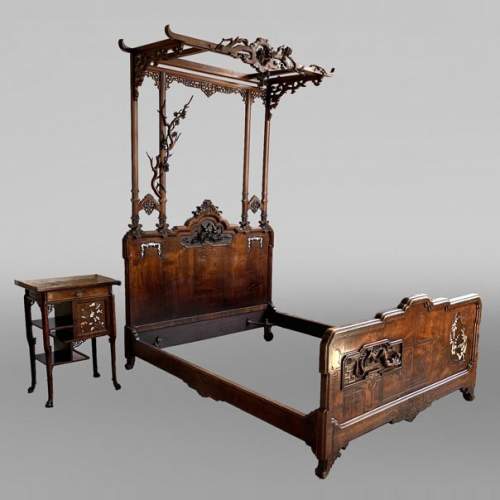
Gabriel VIARDOT, Japonist bed with a canopy and accompanying nightstand, second half of the 19th century
Nightstand : H. 81 cm / 31’’ 7/8 ; L. 59 cm / 23” 1/4 ; P. 38 cm / 14” 15/16
This set of a Japonist bed and nightstand was crafted by Gabriel Viardot in the second half of the 19th century. A talented wood sculptor, Gabriel Viardot opened a furniture workshop and store in Paris in 1853. In the 1870s, he decided to dedicate himself to “Chinese-Japanese style furniture”. He received prestigious awards at the Universal Exhibitions in Paris in 1878, 1889, and 1900, and won a gold medal at the International Exhibition in Antwerp in 1884.
The foot of the bed features carved ornamentation in low and very low relief, inspired by Far Eastern art: on the left, a dragon moves across a geometric structure that extends beyond the frame in which it is inscribed, while on the right, a second frame houses a delicate mother-of-pearl marquetry depicting a sakura (cherry blossom) branch, accompanied by a bas-relief sculpture of a flowering branch mirroring the dragon. The contours display ornamentation characteristic of the artist: the feet are adorned with geometric scrolls, while the top mimics the shape of a cloud.
The headboard is topped with two birds fluttering near a sakura branch, surmounted by cloud or smoke scrolls. On either side, there are panels inlaid with mother-of-pearl from the Far East. Four columns rise from the headboard, connected in pairs by an openwork design typical of Viardot’s style. On the left, a sakura branch seems to sprout from one of the two columns, first spreading between them, then into the central space, giving the piece a beautiful asymmetry.
The canopy is also adorned with openwork motifs. The two top beams curve upwards at each end to evoke the roof of pagodas. At the front, another blossoming cherry branch harmoniously integrates into the central openwork design.
The nightstand rests on four lion paws. It features asymmetrical open shelves reminiscent of Japanese “cha’dansu” (tea cabinets). One of these, covered with white marble on the inside, is closed by a lacquer panel, imported during that period to Europe. At the top, the small drawer, equipped with a decorative handle, displays an engraved bamboo leaf motif, while the sculpted tabletop is raised on one side and lowered on the other, a layout characteristic of the artist’s creations.
The nightstand is also signed, a rare occurrence in Viardot’s work, indicating the exceptional care he took in crafting this piece.
With this set, Gabriel Viardot follows one of the conventions of Japonism that developed in Europe from the 1870s: he adapts ornamentation inspired by Far Eastern art to an eminently European structure, as both the bed (especially when equipped with a canopy) and the nightstand are furniture pieces that do not exist in Far Eastern culture.
One of the drawings found in Viardot’s archives depicts a canopy bed very similar to this one; the posts of the canopy and their ornamentation are quite similar, as is the overall shape of the bed, and much of the ornamentation shows numerous similarities.