menu
Menu
account_box
Categories
Contact
email Send us a message

Contact

phone By phone

+33 (0)1 42 25 12 79
Tue.-Sat., from 10am to 6pm
+33 (0)6 60 62 61 90
Everyday from 9am to 7pm.

email by Email

Adress: contact@marcmaison.com

share Let's get social

Languages
And also...
My selection
(8 Objects)

My selection (8 Objects)


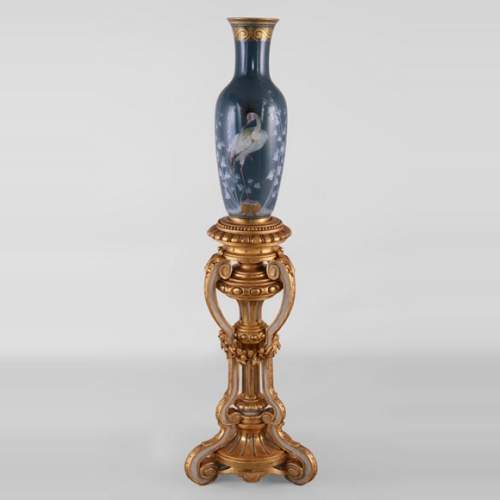
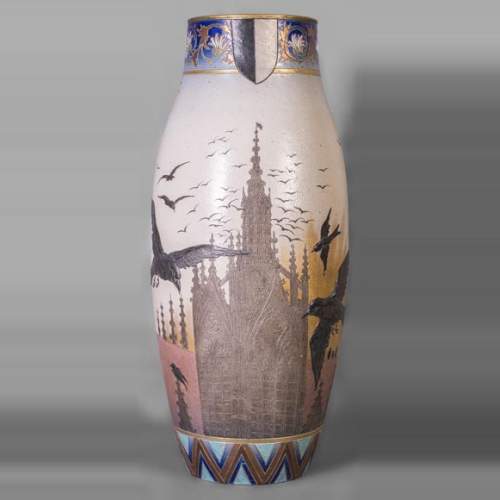
Albert DAMMOUSE and MANUFACTURE DE SEVRES - Important antique exhibition vase, "vase potiche  allongée" model, with ibis on its golden wooden pedestal

Ref.10647
Albert DAMMOUSE and MANUFACTURE DE SEVRES - Important antique exhibition vase, "vase potiche allongée" model, with ibis on its golden wooden pedestal

This important antique vase with an ibis on its golden wooden pedestal was made by the renowned French ceramist Albert Dammouse in 1873. There is the Manufacture de Sèvres’s seal. This vase is both emblematic of the period’s decorative arts and of Albert Dammouse’s works who was known for his dexterity in the material treatment as well as his qualities as decorator. Albert Dammouse, whose father was sculptor at the Manufacture de Sèvres, joins the École nationale des Arts décoratifs in 1863 before study from 1868 Milès Solon’s lessons, also decorator at the Manufacture de Sèvres, at the School of Fine Arts. In 1871, he moved to his own workshop in the city of Sèvres, next to the Manufacture, until his death in 1926. Albert Dammouse is interested in all the ceramics, but his porcelains have made first his reputation. In 1874, at the Union centrale des Arts Décoratifs, he exhibits porcelains and gets the gold medal. He won then a gold medal at the third Paris World’s Fair in 1878 and built ovens and workshops in Sèvres in order to produce more works. Although Dammouse has his own workshop some of his works, such as our vase, are the result of collaboration between Dammouse and the Manufacture de Sèvres. This is the model "elongated ovoid porcelaine vase" invented by Jules Peyre and used by many artists with sometimes some variations such as this Chinese Vase No. 1 entitled "Pécher", made around 1860 and decorated by Marc Emmanuel Louis Solon. Renowned throughout Europe, the Sèvres factory, where this vase was decorated, remains at the end of the century renowed for its technical and artistic savoir-faire even if industrialisation was growing.Notably, thanks to the discovery, in 1768, of the first kaolin field in France by Pierre-Joseph Macquer and Robert Millot, two researchers at the Manufacture de Sèvres, hard-paste porcelain (made up of nearly 75% of kaolin), whose manufacturing secret was kept by Saxony, is finally developed in France. With this discovery, the Manufacture de Sèvres is developing, particularly from the beginning of the 19th century. The productions are characterized by their modernity and the diversity of styles. While the pedestal is representative of the 19th century richness of ornamentation and eclectic revival of historic styles, the vase is characterized by a certain lightness and purity, aesthetic appeared with Japonism. Nature is one of the favorite themes of Japanese art, and the vase is decorated with an ibis and a shrub around wich birds are flying. Indeed, Japonism, which inspires Europeans arts in the second half of the century, is one of the principal inspiration in Dammouse’s works. With the various exchanges that took place between France and Japan from 1858, the year of the signing of a commercial treaty, and the contribution of the World's Fairs, true international encounters, the West discovers the Japanese art that provides to the artists some new patterns and a new and refine aesthetic. In 1873, year of the creation of this vase, takes place the first Japanese exhibition in Paris. The art dealer Siegfried Bing opens the store "Art Nouveau", rue de Provence, around 1872 and where Dammouse will be exposed. Later, Albert Dammouse, who was inspired especially by flora, will be one of the first, concerning ceramic, to create Art Nouveau style works of art . This vase, with its decorative and sophisticated look, belongs to the trends of its time. In the same vein, Ferdinand Mérigot is at the origin of the Japanese decoration that adorns this pair of vases made in 1868 and whose model is also Chinese Vase No. 1, variant of our form. The pedestal in golden wood, inspired by Napoléon III style, is ornated with rococo bows and acanthus leaves. This very elaborate pedestal was specially created to highlight the porcelain. The vase does not have a bottom: the bottom is pierced, and thanks to a system it is possible to fit the vase to the base. Thus deprived of any practical function but destined primarily to the decor, it seems certain that this vase participated in an exhibition. Although Dammouse was one of the artistes of the great trends of his time, Roger Marx, in his Paris World's Fair’s report in 1900, wrote with relevance : « no material that he treated with a sovereign skill, no trend that made him lose the notion of composed decor », qualities by which he was renowed. « Dammouse is a skilled ceramist, but is above all an artist », wrote the critic Georges Vogt in his Paris World's Fair’s report in 1900.

Dimensions:
Width: 43 cm
Height: 158 cm
Depth: 43 cm

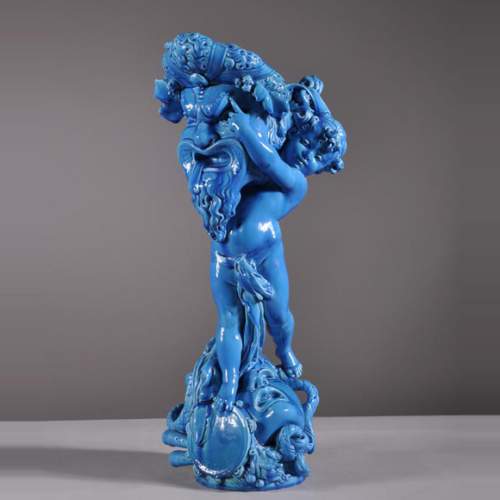
Joseph Chéret (1838 - 1894) for the Manufactory of Sèvres "Putto with greek masks" Coin tray made in faience with a blue glaze

Ref.15462
Joseph Chéret (1838 - 1894) for the Manufactory of Sèvres "Putto with greek masks" Coin tray made in faience with a blue glaze

This coin tray was made in blue glazed faience in the 19th century by the manufacture of Sèvres, after an artwork of Joseph Gustave Cheret (1838-1894). This sculpture represents a putto with two Greek comedy masks. The first one, sitting at its foot, is a woman's mask of a courtesan called 'pseudokoré'. The putto is holding the other one in his arms, it is the mask of a bearded man called 'pornoboskos'. The putto is partially covered with a drape. At his feet are severals musical instruments : a flute, some bells and a tambourine, with the signature 'Joseph Cheret Saw'. Another mark 'CH FICQUENET. - Sevres' is on the side. Cheret is an important sculptor of the 19th century. He was trained by the famous Carrier-Belleuse. This very gifted student eventually married one of the daughters of his mentor in 1868. From 1863 he regularly presented works in different Fairs and Exhibitions. We owe him the first salamander design, which he realized in collaboration with the Chaboche Company. This object is inspired by sculptures depicting putti or young satyrs having fun with Greek comedy masks. Very popular in the imperial Rome period, these images are experiencing a revival during the Renaissance and then in the 19th century during eclecticism. It is particularly representative of the 19th century taste, especially by its material: a blue glazed faience. At that time, ceramic techniques were very popular. This blue can be compared to 'Deck blue', used by Théodore Deck at the same time.

Dimensions:
Width: 25 cm
Height: 63 cm
Depth: 27 cm

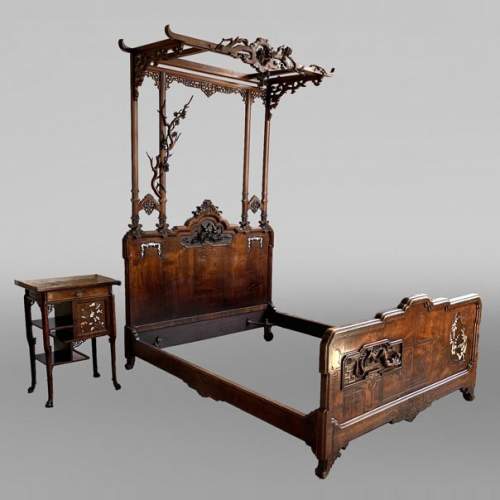
Gabriel VIARDOT, Japonist bed with a canopy and accompanying nightstand, second half of the 19th century

Ref.15445
Gabriel VIARDOT, Japonist bed with a canopy and accompanying nightstand, second half of the 19th century

Nightstand : H. 81 cm / 31’’ 7/8 ; L. 59 cm / 23” 1/4 ; P. 38 cm / 14” 15/16 This set of a Japonist bed and nightstand was crafted by Gabriel Viardot in the second half of the 19th century. A talented wood sculptor, Gabriel Viardot opened a furniture workshop and store in Paris in 1853. In the 1870s, he decided to dedicate himself to “Chinese-Japanese style furniture”. He received prestigious awards at the Universal Exhibitions in Paris in 1878, 1889, and 1900, and won a gold medal at the International Exhibition in Antwerp in 1884. The foot of the bed features carved ornamentation in low and very low relief, inspired by Far Eastern art: on the left, a dragon moves across a geometric structure that extends beyond the frame in which it is inscribed, while on the right, a second frame houses a delicate mother-of-pearl marquetry depicting a sakura (cherry blossom) branch, accompanied by a bas-relief sculpture of a flowering branch mirroring the dragon. The contours display ornamentation characteristic of the artist: the feet are adorned with geometric scrolls, while the top mimics the shape of a cloud. The headboard is topped with two birds fluttering near a sakura branch, surmounted by cloud or smoke scrolls. On either side, there are panels inlaid with mother-of-pearl from the Far East. Four columns rise from the headboard, connected in pairs by an openwork design typical of Viardot’s style. On the left, a sakura branch seems to sprout from one of the two columns, first spreading between them, then into the central space, giving the piece a beautiful asymmetry. The canopy is also adorned with openwork motifs. The two top beams curve upwards at each end to evoke the roof of pagodas. At the front, another blossoming cherry branch harmoniously integrates into the central openwork design. The nightstand rests on four lion paws. It features asymmetrical open shelves reminiscent of Japanese “cha’dansu” (tea cabinets). One of these, covered with white marble on the inside, is closed by a lacquer panel, imported during that period to Europe. At the top, the small drawer, equipped with a decorative handle, displays an engraved bamboo leaf motif, while the sculpted tabletop is raised on one side and lowered on the other, a layout characteristic of the artist’s creations. The nightstand is also signed, a rare occurrence in Viardot’s work, indicating the exceptional care he took in crafting this piece. With this set, Gabriel Viardot follows one of the conventions of Japonism that developed in Europe from the 1870s: he adapts ornamentation inspired by Far Eastern art to an eminently European structure, as both the bed (especially when equipped with a canopy) and the nightstand are furniture pieces that do not exist in Far Eastern culture. One of the drawings found in Viardot’s archives depicts a canopy bed very similar to this one; the posts of the canopy and their ornamentation are quite similar, as is the overall shape of the bed, and much of the ornamentation shows numerous similarities.

Dimensions:
Width: 159 cm
Height: 251 cm
Depth: 213 cm