menu
Menu
account_box
Categories
Contact
email Send us a message

Contact

phone By phone

+33 (0)1 42 25 12 79
Tue.-Sat., from 10am to 6pm
+33 (0)6 60 62 61 90
Everyday from 9am to 7pm.

email by Email

Adress: contact@marcmaison.com

share Let's get social

Languages
And also...
My selection
(19 Objects)

My selection (19 Objects)


Frédéric-Eugène PIAT (1827-1903) (model by) for Maison PERROT (bronze maker) - Elegant japonese-style inkwell with butterfly

Ref.11435
Frédéric-Eugène PIAT (1827-1903) (model by) for Maison PERROT (bronze maker) - Elegant japonese-style inkwell with butterfly

This model of Japanese-style inkwell and candle holder was created by Frédéric-Eugène Piat, sculptor and ornamental designer, for Maison Perrot in Paris, bronze manufacturer. Frédéric-Eugène Piat is famous for the extreme quality of his creations, especially for his works of art models in bronze that were executed by the greatest Parisian bronze makers of his time such as Marchand, Barbedienne, Denière, Boy or, as we have an example here, Maison Perrot. The Japanese decor on this inkwell is characteristic of the late 19th century, resulting from the discovery of the Far Eastern arts at the World’s Fair of 1867 held in Paris. The opening of Japan to the Western world then allows the creation of a naturalistic-inspired decorative repertoire in which stylized foliages mingle with a world of butterflies and birds. On this piece, a graceful butterfly, to which the very fine carving of the wings and the body gives an extremely realistic character, thus comes to land on a sinuous branch. This branch forms an elegant connection between the ink tank and that one of sand, which was used before the invention of the blotter to absorb the ink of the paper. These are treated as stylized fruits, whose flowers hatch on the lid's grip. These branches unfold on the base, bringing a great refinement to the composition. The body of the inkwell is made out of varnished metal of brown color imitating Japanese lacquers. This work belongs to the series of small objects that Eugène Piat designed for the Maison Perrot et fils, specialized in the production of "small bronzes". The dual use of this object, inkwell and candlestick, marks a real innovation. The Eugène Piat Museum in Troyes preserves two inkwells of the same model, one much more ornated than the other, which were given by Frédéric-Eugène Piat himself in 1894 at the foundation of the museum. The Catalog of the Troyes Museum, in 1897, describes one of these inkwells: « The body of this inkwell is in green bronze. It has the appearance of an oblong box, having rounded angles, and entwined with a leafy and blooming stalk. Two blooming flowers (located on the casket) encase the inkwells in their calices; two other flowers placed outside, on the two ends of the casket, are candlesticks, while a section of the stem serves as a handle for the drawer under the inkwells. » (Catalog, Decorative Art, Troyes Museum, 1897, No. 34, page 41). Born in 1827, Frédéric-Eugène Piat was 6 when his father, a carpenter, moved with his family to Paris. After an apprenticeship with a crew painter, the young Piat helped his father at his furniture factory. He quickly showed a taste and a skill for drawing, which led him to enter, in 1841, apprenticeship with an ornamental designer named Martin, who worked mainly for bronze manufacturers. Frédéric-Eugène Piat was to become one of the most active craftsmen in the new flourishing of French decorative arts. Inventiveness and an extraordinary faculty of creation are his main qualities. In 1843, Piat entered the workshop of a sculptor, Gossin, who had an important terracotta factory. In this workshop, Piat will perfect the control of his gesture, especially in modeling, and, at the end of the year 1845, he begins to execute industrial models alone. "Served by his reputation, his ease at composition, his already remarkable work power, the young Piat soon got orders. As early as 1849, he composed for the bronze manufacturers Denière, Graux-Marly, Boy, etc., clocks sets or andirons, which were successful. At the age of thirty, Eugène Piat was already famous. Manufacturers were competing for his models. (…) They were actively looking after Piat's collaboration because his dominant quality was that he knew how to make his models executable. He conceived decorative arrangements perfectly feasible in the material in which they had to be realized. His bronze flares looked like bronze. His wrought-iron andirons had the design that suited this metal. In a word, the artist's imagination complied with the multiple conditions of industrial production and went to the most difficult problems of execution to solve them with remarkable ingenuity. Such a mastery made the part Piat took in the development of the bronze industry all the more valuable. He became the appointed artist of the manufacturers, the one whose collaboration was most highly appreciated, especially when approaching the periods of universal exhibitions. (…) One of the most prominent bronze makers then was M. Marchand, who, to make a brilliant appearance at the London World's Fair in 1862, contracted the exclusive collaboration of Eugene Piat. The latter immediately began to work and executed, among other pieces, a monumental Neo-Greek fireplace, which may be considered one of his most important works. It was about six meters high and included marbles and polychrome bronzes. A statue of Minerva, in gilded bronze, was placed in the center, standing out against a background decorated with graceful drawings. (...) Unfortunately, this important work is lost. Shipped to a purchaser on a sinking ship, it now rests at the bottom of the sea. The years that followed were particularly well used. When the World’s Fair of 1867 arrived, it was a real triumph for our artist. Not only with Mr. Marchand, but with several other bronze manufacturers, he had created works in which the litheness and strength of his mature talent were visible. (...) The most brilliant period of the career of Eugene Piat, the one where his talent manifested with the most variety and the most power, is marked by the World’s Fair of 1878. " (Victor Champier in Musée de Troyes, Art décoratif (Musée Piat), Catalogue, 1897). The collaboration between Piat and Maison Perrot began especially on the occasion of the World’s Fair of 1878 since the major pieces presented by the bronze manufacturer are designed by Frédéric-Eugène Piat. One can easily imagine that it was in this artistically fertile period that this inkwell model was created. The catalog of the Troyes museum, published in 1897, mentions that the Japanese inkwells preserved there were made by the foundry Aubin and Leroux who exhibited at the World’s Fair of 1889, which is probably also the case for our inkwell.

Dimensions:
Width: 48 cm
Height: 19 cm
Depth: 17 cm

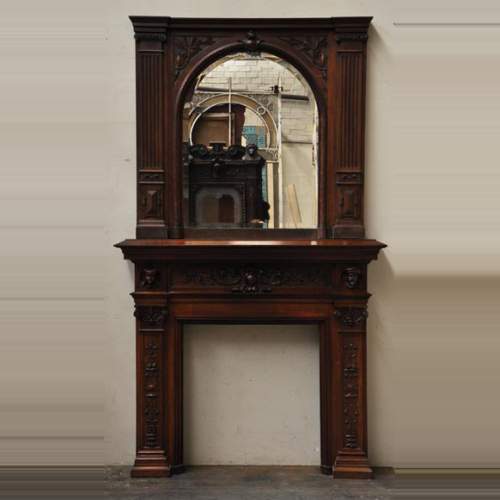
Remarkable and monumental Flemish Neo-Renaissance style fireplace, second half of the 19th century

Dimensions:
Width: 213 cm
Height: 204 cm
Depth: 70 cm
Inner width: 120 cm
Inner height: 150 cm

Louis XVI style mantel with curved flutes and carved capitals in highly veined Arabescato marble

Dimensions:
Width: 145 cm
Height: 111 cm
Depth: 40 cm
Inner width: 94 cm
Inner height: 86 cm

Louis XIV style mantel with acroterion in Rouge du Nord marble

Dimensions:
Width: 146 cm
Height: 115 cm
Depth: 35 cm
Inner width: 115 cm
Inner height: 87 cm

Louis XV period mantel in Rouge du Nord marble

Dimensions:
Width: 163 cm
Height: 108 cm
Depth: 30 cm
Inner width: 131 cm
Inner height: 86 cm

Louis XV style fireplace with floral palmette, in Arabescato marble

Dimensions:
Width: 155 cm
Height: 111 cm
Inner width: 116 cm
Inner height: 91 cm

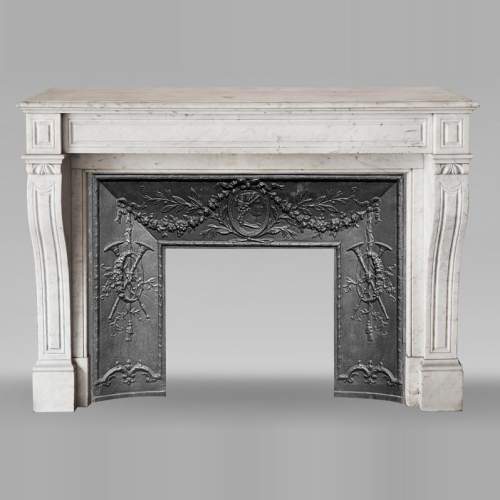
Beautiful Louis XVI style fireplace with very rich decoration, sculpted in Carrara marble

Ref.6050
Beautiful Louis XVI style fireplace with very rich decoration, sculpted in Carrara marble

This fireplace was crafted at the end of the 19th century in white Carrara marble. The material displays a fine grain and discreet grey veining. The overall design is in the Louis XVI style. The structure features a wide moulded shelf set on a straight entablature. The façade is arranged in three sections: a central frieze flanked by two long panels, and two console-shaped jambs resting on square bases. The opening is rectangular, framed by a simple surround that reveals a cast iron interior. The carved decoration is abundant and precise. At the centre of the frieze, a bouquet of flowers in high relief is tied with a ribbon; open blossoms, buds and small berries can be distinguished, each leaf treated individually. The side panels are animated with a regular scroll pattern: the volutes form medallions enclosing rosettes and small fruits, bordered by a string of pearls. Beneath the frieze, a central console (with leafy drop and small dentilled blocks) emphasises the axis. The jambs, shaped as consoles, are enriched with a long vertical panel: a vegetal drop with central braiding ending in a foliage motif at the bottom, while the top of each jamb bears a block decorated with a fleuron. The cast iron interior continues the vegetal vocabulary. The lintel carries a central trophy composed of a drum with its sticks, framed by branches tied with a ribbon. Each side panel shows a vertical motif of a stylised vase or bouquet placed on scrolls, within a beaded frame following the contour. On the floor, the rectangular hearth slab in white marble is decorated with three dark insets aligned across the front of the firebox, giving rhythm to the base. The ensemble combines classical order with rich floral decoration, characteristic of the revival of the Louis XVI style at the end of the 19th century.

Dimensions:
Width: 166 cm
Height: 115 cm
Depth: 45 cm
Inner width: 111 cm
Inner height: 83 cm

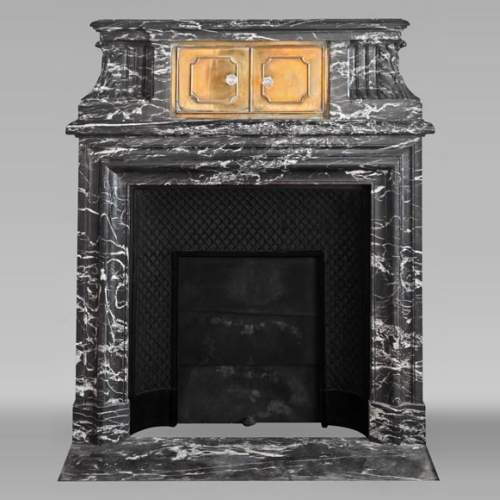
Louis XIV style fireplace in highly veined black Marquina marble

Dimensions:
Width: 135 cm
Height: 109 cm
Depth: 38 cm
Inner width: 96 cm
Inner height: 89 cm