menu
Menu
account_box
Categories
Contact
email Send us a message

Contact

phone By phone

+33 (0)1 42 25 12 79
Tue.-Sat., from 10am to 6pm
+33 (0)6 60 62 61 90
Everyday from 9am to 7pm.

email by Email

Adress: contact@marcmaison.com

share Let's get social

Languages
And also...
My selection
(44 Objects)

My selection (44 Objects)


Maison TAHAN and Julien-Nicolas RIVART (1802-1867) - Perfume box decorated  with porcelain marquetry

Ref.16684
Maison TAHAN and Julien-Nicolas RIVART (1802-1867) - Perfume box decorated with porcelain marquetry

Bibliography: Marc Maison and Emmanuelle Arnauld, Masterpices of Marquetry in the 19th century, Patents. Rivart, Cremer, Fourdinois, Kayser Sohn et Duvinage, Dijon, Faton, 2012, p. 45. This elegant perfume box, signed by the Maison Tahan , is a rare example of their collaboration with an artist outside the company. Decorated with gilt-bronze ornaments and porcelain marquetry panels, this piece is a fine example of the new technique of inlaid porcelain that Julien-Nicolas Rivart patented in 1849. In this process, each piece of porcelain is used as true marquetry where each element is independent. Rivart 's patent allowed him to retain exclusivity on this type of work and he was obviously closely involved with the box's fabrication. Rivart won awards for his porcelain marquetry on several occasions at international exhibitions, as this technique was highly esteemed for its great naturalism in reproducing flowers. In this example, the roses that decorate the lid of the box are executed in a range of elegant pastel tones that depict each petal with great precision while conveying the fragile quality of the flowers. The use of green-tinted resin for the delicate stems adds to the refinement and realistic look of the bouquet of flowers. The four small panels decorating the side panels continue the floral theme, a favorite device used by Rivart . Pansies, lilacs and rose leaves cover the surface of the wood, painted in delicate, monochrome tones of white and mauve. This technique, patented by Rivart in 1849, was described as a "delicious process" and won immediate and unanimous praise for the charming quality of these decorations in porcelain marquetry, as well as for the originality of his technique. Rivart was critically acclaimed at the World's Fairs where he won several medals, thus leading him to further develop this type of ornamentation until his death, in 1867. For more than twenty years, Rivart was the only one to create works using this technique, a fact that explains the rarity of this type of production. There is no signature of the painted inlaid flowers; however, it is possible to attribute the work to Pierre-Joseph Guérou , a painter who worked at the Sèvres factory in 1847 and 1848 and whose signature appears on several pieces of furniture made by Rivart , such as the jewel cabinet at the Château de Compiègne. When looking at the delicacy and naturalism of porcelain marquetry, we too can experience the feelings described by the commentators at the International Exhibition when they enthusiastically wrote: "one cannot help but admire the graceful richness of these inlaid painted porcelain flowers" (Paris en 1855, journal de l'exposition générale…, May 27, 1855). The origins of the Maison Tahan go back to Belgium at the beginning of the 19th century when Pierre Lambert Tahan founded a workshop that produced small tabletry objects using wood from the resort town of Spa, the small village in the Ardennes. Pierre Lambert decided to leave Spa shortly before 1806 to set up shop in the Temple area of Paris. He worked there as a cabinetmaker and also produced nécessaire boxes. In 1825, Pierre Lambert and his son, Jean Pierre Alexandre, ran two factories producing these same types of wares. In 1844, Pierre Lambert Tahan retired and left the direction of the company to his son who would completely reorganize the business by separating the factory from the shop, located at number 32 rue de la Paix. A year later, he was already known as a "Supplier to the King and Princes". In 1855, he held the title of "Supplier to the Emperor" which allows us to date this perfume box to after that time. The Court gave him a great number of commissions for bookcases, tables, pedestal tables and nécessaires. Pierre Alexandre Tahan participated in the great international exhibitions of his time. It was at the International Exhibition of 1855, in Paris, that he showed an extraordinary aviary in walnut sculpted with leaves and birds in flight.

Dimensions:
Width: 43 cm
Height: 24 cm
Depth: 33 cm

Maison MARNYHAC (att. to) - Antique Chinese style firescreen in brown patina bronze, second half of the 19th century

Ref.10497
Maison MARNYHAC (att. to) - Antique Chinese style firescreen in brown patina bronze, second half of the 19th century

This rare Chinese antique firescreen was made during the second half of the 19th century. This firescreen is attributed to the Maison Marnyhac, specialized in the creation of luxury art object and whose a part was imbued with the chinese and japonizing vogue, beacause of the the quality of the bronze and its beautiful perforated decoration, as well as the style of it, Maison Marnyhac is the commercial name of a society of bronzes and furniture called Society of Marbles and Artistic Bronzes founded by Charles de Marnyhac and located in Paris Avenue de l’Opera before move to 1, rue de la Paix. She competed with the greatest workshopes of the time, Barbedienne in particular, and the quality of its productions was rewarded during the World Fairs of 1867 and 1878 where Maison Marnyhac won medals. Thanks to his fame, Charles de Marnyhac opened an exhibition in 1875 in London. It closed its doors around 1910. « In summary, and I conclude on this appreciation of which I am ready to assume all the responsibility, the exhibition of the Maison Marnyhac clearly demonstrated to me that Paris has two Barbedienne, that is to say two art industrialists and the whole of Europe can not oppose other equals personalities. This demonstration was worth a medal of honor; what do you think? » Emile de Bergerat, Les Chefs d'oeuvre d'art à l'Exposition Universelle de 1878, Paris, L. Baschet, 1878, p, 188. The brown patina bronze decor is very complex and elaborate.The curved frame is richly decorated with volutes and perforated decorations which look like signs inspired by Chinese calligraphy. At the center, on a red bright fabric highlighting the bronze, is represented under a typical architecture a man with a stern look, surely the Emperor, surrounded by his impassible guardians and his subjects, who, on their knees, prostrate themselves behind him. One of them, however, stands and raises his arms to the Emperor, like a prayer. A phoenix and two chimeras whose iconography is close to the dragons encircle the scene. The feet of the firescreen too take the form of monstrous creatures approaching the iconography of the Foo dog. This attraction for chinoiseries begins in Europe as early as the 14th century and grows especially from the 18th century. Thanks to the eclecticism and the Orientalism during the nineteenth century, Chinese art still has a great success incited by the World expositions. It is during the one in 1867 that European artists have the opportunity to visit the Chinese and the Japanese pavilions that give a breath of fresh air to this exotic inspiration. From then on, painters, decorators and architects will create an eclectic wave, both Japanese-inspired and / or Chinese, which will satisfy the taste for the curiosities and the eccentricities of the 19th century.

Dimensions:
Width: 73 cm
Height: 83 cm
Depth: 37 cm

CARRIER-BELLEUSE Louis et Manufacture de CHOISY LE ROI, "Every man for himself"!

Ref.17257
CARRIER-BELLEUSE Louis et Manufacture de CHOISY LE ROI, "Every man for himself"!

Glazed red and white faience. Another example, presented at the Salon de la Société Nationale des Beaux-Arts, in 1898, and numbered 4060, was shown with three other vases: Hercules and Omphale, Children with Butterflies (in the collection of the Petit Palais, Paris), and Music. Resting on a square base, this pair of vases is decorated with a group of putti who encircle its lower section. These children, who look frightened, run in all directions, seemingly to escape some imminent danger. The ceramicist, who carefully studied how he was going to present the figures, succeeded by placing each one in a different position: some are running with outstretched arms; some are on the ground, probably having fallen on their terrified flight; still others look upward in a quest to understand the cause of their anguish: the two winged demons placed on either side of the top of the vase. These two small monsters are finished with a greenish glaze that gives them a hideous appearance. The title of the work, “Every man for himself!” is written twice on the underside of the vase and explains the iconography. The children, who sense they are in danger, attempt to escape as quickly as possible.     Louis Carrier-Belleuse first showed these vases in a plaster version at the Salon de la Société Nationale des Beaux-Arts of 1896. They then reappeared at the Salon of 1898, this time in stoneware, with three other vases that formed a series: Hercules and Omphale, Children with Butterflies and Music. It was on this occasion, in 1900, that the vase was illustrated in the review La Décoration ancienne et moderne.     Son and pupil of the sculptor Albert-Ernest Carrier-Belleuse (1824-1887), Louis Carrier-Belleuse studied with Gustave Boulanger and Alexandre Cabanel at the Beaux-Arts academy. He began his career as a painter at the Salon of 1870 and started exhibiting his sculpture in 1889. Early on, he became interested in the industrial arts: for several years, he worked at the Sèvres factory with his father who had been the artistic director since 1875. Then, in 1877, thanks to Théodore Deck, he acquired his first training as a ceramicist, an experience that would determine the path he would eventually pursue: he became the artistic director of the Choisy-le-Roi faience manufactory. He created numerous models for them and often won awards, notably a medal in 1896, the year he showed the plaster version of “Every man for himself!”.    As artistic director of the Choisy-le-Roi faience manufactory, he designed numerous models of the highest quality, including this pair of vases, which is an exceptional example of his artistry. 

Dimensions:
Height: 51 cm

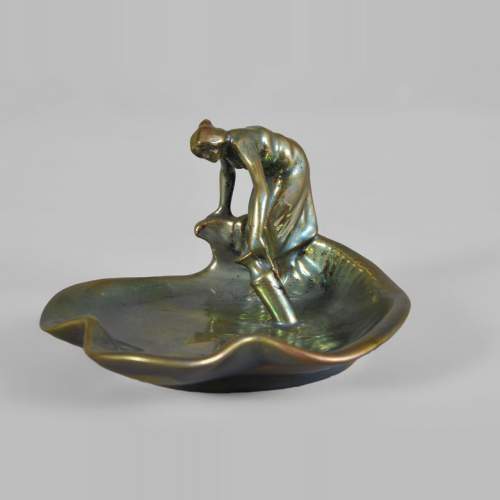
ZSOLNAY Manufacture - "Young woman at the source", vide poche in iridescent ceramic

Ref.18458
ZSOLNAY Manufacture - "Young woman at the source", vide poche in iridescent ceramic

This Art Nouveau style vide-poche (storage tray) made of iridescent ceramic is from approximately 1900 and signed “Zsolnay Pecs Made in Hungary.” A female figure is leaning down with a jar to collect water. The object's asymmetrical shape, curved outlines, and iridescent ceramic translate the movement, texture, and blueish-green colors of the water. This colorful and original vide-poche belongs to the Art Nouveau movement, an artistic movement from the beginning of the 20th century that wanted to break away from traditional forms and historicist styles from the 19th century. The defenders of the Art Nouveau movement wished to create an art form that included both modernity and a return to nature and its symbols. This vide-poche's modernity is brought by the shine and colors of the iridescent ceramic, and by the object's simple outlines. It also has a very organic, natural side to it, as every aspect helps to recreate the water that the female figure is collecting. As the stamp on the bottom says, this object is from the Zsolnay Factory, a Hungarian ceramics factory founded in 1851 by the merchant Miklos Zsolnay. It first produced simple, useful objects, and in 1865, when Vilmos Zsolnay, Miklos' brother, took over the company, it began creating decorative dishware. It exhibited faience at the World's Fair of 1878 in Paris and obtained a Grand Prize. From the 1890's, the factory also produced architectural ceramics.

Dimensions:
Width: 14 cm
Height: 14 cm
Depth: 9 cm

Musgrave & Co mannheim - Enameled cast iron stove adorned with views of important buildings in the Palatinate, Germany, circa 1900

Ref.4766
Musgrave & Co mannheim - Enameled cast iron stove adorned with views of important buildings in the Palatinate, Germany, circa 1900

This original Art Nouveau style enameled cast iron stove is a German work of the company Musgrave & Co dating from the beginning of the 20th century. Product of the industrial revolution, Musgrave & Co. was an Irish company making stoves located in Belfast. Founded in the mid 1840’s as a hardware merchant, it quickly develops a patent on the stove with slow combustion adapted to barns. In 1899, the brand was became widely known and a second factory was built in Mannheim, in Germany, with added exhibition rooms in Paris and Frankfort. Not only has settled and furnished the heat system for the Impress Frederic of Germany’s stables, but also for the King of Spain, and many British lords. Germany had a particularly enthusiast clientele for the very decorative stoves models as ours, it was also the only country in which they were sold. The decoration of our stove pays tribute to the Palatinate region as indicates the inscription «  Fröhlich Pfalz Gott erhalt's » literally meaning Happy Palatinate God saves it, through representation of emblematic monuments of the region. Indeed, we can recognize on the main side, the Speyer Cathedral, built in 1030 by Conrad II (v.990-1039) today registered in the UNESCO World Heritage sites. Also, it is the biggest Roman cathedral of the world. On the right side, is depicted the Godesburg castle, built in the 13th century on a volcanic hill and partially destroyed after the 1583 siege in the beginning of the Cologne War. Finally, we can see on the left side the Tower of Andernach, defensive tower built between 1440 and 1453.

Dimensions:
Width: 40 cm
Height: 110 cm
Depth: 51 cm

Rocaille style composite stone garden furniture

Dimensions:
Width: 160 cm
Height: 74 cm
Depth: 98 cm

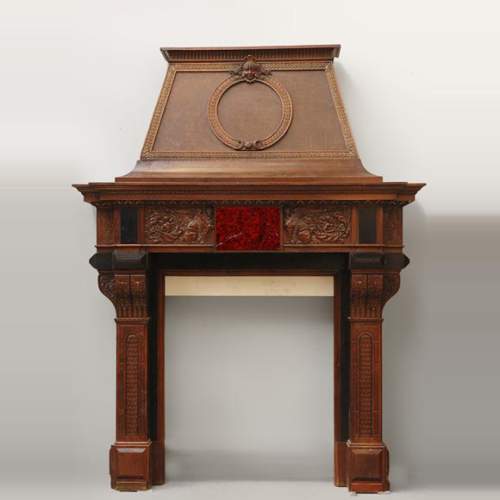
Important Neo-Renaissance syle mantel carved in walnut wood and oak

Dimensions:
Width: 234 cm
Height: 334 cm
Depth: 98 cm
Inner width: 83 cm
Inner height: 75 cm

After Philippe MAGNIER, after the antique, The Wrestlers

Ref.15976
After Philippe MAGNIER, after the antique, The Wrestlers

This bronze was made after the antique The Wrestlers by Philippe Magnier (1648-1715) between 1884 and 1888, based on a plaster cast from the antique preserved in the Uffizi Gallery, in Florence. It depicts two wrestlers or pancratiasts in action: one holds his opponent on the ground using his legs, while twisting his arm with one hand; the other, with his body folded over to the extreme, tries to resist the pressure exerted on him by his opponent; his face reveals effort and suffering, while maintaining classical perfection of features. The bulging muscles of the fighters demonstrate a precise study of human anatomy by the artist and a desire to accurately represent the sport, starting from Antiquity. The antique sculpture The Wrestlers, probably inspired by a now-lost Greek bronze, was discovered near Rome in 1583. It reminds us that pankration is a Greek combat sport, practiced during the ancient Olympic Games, which allowed the opponents great freedom in their attacks. This sport was practiced nude, as shown in this representation. In the 1680s, at a time when copies of antiques and modern commissions populated the king’s groves, a marble statue after the antique was commissioned by the royal administration from Philippe Magnier for the gardens of Versailles. The sculpture was placed in the park of the Château de Marly in the 1690s, where it remained until the Revolution. Numerous bronze casts were executed from Magnier’s marble in France in the 19th century. This medium, which gives an enhanced naturalistic impression compared to white marble, highlights the athletes' musculature. This bronze is thus emblematic of the enthusiasm generated by this representation of two wrestlers from its rediscovery during the Renaissance until the 19th century.
Dimensions:
Width: 28 cm
Height: 43 cm
Depth: 43 cm

Gabriel VIARDOT (1830-1901) – Japanese-style fireplace in stained sycamore wood, topped with a dragon and an imposing circular mirror

Ref.6100
Gabriel VIARDOT (1830-1901) – Japanese-style fireplace in stained sycamore wood, topped with a dragon and an imposing circular mirror

A talented wood sculptor, Gabriel Viardot opened a furniture factory and store in Paris in 1853. In the 1870s, he decided to dedicate himself to Japanese-style furniture. Participating in the numerous exhibitions that marked the art scene of the second half of the 19th century, each of his contributions was met with success. He won a silver medal at the Universal Exhibitions of 1878, 1885, and 1889, and then a gold medal at the Universal Exhibition of 1900. Measuring 261.5 cm in height and 160.5 cm in width, this fireplace is among the cabinetmaker's most imposing creations. The design of our fireplace is particularly original in that it is based on the complementary superposition of a circular mirror and a rectangular firebox. Technically and artistically, the creation of such a piece is a tour de force. The jambs are each adorned with a rampant dragon whose menacing heads are turned outwards. Their contorted bodies form an "S" shape, and their claws are firmly anchored in the wood. The lintel is richly decorated with geometric motifs typical of Japonisme and features a medallion adorned with flowers at its center. Evoking the overhanging roofs of Japanese temples, the lintel's projecting ends are slightly curved inwards. The upper part of the fireplace is remarkably complex. In the center, a secondary structure replicates the same notched profile as the lintel, and Viardot adds exquisitely openwork spandrels. At the top of this pagoda-like structure, a dragon with its mouth slightly open looms over the composition with a menacing air. The use of stained sycamore allows for a high degree of finish, particularly noticeable in the rendering of musculature and details. Set back against the wall, an imposing circular mirror defines the visual balance of the ensemble. The wooden crossbars that span it serve as a pretext for ornamentation: thus segmented, the different sections of the mirror act as a changing backdrop to this Japanese-inspired fantasy where plants and abstract geometric forms mingle. In 1887, the Revue des Arts Décoratifs praised Gabriel Viardot's work: "Inspired by Chinese and Japanese art, these pieces of furniture, adapted to European tastes, are far superior in craftsmanship to the originals, which most often have only decorative value and whose joinery is almost always defective; this adaptation is very interesting, for Mr. Viardot knows how to give his furniture a special character, while retaining the Asian style." » The fireplace attributed to Gabriel Viardot, which was sold in New York in 2013 (Christie’s, New York, April 18, 2013, lot 13), does not include a mirror and features a design and treatment of detail particularly close to our example.
Dimensions:
Width: 180 cm
Height: 265 cm
Depth: 44 cm