menu
Menu
account_box
Categories
Contact
email Send us a message

Contact

phone By phone

+33 (0)1 42 25 12 79
Tue.-Sat., from 10am to 6pm
+33 (0)6 60 62 61 90
Everyday from 9am to 7pm.

email by Email

Adress: contact@marcmaison.com

share Let's get social

Languages
And also...
My selection
(29 Objects)

My selection (29 Objects)


Théodore DECK (ceramist) and Anthony Ludovic REGNIER (painter) - Ceramic dish glazed with tiger lily and butterfly on a blue background

Ref.11594
Théodore DECK (ceramist) and Anthony Ludovic REGNIER (painter) - Ceramic dish glazed with tiger lily and butterfly on a blue background

This glazed ceramic dish was made in the workshop of the ceramist Théodore Deck (1823-1891) and painted by Anthony Ludovic Régnier (1851-1930) in 1881. It is signed in the decor "A. L. REGNIER" and dated in "1881". In the back, it wears the mark "TH. Deck" ; it is entitled "LIS TIGRE" and bears the number "160". Théodore Deck initially trained as a stove maker. When he set up in Paris on his own account in 1858, he made stove linings and then, on the strength of his success, moved into ceramics. The studio produced many dishes in collaboration with well-known painters, including Anthony Ludovic Régnier. Deck gradually perfected his technique and enjoyed great success at the many World’s Fairs he took part in. In 1878, he was made an Officer of the Légion d'Honneur. He ran the Sèvres factory between 1887 and his death in 1891. Anthony Ludovic Régnier was a prolific artist from the workshop of Théodore Deck, specialising in flower paintings. He is otherwise little known. The painter's mastery is evident in his particularly precise and detailed depiction of the tiger lily, whose flowers are in various stages of bloom. A bindweed flower curls around its stem, adding complexity to the pattern. A butterfly flutters around the lily, as does a small yellow and black striped insect. This work is a fine example of the Japonism that swept through European art from the 1870s until the early years of the 20th century, and which particularly influenced Théodore Deck, a collector of Far Eastern art. The Musée des Arts décoratifs, de la Faïence et de la Mode in Marseille has a dish with daturas and nasturtiums by Deck, decorated by Régnier. The different flowers give the decoration great variety.

Napoleon III set clock in gilt bronze and onyx, circa 1860

Ref.12004
Napoleon III set clock in gilt bronze and onyx, circa 1860

This beautiful set clock made in Algeria onyx marble depicting a rich gilt bronze decoration is a work made in the 1860's. Its eclectic style is typical of the decorative art production under the reign of Napoleon III. The central element of the set clock, the clock, depicts an onyx structure on wich are taking place numerous decorative elements, all in gilt bronze, starting with the top feet. On the base, some little chiseled fleur-de-lis brighten up the decoration while above, two putti in high-relief frame a hive from where they are picking up the honey with their hands. This triangular composition is surmounted by the clock dial, and framed with slim flowers garlands depicting a very precise chisel work. A vase full of flowers and welcoming birds crowns this delicate but rich whole. The mecanism is accessible on the back of the clock. The candelabrum framing the clock are also made with of onyx mounted and garnished with bronze. Shaped as baluster, they also lay on top feet. On the upper part, seven light arms in gilt bronze are adorned, from the arm base to the bobech with acanthus leaves. The sirens decoration that is adorning the belly of the baluster reminds of the decorative vocalubary of the reign of Louis XIV ande the Regence, composed of flowers garlands and arabesques derived from the Renaissance grotesques. The Algeria onyx marble is a stunning stone, looked after for its transparence wich puts it between the marble and the alabaster. We find it in different shades - white, yellow, red or green. Used during the Ancient time, we have to wait until 1849 for the quarry to be discover again in Aïn Tembalek in the Oran region. Quickly, the exploitation rights fall into the hands of the Société Alphonse Pallu & cie, they transport the raw material from Algeria to the Paris factory where the stone is then debited to make every sort of little objects or archtitectural elements. The company owns also its own bronze workshop to create the mounts. The material wins a huge sucess during the Exposition des Produits d'Algérie in the Palais de l'Industrie in 1860, the in the International Exhibition in 1862 in London during which the Pallu company wins a silver medal. One of the most emblematic construction site of the Algeria marble onyx rise under the Second Empire is the one in Païva hotel, where it has been largely used to create the interior decoration.

Dimensions:
Width: 32 cm
Height: 46 cm
Depth: 17 cm

GUERET Frères - Splendid oak chest richly sculpted with a forest animal decoration

Ref.13660
GUERET Frères - Splendid oak chest richly sculpted with a forest animal decoration

This splendid chest was made of oak by the Guéret brothers in the 1870. The sculpture work is truly remarkable and shows the virtuosity of its creator who makes a decor on the forest theme in which we can see a fox, a pheasant or even a bird with its wings spread out on the top, in a rocks and tree decoration. Denis-Désiré (born in 1828) and Onésime Guéret (born in 1830) create a factory of sculpted furniture in 1852 or 1853 at 7 rue Buffault in Paris under the name "Guéret Frères". Ten years later, the store is moved at 5 boulevard de la Madeleine, then at 216 rue Lafayette where it stays until the definitive closure. From 1877, the factory is managed by the youngest brother and becomes "Guéret Jeune et Cie", its activity continues until the end of the 19 th century.The Guéret brothers participate to each exhibitions from 1855, win a lot of rewards and acritic always eulogistic,like the one published in the Art Journal, about the InternationalExhibition of 1878 : “M. Gueret, a renowned cabinet-maker of Paris, contributed to theExhibition a large number of admirable works, designed with rare Art power, and executed with refined delicacy, in various woods – generally in satin-wood inlaid – all possessing thorough artistic merit”. The excellency of their work for the sculpted furniture making,often rewarded, increases their orders book. Rich bourgeois but also renowned personalities such as the Duke of Aumale, Napoléon III or even Mr Bryce, buyers of these sumptuous furniture, made some orders. Mr Bryce, for instance, ordered the realization of his whole furniture for his mansion on avenue Gabriel in Paris.

Dimensions:
Width: 42 cm
Height: 33 cm
Depth: 32 cm

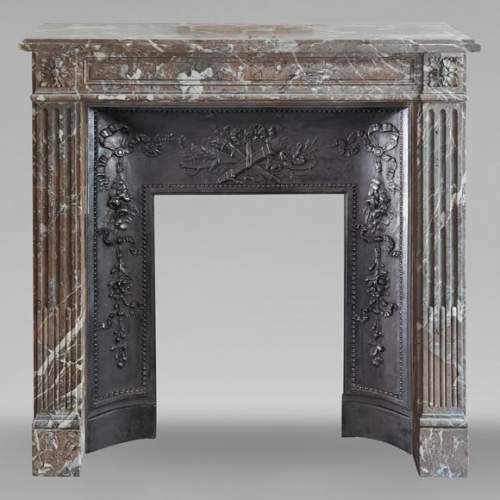
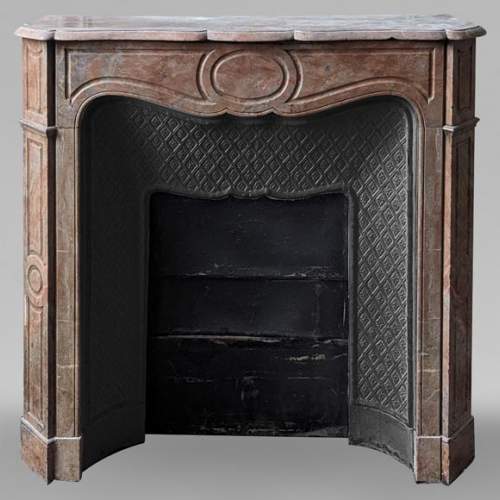
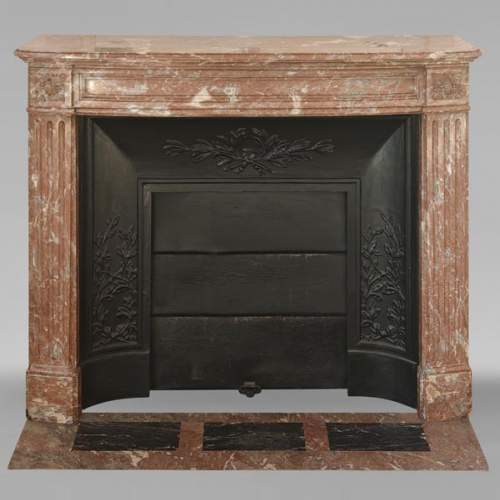
Louis XV style mantel with rich décor of shells and volutes in Griotte marble

Dimensions:
Width: 150 cm
Height: 107 cm
Depth: 46 cm
Inner width: 110 cm
Inner height: 81 cm

Albert ANKER (painter), Théodore DECK (ceramist), Ornamental Dish “Cleopatra”, 1869

Ref.14204
Albert ANKER (painter), Théodore DECK (ceramist), Ornamental Dish “Cleopatra”, 1869

This ornamental dish, adorned with a design inspired by Egyptian art and executed in 1869, is the result of the long-term collaboration between Albert Anker and Théodore Deck. The Swiss painter Albert Anker (1831-1910) joined the École des Beaux-Arts in Paris in 1855. He collaborated with Théodore Deck between 1866 and 1892 and excelled in the genre of historical portraiture, to which this work is closely related. Théodore Deck initially trained in stove manufacturing. When he established his own business in Paris in 1858, he specialized in stove coverings before expanding into ceramics due to his growing success. The workshop produced numerous plates, sometimes in collaboration with renowned painters, including Edmond Lachenal. Deck gradually perfected his technique and enjoyed significant acclaim at the many World’s Fairs in which he participated. In 1878, he was made an Officer of the Legion of Honor. He directed the Sèvres porcelain manufactory from 1887 until his death in 1891. This plate is decorated with the portrait of a woman bearing the attributes of ancient Egyptian nobility: she wears a vulture headdress, a symbol of the goddess Nekhbet, the tutelary figure of Upper Egypt and protector of the pharaohs, along with a broad usekh collar. The figure represents the famous Egyptian queen Cleopatra, depicted as on one of the bas-reliefs in the Temple of Hathor at Dendera (50-55 B.C.E.). The rim of the dish also features an Egypt-inspired style, with four scenes drawn from temple and tomb art interspersed with hieroglyphic inscriptions. Through its theme and adopted style, this plate reflects the passion for ancient Egypt that swept through the 19th century. The two artists produced several versions of this plate: one is housed in the Gustav-Lübcke Museum in Hamm, Germany; a second in the Kunstmuseum in Bern, Switzerland; and a third, with a slightly different border, in the Théodore Deck and Florival Museum in Guebwiller, France. Our ornamental plate can also be compared to an Assyrian-Inspired Dish created by the same artists a year later, now preserved in the Musée d’Orsay in Paris. For Albert Anker and Théodore Deck, Egyptomania drew on precise archaeological sources, seamlessly integrated into a harmonious contemporary design.

Dimensions:
Width: 33 cm
Height: 5 cm
Depth: 33 cm

Napoleon III style fireplace in sculpted stone, with plant decoration

Dimensions:
Width: 148 cm
Height: 105 cm
Depth: 64 cm
Inner width: 108 cm
Inner height: 85 cm

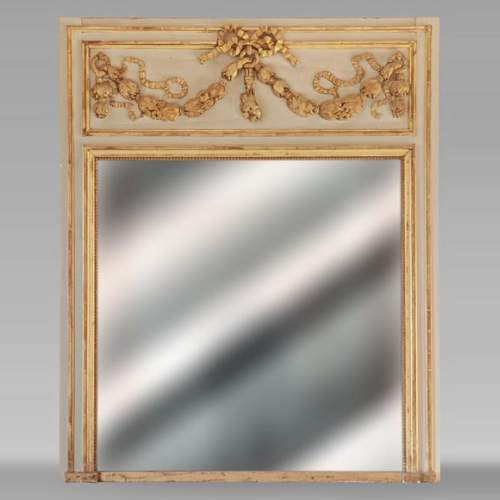
Louis XVI style gilded trumeau topped with a knotted ribbon

Dimensions:
Width: 109 cm
Height: 169 cm
Depth: 20 cm
Inner height: 159 cm

Napoleon III period fireplace with lion's paw feet, in Carrara marble

Dimensions:
Width: 158 cm
Height: 110 cm
Depth: 50 cm
Inner width: 116 cm
Inner height: 81 cm