menu
Menu
account_box
Categories
Contact
email Send us a message

Contact

phone By phone

+33 (0)1 42 25 12 79
Tue.-Sat., from 10am to 6pm
+33 (0)6 60 62 61 90
Everyday from 9am to 7pm.

email by Email

Adress: contact@marcmaison.com

share Let's get social

Languages
And also...
My selection
(25 Objects)

My selection (25 Objects)


Exceptional large clock with the Fô dogs

Ref.03222
Exceptional large clock with the Fô dogs

Brown patina bronze, the base in Red Griotte marble. This magnificent clock was made in France around 1880 out of authentically Chinese bronzes. Two large Foo Dogs, made in China at the start of the 19th century, stand on their hind legs, and support the pendulum with their forelimbs. The pendulum mechanism sits inside a Chinese bronze vase that was specifically cut at its base and reused to make up the body of this clock. It is decorated all over its surface with engraved ornaments. Two dragons carved in relief are placed on the front of this vase and surround the clock's dial. On the back, there is a cockerel with its wings spread, with its head carved in relief. The extremely high quality bronze and the very skilful use of composition makes this clock very original. This clock is typical of a technique that was popular towards the end of the 19th century, which derived from a profound taste in the Far East. This technique involved reusing authentically Chinese elements on European designed objects, which were intended to be used on the most luxurious interiors. The clock's magnificence makes us reflect on the fact that it was made by a true amateur of Chinese Art. The dial's numerals are made out of enamel and are true Chinese numerals. The clock hands feature a dragon which is the result of excellent chiselling skill. These different elements are of French craftsmanship, as is the pendulum featuring an animal with tentacles. The pendulum is signed “ L.M et Cie, Médaille de bronze” (L.M and Cie, Bronze Medal), which confirms that it is off French craftsmanship and was made around 1880.

Dimensions:
Width: 81 cm
Height: 72 cm
Depth: 17 cm

Trumeau of Louis XVI style

Dimensions:
Width: 53 cm
Height: 198 cm
Depth: 6 cm

Rare pair of winged lions, cast iron, 19th century

Ref.12723
Rare pair of winged lions, cast iron, 19th century

Although called "griffins" by the artist and in the foundry's catalogue, they are rather a pair of winged lions, as evidenced by the absence of bird beaks, in cast iron and made by the Ducel or Val d'Osne foundry at the end of the 19th century after a model by Eugène-Louis Lequesne. Le Monde illustré, 18 juillet 1863, pp. 13-16. Initially designed to be part of the decoration of the current Musée de Picardie in Amiens as part of the project for the exterior and interior decoration of the museum by the architect Arthur Diet, these two winged lions, known as "griffins", were commissioned in 1861 by Diet to the sculptor Eugène-Louis Lequesne. In a letter from the architect dated 31 December 1861 addressed to a commission, Diet specified that E. Lequesne: "will make a sketch of them but on condition that these animals (be made) after the antique. If we wanted animals copied from nature, he would not interfere". On 8 February 1861, Lequesne submitted his model, which he exhibits at the 1863 Salon. These "griffins" were drawn by Lequesne after the antique and were included in the catalogue of the Ducel or Val d'Osne foundry at the end of the 19th century. Very popular, this model was delivered in several countries as orders for monuments or outdoor decorations were received. This model can be found in two of the foundry's catalogues : Ducel Val d’Osne catalogue, Folio 405 – Plate 238, N° 10613 and N° 10613 bis. Eugène-Louis Lequesne (1815-1887) was a French sculptor, student of James Pradier, he exhibited his work at the Salon from 1842. He was awarded of the First Prize of Rome in 1844 and had already won second place in 1843. Brilliant sculptor, he was nominated as knight of the Legion of Honour in 1855 and regularly exhibited his work at the Salon, including the model for our sculptures. Many of his works, including the famous "Dancing Faun", adorn public spaces. The figure of the winged lion dates back to the ancient period. This period provided famous examples such as the "Winged Lion of Vulci" from the Etruscan civilisation. In the ancient Greco-Roman world, from which the models that inspired Lequesne were made, artistic representations of the lion were very frequently associated with the figure of the guardian, both of the world of the living and dead. This pair of winged lions is associated with the 19th century taste for both Antiquity and representations of the fantastic. Other sculptors of Lequesne's time produced similar sculptures, such as the chimeras of Henri-Alfred Jacquemart or the statue of the winged lion by Auguste-Nicolas Cain. Comparison work : Henri-Alfred Jacquemart, Chimère ailée, fontaine Saint-Michel, Paris, France, 1858-1860. Other international exemple of « griffins » by Val d’Osne foundry : Town Square Fountain, Leicester, United Kingdom.

Dimensions:
Width: 49 cm
Height: 89 cm
Depth: 88 cm

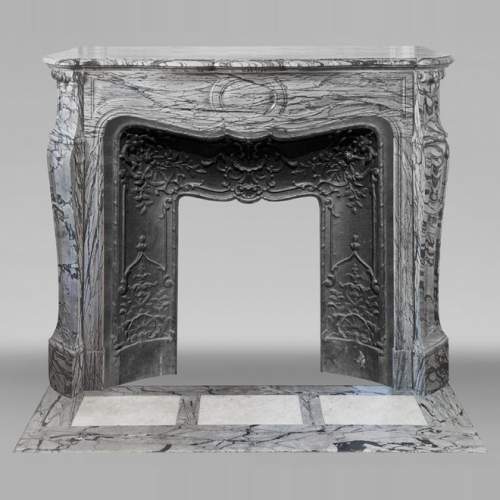
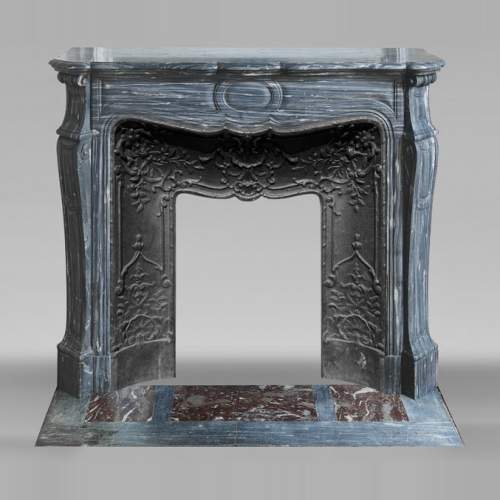
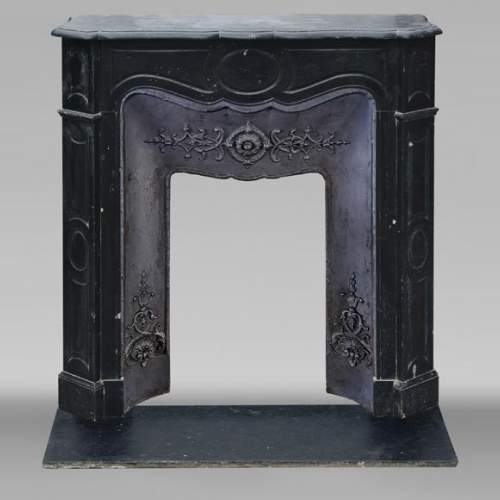
Louis XV style Pompadour mantel in Enjugerais marble

Dimensions:
Width: 109 cm
Height: 101 cm
Depth: 40 cm
Inner width: 73 cm
Inner height: 84 cm

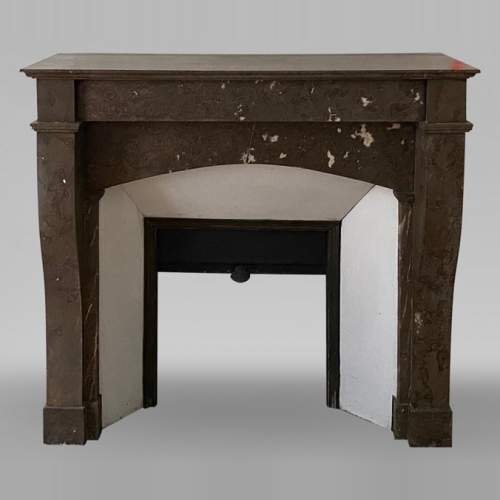
Louis XIV style mantel carved in Breche Sanguine

Dimensions:
Width: 136 cm
Height: 111 cm
Depth: 38 cm
Inner width: 98 cm
Inner height: 90 cm

Jules CANTINI, Large Urn in Numidia Red Breccia Marble,second half of the 19th century

Ref.15300
Jules CANTINI, Large Urn in Numidia Red Breccia Marble,second half of the 19th century

This vase, crafted from Numidia Red Breccia was sculpted in the second half of the 19th century by the sculptor Jules Cantini. Jules Cantini (1826-1916) developed a deep familiarity with marble early in his career, working alongside his brother in a decorative sculpture workshop. He operated several quarries, first near Marseille, his hometown, and later in Italy and Algeria, where the Numidia Red Breccia for this vase was sourced. His business flourished through collaborations with various artists, and he became a significant patron of the arts. In 1908, he was awarded the Légion d’Honneur. The design of both the vase and its pedestal is distinctly neoclassical. The base features alternating fluted quarter columns and flat panels with rectangular moldings. The top of the pedestal bears the artist’s signature. The vase’s overall form is reminiscent of the Warwick Vase, an ancient artifact discovered around 1771 in the ruins of Hadrian’s Villa, later acquired by the second Earl of Warwick, who commissioned a greenhouse specifically to house the piece. Cantini simplified the form: a molded base supports the lower part of the body, which is adorned with gadroons. Above, the concave central section is framed by two delicately sculpted handles with scrolls and vegetal interlaces, between two beadwork friezes. The upper rim flares out elegantly. The choice of Numidia Red Breccia marble is key to the vase’s ornamental appeal. Sourced from the Kristel quarry in Algeria, this marble is prized for its decorative qualities in furniture and art objects. The carved embellishments interact beautifully with the marble’s rich, varied colors, making this vase a stunning example of its artistic and material richness.

Dimensions:
Height: 117 cm

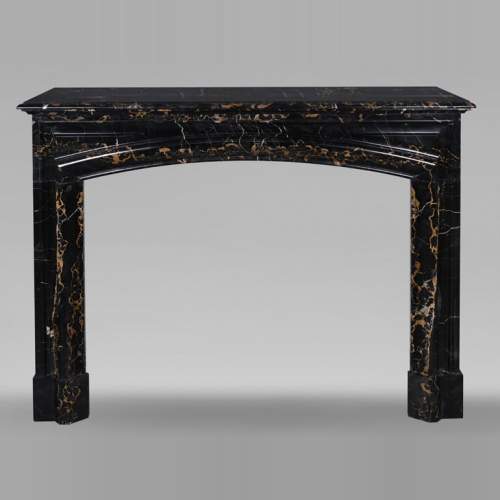
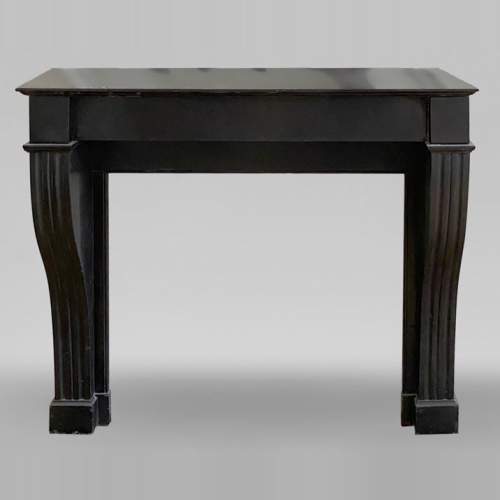
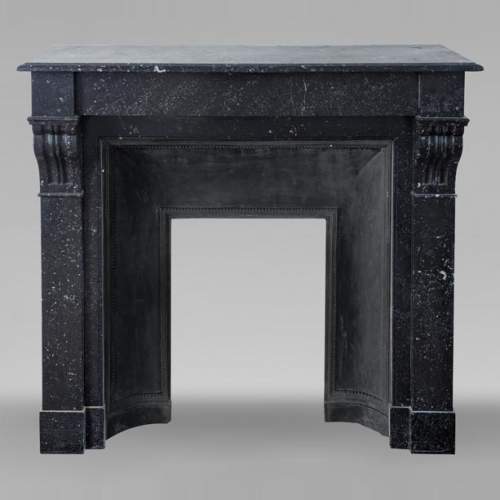
Napoleon III style mantel with modillions carved in black Marquina marble

Dimensions:
Width: 115 cm
Height: 103 cm
Depth: 35 cm
Inner width: 76 cm
Inner height: 81 cm

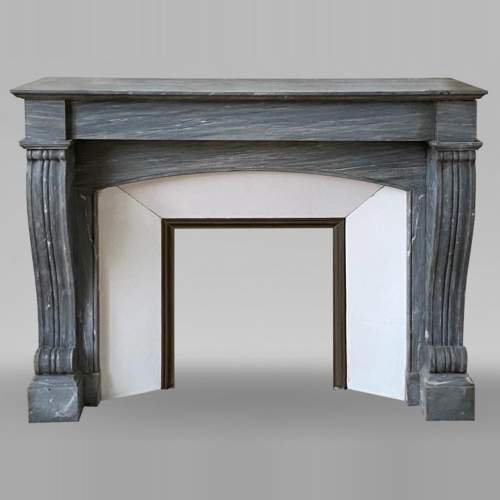
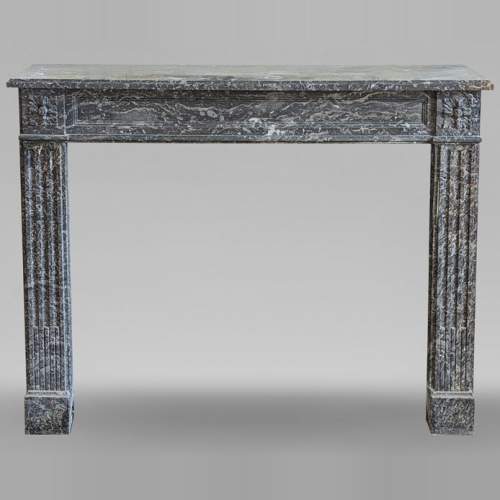
Louis XVI style molded marble mantel in Jourdan wood

Dimensions:
Width: 135 cm
Height: 108 cm
Depth: 39 cm
Inner width: 94 cm
Inner height: 84 cm

Louis XVI style trumeau with quiver and torch

Dimensions:
Width: 127 cm
Height: 167 cm
Depth: 15 cm

Louis XVI style fireplace with acroterion in Northern Red marble

Dimensions:
Width: 150 cm
Height: 142 cm
Depth: 42 cm
Inner width: 103 cm
Inner height: 101 cm

Louis XVI style fireplace decorated with a sunflower, in Arabescato marble

Dimensions:
Width: 146 cm
Height: 109 cm
Depth: 46 cm
Inner width: 103 cm
Inner height: 86 cm