menu
Menu
account_box
Categories
Contact
email Send us a message

Contact

phone By phone

+33 (0)1 42 25 12 79
Tue.-Sat., from 10am to 6pm
+33 (0)6 60 62 61 90
Everyday from 9am to 7pm.

email by Email

Adress: contact@marcmaison.com

share Let's get social

Languages
And also...
My selection
(14 Objects)

My selection (14 Objects)


Eugène-Frédéric PIAT (1827-1903) - Pair of Japanese wall brackets, a similar model of which belonged to Sarah Bernhardt

Ref.11331
Eugène-Frédéric PIAT (1827-1903) - Pair of Japanese wall brackets, a similar model of which belonged to Sarah Bernhardt

This model of wall brackets was created by Frédéric Eugène Piat for the Maison Gagneau in Paris. According to the description proposed by the Museum of Troyes in its "Catalog of Decorative Arts" of 1897, there are arms of light composed of a "Chinese modillon with two brackets, an entablature and a gallery with openwork". Inspired by Chinese art, this pair of wall brackets combines the Far Eastern motifs with French ornamental elements: rinceau scrolls and interlaces characteristic of the Louis XV style, illustrating the vogue for eclecticism that marks the artistic production in the 19th century. The motif of the Asian monster recalls the lions mufles made by the artist in its works of Renaissance inspiration while evoking the imaginary bestiary of Japonism; the monster holds in its jaws a ring that recalls a knocker but devoid of its primary purpose as it is indeed a purely decorative element. The same model belonged to the actress Sarah Bernhardt and is visible on old photographs of her Parisian house. The same pair of wall brackets adorned her studio. Frédéric-Eugène Piat (1827-1903) was one of the leading French sculptors and ornamentalists of the 19th century at the beginning of, with Louis-Constant Sévin in particular, the renewal and development of the French bronze industry. An active member of the Bronzes Manufacturers' Association, he is one of those who have merged art and industry. He later became one of the founders of the Central Union of Fine Arts Applied to Industry in 1864. After training with sculptors and ornamentalists, he started his own business in 1845 and enjoyed a good reputation in the 1850s. During the next decade, he began a collaboration with the founder Louis Léon Marchand (1831-1899). In the 1870s, he collaborated with eminent manufacturers: Georges Édouard Gagneau, Charles de Marnyhac, Emile Colin and the Val d'Osne Foundry. His artistic consecration takes place from the year 1873: while he designs models to be exhibited at the World’s Fair of 1873 in Vienna, he receives the visit of the President of the Republic Adolphe Thiers who makes him knight of the Legion of Honor for his fruitful contribution in the field of the bronze industry in French art. He participated at the Parisian Salons and at nine World’s Fairs in the second half of the century. He is particularly noticed during the World’s Fair of 1878 held in Paris where he exhibited a vast collection of works of art thanks to which he received a gold medal, but especially during the World’s Fair of 1889 when he was decorated with the Grand Prix, higher reward ever given to an industrial artist. Thanks to the quality and style of his productions, which are typical of the taste of the time for historicism and eclecticism, and as shown by this pair of Japanese-style consoles, Piat enjoyed not only a nation-wide reputation but also international.

Dimensions:
Width: 25 cm
Height: 25 cm
Depth: 27 cm

Joseph Simon Volmar (Berne, 1796-1865), Pair of bears in cast iron

Ref.14989
Joseph Simon Volmar (Berne, 1796-1865), Pair of bears in cast iron

Joseph Simon Volmar (or Vollmar) (Bern, 1796-1865) was a Swiss painter and sculptor. Born to a painter father, he was his student at the Bern Art School and later studied in Paris between 1814 and 1824 under Horace Vernet, Théodore Géricault, and the sculptor David d’Angers. In 1836, he was appointed Extraordinary Professor of Academic Drawing and Oil Painting at the Bern Art School. His reputation extended beyond Swiss borders. Volmar was known for his historical, landscape, and animal paintings and sculptures. During the 19th century, an era marked by the emergence of national consciousness, he secured a significant public commission for the monument to Rudolf von Erlach (c. 1299-1360), the victor of the Battle of Laupen in 1339, which preserved the independence of the city of Bern on that occasion. The architect Gottlieb Debler, the caster Rüetschi von Aarau (for the equestrian statue), and the Bisontine foundry Gandillot et Roy (for the bears) collaborated with Joseph Volmar in the construction of the monument between 1841 and 1848. Its inauguration took place during the Laupenfest in 1849, and the monument is now located on the Grabenpromenade. The presence of bears serves as a reminder of the historical identity of the city. Two of the bears sculpted by Volmar were casted again through a private commission from the Marshal of Saxe, who likely admired the monument. Although the plate indicating their authorship and casting location is missing, a comparison with the monument allows us to attribute them to Volmar. These statues were likely cast in Besançon; since the Gandillot et Roy foundry was acquired by the Degoumois et Cie foundry in 1864, it is certain that the bears were cast before that date. The animals, with their varied poses, detailed fur, and great expressiveness, showcase the sculptor’s mastery of animal art. One, ferocious, bares its fangs and raises its paw as if to attack, while the other is more playful, with its ball and its almost smiling expression. In both cases, the sculptor paid great attention to the detailed representation of the animals’ fur. Volmar had the opportunity to observe bears since the city of Bern housed them, and his graphic work includes numerous representations of these animals. Thus, the bears created by Volmar for the monument to Rudolf von Erlach were so admirable that they served as models for a new casting intended for private use. To our knowledge, these bears are the only two examples that have been cast from the monument.

Dimensions:
Width: 107 cm
Height: 224 cm
Depth: 121 cm

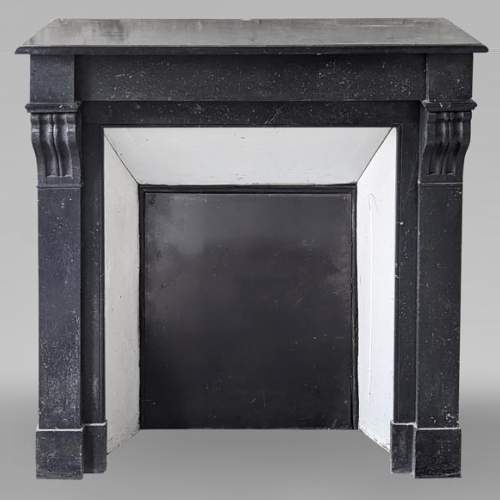
Napoleon III style mantel with modillions carved in black Marquina marble

Dimensions:
Width: 115 cm
Height: 103 cm
Depth: 35 cm
Inner width: 76 cm
Inner height: 81 cm

Small Louis XV style mantel in red Levanto marble

Dimensions:
Width: 115 cm
Height: 99 cm
Depth: 31 cm
Inner width: 82 cm
Inner height: 83 cm

Louis XV style fireplace with floral palmette, in Arabescato marble

Dimensions:
Width: 155 cm
Height: 111 cm
Inner width: 116 cm
Inner height: 91 cm

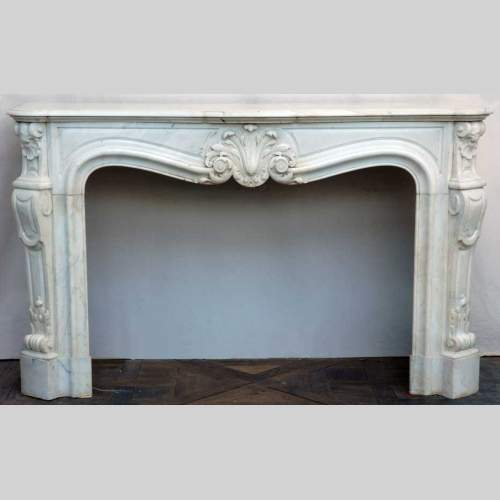
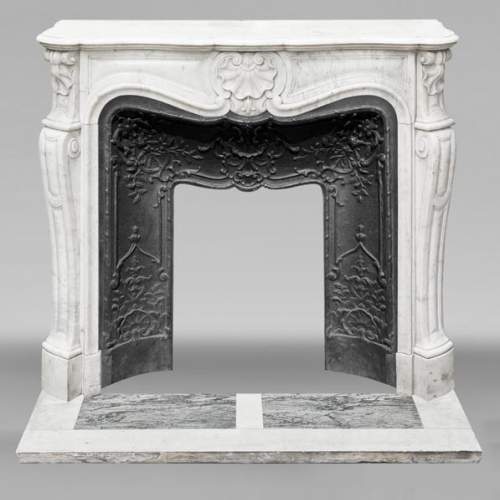
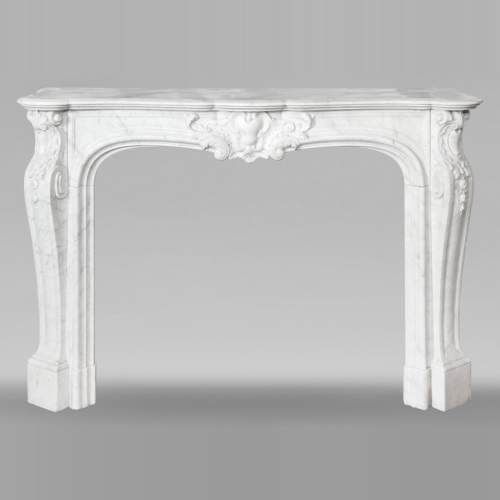
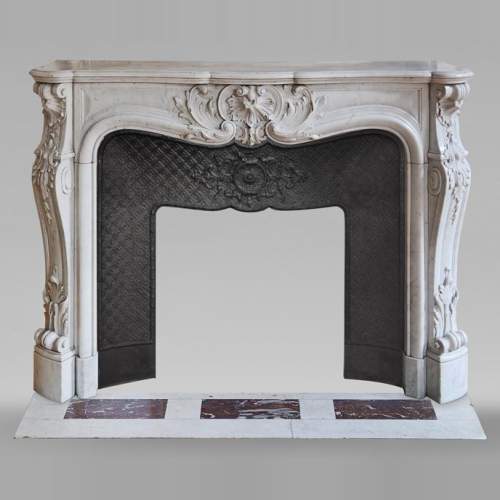
Louis XV style fireplace in Carrara marble with plant decoration

Dimensions:
Width: 155 cm
Height: 105 cm
Inner width: 119 cm
Inner height: 89 cm