menu
Menu
account_box
Categories
Contact
email Send us a message

Contact

phone By phone

+33 (0)1 42 25 12 79
Tue.-Sat., from 10am to 6pm
+33 (0)6 60 62 61 90
Everyday from 9am to 7pm.

email by Email

Adress: contact@marcmaison.com

share Let's get social

Languages
And also...
My selection
(37 Objects)

My selection (37 Objects)


CRISTALLERIE  DE BACCARAT, Neo-Greek, krater-shaped vase, made out of coated crystal, and etched through hydrofluoric acid, 1867 World’s Fair

Ref.13171
CRISTALLERIE DE BACCARAT, Neo-Greek, krater-shaped vase, made out of coated crystal, and etched through hydrofluoric acid, 1867 World’s Fair

This krater-shaped vase made out of coated crystal is a work from the Baccarat crystal-glass making factory, between 1862 and 1867, year when similar models were displayed at the Parisian World’s Fair. It is the Baccarat manufacture’s second entry, the first being at the first Parisian World’s Fair of 1855. Baccarat does win a gold medal, in particular for two vases made out of ruby red crystal, and a crystal fountain of seven meters high. Created under Louis XV’s reign, the crystal-glass making factory got its international fame through its participations, all along the 19th century, and until 1937, to the World’s Fairs.he works of the manufacture are scarcely signed between 1764 and 1860, year where the first labels did appear punctually. Fifteen years later, a seal with the name of the firm is placed on some blowing models and gilded bronze pieces. It is not until 1936 that the « BACCARAT » brand, with a carafe and two glasses, started appearing systematically on every production. During the 1867 World’s Fair, Baccarat inspired itself from the Bacchus cult for most of its production. We can see in our vase the influence of ancient ceramics through the shape of a krater – a piece of ceramics used by Greeks to dilute wine with water – as well as in the composition and the decoration’s subject. The latest is engraved thanks to hydrofluoric acid, a technical mastered by the German chemist Louis Kessler in 1855, who did improve the chemical formula of the bath to make it less aggressive and thus, less dangerous. Baccarat bought the patent in 1864, allowing the manufacture to diverse its production and to reach a new level of virtuosity. Detaching themselves from an opaque, white background, pink colored figures are represented in the spirit of ancient decorations on ceramics. We can see on one face a maenad wearing a spinning drapery, holding a drinking cup in one hand and a thyrsus in the other – a stick similar to a scepter and crowned with a pine cone, Dionysus’s attribute. On the other side, two figures are placed face to face, a masculine and a feminine one. They might represent the divine couple of Dionysus and Ariadne : she is sat on an ancient seat, richly dressed, and addressing the half-naked young man that is also carrying a thyrsus. In order for this decoration to be perfect, the two figurative scenes are framed with different patterns : palm motif, interlacing, Greek key frieze and laurel leaves.The handles have been realized after : they were shaped in clear crystal, and then adorned with gold painting applied with a brush. Even if, until today, our vase is the only one known showing this krater shape and the color rose, other similar models, with similar decorations, does exist – in particular in blue and yellow. Moreover, this bacchanal scene on an opaque white background have been applied on other pieces produced by the firm, that can be seen in museums’ collections, such as the Corning Museum of Glass, the Chrysler Museum of Norfolk, the Musée d’Orsay or at the Petit Palais.

Dimensions:
Width: 31 cm
Height: 25 cm
Depth: 25 cm

VAL D’OSNE Foundry - Exceptional Renaissance style fountain  Model presented in the 1851 World Fair

Ref.12400
VAL D’OSNE Foundry - Exceptional Renaissance style fountain Model presented in the 1851 World Fair

This exceptional painted cast iron fountain in the Neo-Renaissance style was crafted at the Val d’Osne foundry for the inaugural Universal Exhibition of 1851 in London, where it was prominently displayed. Hubert Lavigne created the model for our monumental Neo-Renaissance-style fountain for the Val d’Osne foundry. Resting on an octagonal pedestal adorned with shells and reeds in slight relief, the fountain consists of a first broad basin with small lampposts encircling it, punctuated by fleurons with pierced openings from which water can flow and be adorned with arabesques. In the center of this basin, a beautiful decoration of reeds has been sculpted, where a heron, a turtle, a frog, and a duck flourish in a very realistic manner. It supports a second basin with undulating contours and exterior striations reminiscent of a seashell's characteristics. This last basin features a sculpture in its center representing a woman draped in ancient attire around her waist and brandishing a cup with her left arm. Children seated on dolphins, blowing into a conch shell, have been placed all around the base to animate it. The sculptor's artistry is particularly evident in their modeling, reminiscent of the children sculpted on the facade of the Louvre. In the context of the industrial revolution and the flourishing of free trade, industrial exhibitions, initially national in scope, provided a platform for sharing inventions that opened up future horizons. Thus, the first Universal Exhibition took place in London from May 1 to October 15, 1851, at the Crystal Palace. Queen Victoria's reign demonstrated its modernity and adherence to a liberal philosophy, where international trade would be a guarantor of peace and the flourishing of human genius. The Crystal Palace, conceived for the occasion by Joseph Paxton and executed by Owen Jones, was a giant structure of iron and glass covering 8 hectares, erected swiftly through modern prefabrication methods, showcasing the progress of industry. Unfortunately, this architectural masterpiece was permanently destroyed in a fire on November 30, 1936. Functioning as a demonstrative showcase of Great Britain's supremacy in the global economy and industry, the Exhibition was designed as a presentation of the products of art and industry on a grand scale from each country. The interior was segmented into four sections, later adopted for subsequent Universal Exhibitions: raw materials, machinery, manufactured goods, and works of art. For each section, national pavilions served as showcases for their best productions and innovations. The color illustrations by Dickinson and Matthew Digby Wyatt are valuable testimonies to this event, capturing the beauty of the venue and the precious art objects on display. Infused with pedagogical intent and national affirmation, the 1851 Universal Exhibition inaugurated a highly successful practice, creating an artistic and technical dialogue beyond borders. The participation of the Val d’Osne foundry in this first Universal Exhibition, notably featuring the presentation of our fountain in the vast glass nave, bestowed upon it international recognition. Its frequent participation in such events, coupled with the accolades it received each time, quickly elevated the foundry to the foremost position in France during the second half of the 19th century. Established in 1836 at the initiative of Jean-Pierre-Victor André, founder of the "J.-P.-V. André" house and considered the pioneer of ornamental cast iron in place of wrought iron, the foundry offered urban furniture and decorative cast iron. Thriving over the years, the establishment changed hands without compromising its quality until 1986, absorbing several competing establishments including Barbezat and Ducel, thus enriching its catalog with over 40,000 different models. This included balconies, urban furniture, lighting, as well as monumental fountains, animal groups, statues, and large cast iron groups inspired by ancient or classical models. To achieve this, the foundry collaborated with numerous significant artists such as Albert Ernest Carrier-Belleuse, Mathurin Moreau (a shareholder in the company), James Pradier, and Hubert Lavigne, the sculptor of our fountain. Hubert Lavigne, born in Moselle, specifically in Cons-la-Grandville, in 1818 and deceased in Paris in 1882, studied at the Beaux-Arts in Paris under the guidance of sculptors Ramey and M.A. Dumont. A remarkable sculptor, he won the Third Prize in Rome in 1843 with a plaster bas-relief depicting the Death of Epaminondas, now housed in the Museum of Fine Arts in Nancy. He also won two medals at the Salons of 1861 and 1863, to which he was a dedicated participant between 1849 and 1881. He received commissions for Parisian buildings, including the Palais Royal at the Louvre, where his sculptures adorn the facade of the Turgot wing, as well as the Sorbonne church and the Saint-Michel Fountain. He also created numerous works in cast iron for the Val d’Osne foundry, such as agricultural representations, eagles, tritons, children blowing into a conch shell, and more. A prolific and talented sculptor, Théodore Véron Hubert, lamented in his 1877 work, Dictionnaire Véron, ou mémorial de l'art et des artistes de mon temps, that our sculptor was not duly recognized for his merits: "And to think that after so much study and conscientiousness, so many superior productions marked by an aesthetic worthy of a Dumont, this eminent artist, and at the same time a noble character whom we have followed since 1841 when we drew together (at the Lapin Academy), and whose superior creations we see every year; to say that this truly distinguished sculptor is not yet decorated or recognized! Truly, it's enough to discourage modesty and conscience!" Featured in the foundry's catalog, our fountain was commissioned by numerous cities to adorn their squares. Notably, a model can be found in Cirey-sur-Vezouve in eastern France, another in Saint-Pierre de la Réunion, and yet another on the island of Sao-Miguel in Portugal.

Dimensions:
Width: 260 cm
Height: 430 cm

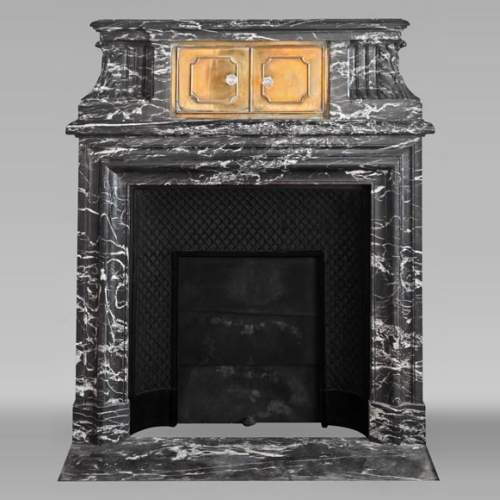
Louis XV style Pompadour mantel in Enjugerais marble

Dimensions:
Width: 109 cm
Height: 101 cm
Depth: 40 cm
Inner width: 73 cm
Inner height: 84 cm

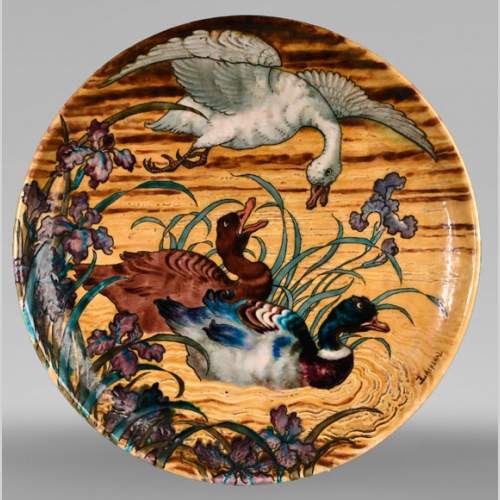
Théodore DECK (1823-1891), Earthenware dish with a flying mallard

Ref.12820
Théodore DECK (1823-1891), Earthenware dish with a flying mallard

This glazed ceramic dish was made in the workshop of the ceramist Théodore Deck (1823-1891). Théodore Deck initially trained as a stove maker. When he set up in Paris on his own account in 1858, he made stove linings and then, on the strength of his success, moved into ceramics. The studio produced many dishes in collaboration with well-known painters, including Ernest Carrière, who made a series of dishes on the same subject as this one in the 1890s-1900s. Deck gradually perfected his technique and enjoyed great success at the many World’s Fairs he took part in. In 1878, he was made an Officer of the Légion d'Honneur. He ran the Sèvres factory between 1887 and his death in 1891. The dish is decorated with an extremely naturalistic mallard captured in full flight, in the middle of a sky with cottony clouds and above a vast expanse of water as if wrinkled by a breath of wind. The background of this dish is particularly elaborate, clearly distinguishing between the sky and the water thanks to variations in the thickness of the glaze. This decoration reveals Deck’s interest in Far Eastern art, which he collected from the 1870s onwards. This inspiration is particularly evident in the choice of the mallard, often depicted by Hiroshige in his prints. This work is an emblematic example of Théodore Deck’s mastery of the enamel technique, enabling him to achieve great finesse in his work: the bird is depicted with great precision and clarity. The Théodore Deck et des pays du Florival Museum, in Guebwiller, has a dish also made by Deck, decorated with a mallard taking flight in front of a golden sun, which is very similar to another dish in the Marc Maison gallery.

Dimensions:
Height: 4 cm

Louis XVI period mantel in Rouge Royal marble

Dimensions:
Width: 147 cm
Height: 112 cm
Depth: 34 cm
Inner width: 93 cm
Inner height: 111 cm

Louis XVI mantel in Turquin marble with curved flutes

Dimensions:
Width: 145 cm
Height: 108 cm
Depth: 37 cm
Inner width: 104 cm
Inner height: 82 cm

Louis XVI style mantel in light blue Turquin marble decorated with bronze sunflowers

Dimensions:
Width: 123 cm
Height: 104 cm
Depth: 39 cm
Inner width: 87 cm
Inner height: 84 cm

Louis XVI period mantel in Gris Saint Anne marble

Dimensions:
Width: 148 cm
Height: 114 cm
Depth: 25 cm
Inner width: 110 cm
Inner height: 94 cm

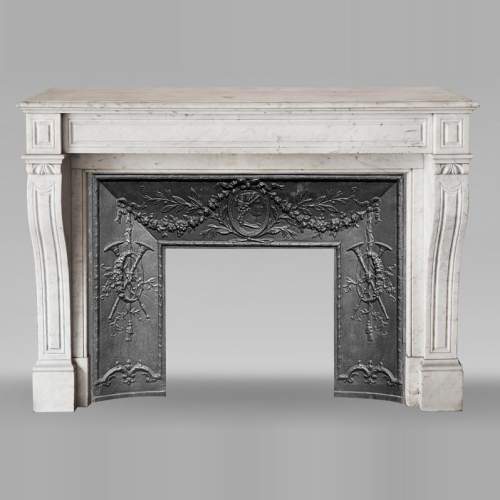
Louis XV style fireplace in Carrara marble with plant decoration

Dimensions:
Width: 155 cm
Height: 105 cm
Inner width: 119 cm
Inner height: 89 cm

 Louis XVI period fireplace in red northern marble, slightly curved

Dimensions:
Width: 163 cm
Height: 103 cm
Depth: 64 cm
Inner width: 128 cm
Inner height: 84 cm