menu
Menu
account_box
Categories
Contact
email Send us a message

Contact

phone By phone

+33 (0)1 42 25 12 79
Tue.-Sat., from 10am to 6pm
+33 (0)6 60 62 61 90
Everyday from 9am to 7pm.

email by Email

Adress: contact@marcmaison.com

share Let's get social

Languages
And also...
My selection
(16 Objects)
My selection (16 Objects)

Louis XV style trumeau with large sunflower

Dimensions:
Width: 140 cm
Height: 182 cm
Depth: 5 cm

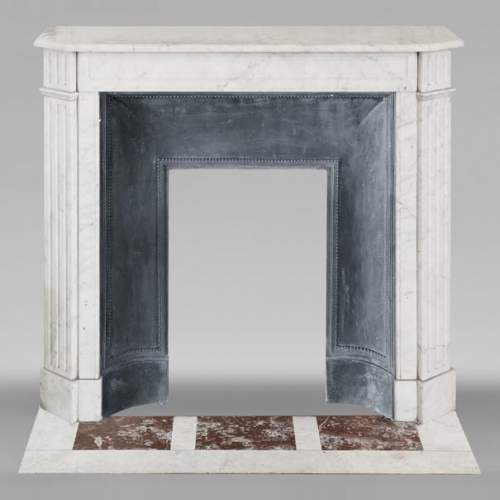
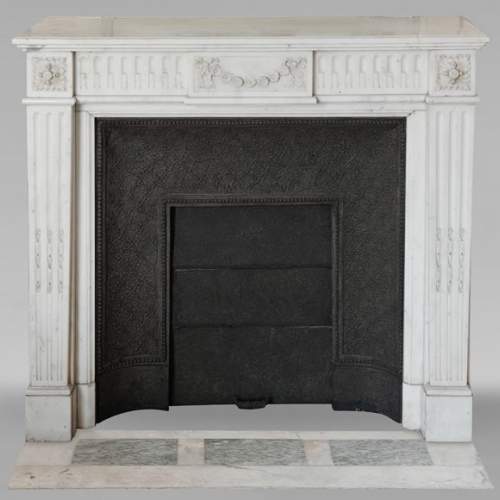
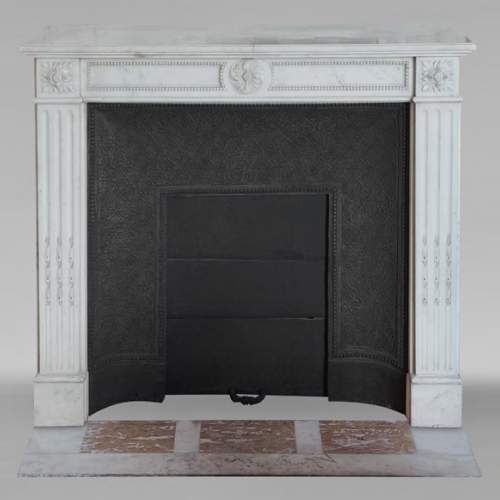
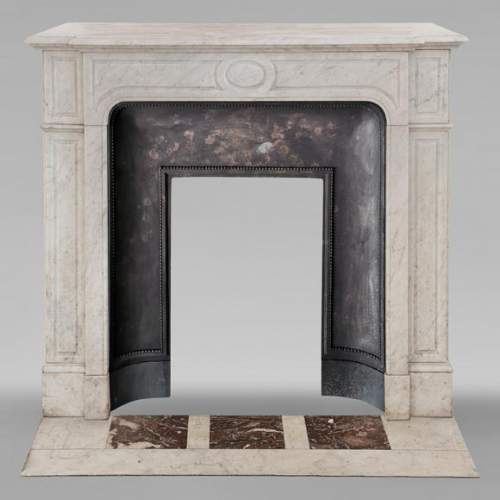
Louis XVI periode mantel in statuary marble adorned with a string of pearls

Dimensions:
Width: 160 cm
Height: 107 cm
Depth: 34 cm
Inner width: 126 cm
Inner height: 88 cm

Napoleon III style walnut wood mantel with overmantel

Dimensions:
Width: 160 cm
Height: 255 cm
Depth: 47 cm
Inner width: 108 cm
Inner height: 80 cm

Louis XVI style trumeau decorated with pearls

Dimensions:
Width: 121 cm
Height: 171 cm
Depth: 6 cm

Jacques Louis KESSLER, Pair of Vases Engraved with Greek Revival Decor Using the “Kessler” Process, mid-19th century

Ref.15609
Jacques Louis KESSLER, Pair of Vases Engraved with Greek Revival Decor Using the “Kessler” Process, mid-19th century

This pair of vases, crafted in the 19th century, was made using a technique developed by engineer Jacques Louis Kessler in 1855 and patented in 1858. The decoration of these two vases, made of double-layered crystal (blue on the outside and transparent on the inside), was achieved using Kessler’s engraving process. This innovative method utilized alkaline fluorides mixed with acids and a system of stencils, allowing for an immediate contrast between a bright, colored design and a matt background. The Baccarat crystal manufacturer later acquired exclusive rights to this patented process, which brought them widespread acclaim during the 1867 Paris Exhibition. These baluster-shaped vases feature neo-Greek ornamentation, alternating between blue-toned designs and matt crystal. Their clean, elegant lines are accented by several ornamental blue crystal bands. The decoration is composed of three primary scenes: the first depicts two combatants. The second portrays a winged Victory holding a palm in one hand while crowning a resting warrior with laurel in the other; the warrior stands before her. The third depicts three figures: a woman playing the lyre for a king holding a long scepter, with a young ephebe standing behind him. The scenes are separated by depictions of weapon trophies. The iconography draws inspiration from scenes commonly found on ancient Greek vases, while emphasizing the fluidity of the figures’ movements and features. Each vase rests on a circular mount supported by four spheres, with one vase bearing the number “2” engraved under its base. When Baccarat acquired the rights to Kessler’s technique, the company used it to create similar pieces, incorporating this innovative method into its repertoire. At the 1867 Paris Exhibition, Baccarat showcased a celestial blue crystal punch bowl and matching glasses engraved using this process; this set is now housed at the Corning Museum of Glass. The Galerie Marc Maison also presents an elegant neo-Greek vase made using the same technique (reference 15013). Due to Baccarat’s early acquisition of Kessler’s patent, vases like ours remain rare examples of the exceptional quality of pieces produced before the patent transfer, representing some of the earliest works created using Kessler’s revolutionary innovation.

Dimensions:
Height: 32 cm

Wall-mounted fireplace with trumeau, carved and gilded wood, elements from the 18th and 19th centuries

Ref.6108
Wall-mounted fireplace with trumeau, carved and gilded wood, elements from the 18th and 19th centuries

Architectural fireplace in carved and gilded wood, composed of a 19th-century fireplace base embellished with 18th-century relief decorations. The 19th-century gilded stucco overmantel is surmounted by a pediment adorned with a crowned coat of arms framed by rocaille scrolls and supported by a protruding lion's head. The central coat of arms bears the Latin motto "Linea recta brevissima" (the shortest path is the straight line). The Latin expression Linea recta brevissima is due to the Greek mathematician Euclid (circa 300 BC) and translates as "the straight line is the shortest." While not strictly speaking a heraldic motto, it was used by many families from the lower ranks of the nobility or the bourgeoisie in northern Italy and France. It is often used by institutions or universities in reference to geometry and the sciences. The base of the fireplace features a high-relief decoration of garlands of flowers and fruit: burst pomegranates, roses, grape clusters, and various foliage, treated with lavish naturalism. The side jambs are each adorned with a sculpted, polychrome cartouche depicting a crowned coat of arms. The coat of arms on the left features a tower, likely of urban or seigneurial origin; the one on the right is quartered with coats of arms featuring rich heraldic motifs, surrounded by a twisted collar. The sculpted elements, likely taken from 18th-century furniture or woodwork, were reused in a later neo-Renaissance structure, following a common practice in the 19th century, in an effort to enhance the original decor.

Dimensions:
Width: 127 cm
Height: 253 cm
Depth: 46 cm

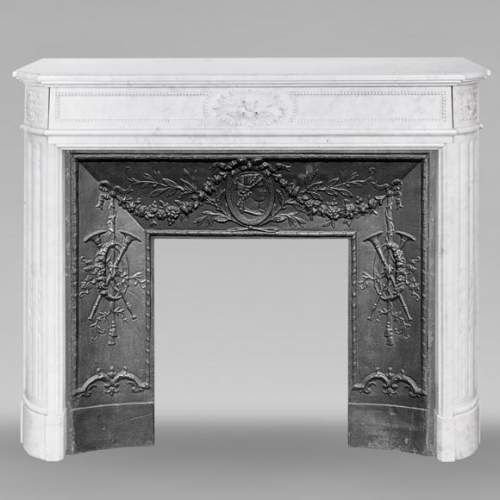
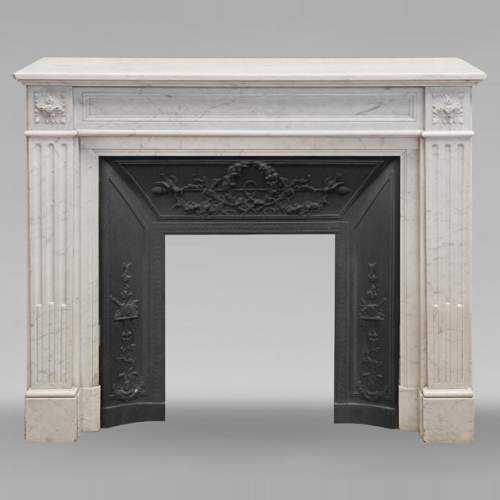
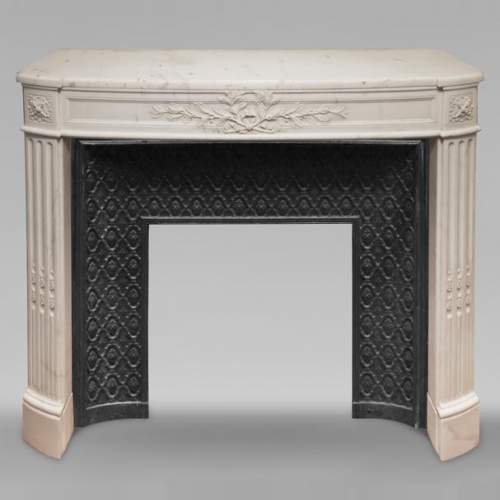
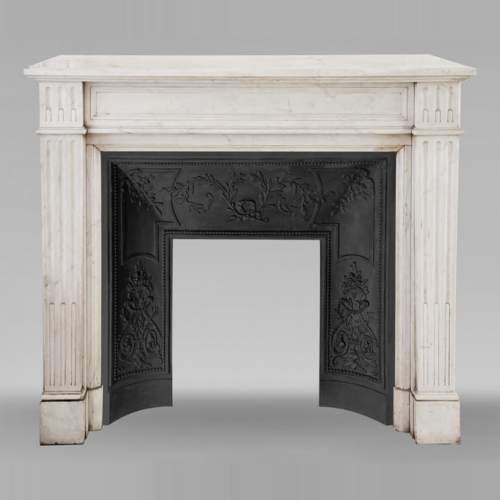
Louis XVI style fireplace decorated with a laurel wreath, in Carrara marble

Dimensions:
Width: 145 cm
Height: 110 cm
Depth: 40 cm
Inner width: 101 cm
Inner height: 85 cm

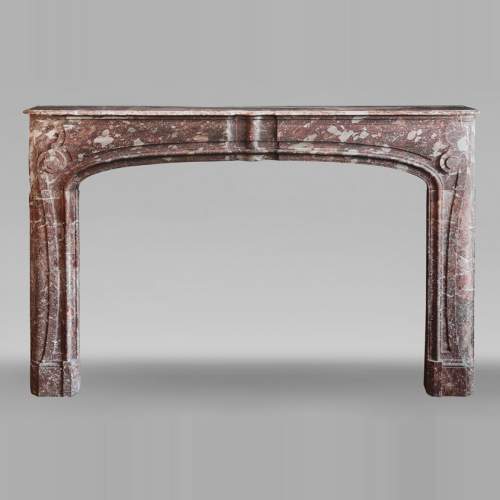
Louis XIV style fireplace with molding, in Royal Red marble

Dimensions:
Width: 146 cm
Height: 111 cm
Depth: 38 cm
Inner width: 107 cm
Inner height: 91 cm