menu
Menu
account_box
Categories
Contact
email Send us a message

Contact

phone By phone

+33 (0)1 42 25 12 79
Tue.-Sat., from 10am to 6pm
+33 (0)6 60 62 61 90
Everyday from 9am to 7pm.

email by Email

Adress: contact@marcmaison.com

share Let's get social

Languages
And also...
My selection
(9 Objects)

My selection (9 Objects)


Pierre BRAECKE, Art Nouveau style handle with the inscription “L. Solvay”, 1901

Ref.14067
Pierre BRAECKE, Art Nouveau style handle with the inscription “L. Solvay”, 1901

This handle bearing the inscription "L. Solvay" comes from the house of Lucien Solvay (1851-1950), a journalist, art historian and poet. He was also a member of the Solvay family, one of the greatest patrons of Art Nouveau. This house was built in 1901 by the architect Georges Hobé at number 76 rue Gachard in Ixelles (Brussels). Hobé commissioned sculptor Pieter Braecke (1858-1938) to create this handle, which adorned the front door of Lucien Solvay’s house. This work is both functional and highly decorative. Its base, adorned with a feather recalling the commissioner's literary activities, also bears the inscription that gives his name. The recess in the handle is formed by the body of a woman drawing a bow; a drapery emphasises its curve. Pieter Braecke was one of Victor Horta's most loyal friends. When the architect built his house and studio in 1903, the sculptor designed the door handles himself. They take up the idea of inscribing the name of the owner of the house and feature the motif of the drapery enveloping the woman in the Solvay handle, in a stylised way. The shape of the woman's body is also reminiscent of the Braecke statuettes crowning the sideboards in the dining room created by Victor Horta at number 22 Voorstraat, Kortrijk. Finally, a handle similar in shape to that of Lucien Solvay can be found on the front door of the house built by the architect Ch. Sée in 1909 at number 51 rue Forestière, Brussels. As with Braecke, a female sculpture in relief forms the handle. Sée drew his inspiration from Braecke, since the rue Forestière house was not completed until eight years after the Solvay house. At the time of its conception, the imposing door handle created by Pieter Braecke for Lucien Solvay had both a practical and highly decorative purpose. Today, it retains mainly its ornamental interest, making it an art object. The delicacy of the sculpture and the prominence given to the personality of the commissioner make it one of the most interesting testimonies both to the history of Lucien Solvay's commission for his house and to the art of Pieter Braecke.

Dimensions:
Width: 16 cm
Height: 35 cm
Depth: 7 cm

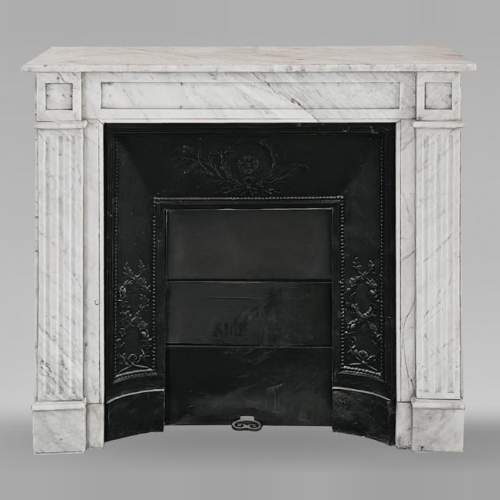
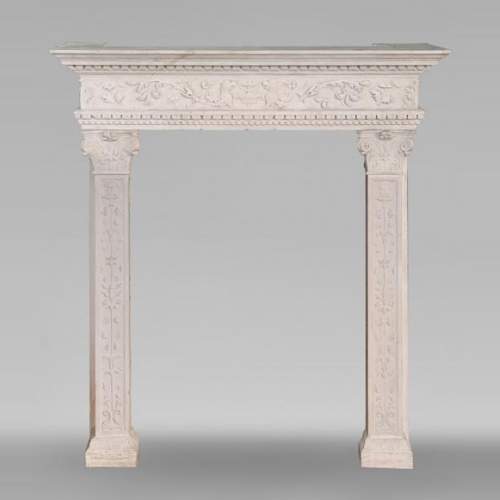
Louis XVI style Arabescato marble mantel with curved entablature decorated with a laurel wreath

Dimensions:
Width: 146 cm
Height: 108 cm
Depth: 38 cm
Inner width: 100 cm
Inner height: 84 cm

JULES VIEILLARD & COMPAGNIE, large Japanese-style cachepot in Bordeaux earthenware with polychrome enamel decoration

Ref.14002
JULES VIEILLARD & COMPAGNIE, large Japanese-style cachepot in Bordeaux earthenware with polychrome enamel decoration

This large, Japanese-style cachepot in Bordeaux earthenware is signed Jules Vieillard et Compagnie. The rich polychrome enamel decoration blends scrolls, flowers, medallions, and stylized cranes. The base is decorated with a Greek key frieze and blue Japanese-style volutes. Acanthus scrolls unfold against a plain background, displaying large blue flowers. The decoration alternates a series of blue medallions with symmetrical floral motifs with large pink medallions depicting cranes in flight. The shoulder features an alternating frieze of stylized blue and pink petals, characteristic of Japanese ornamental design. Our cachepot is signed under the base: three interlaced crescents represent the coat of arms of the city of Bordeaux. This mark indicates a period of manufacture between 1868 and 1895, when Jules Vieillard's two sons, Charles and Albert, managed the factory. The genesis of this type of Japonisme decoration can certainly be attributed to the presence of Amédée de Caranza at Vieillard from 1878 onwards. A visionary workshop manager with a sensibility imbued with Orientalism and Japonisme, the Bordeaux factory flourished after the 1878 Universal Exhibition, largely thanks to the models, designs, and enameling techniques introduced by Amédée de Caranza. This superb Japonisme cachepot can be dated to the last quarter of the 19th century, between 1878 and 1895.

Dimensions:
Height: 31 cm