menu
Menu
account_box
Categories
Contact
email Send us a message

Contact

phone By phone

+33 (0)1 42 25 12 79
Tue.-Sat., from 10am to 6pm
+33 (0)6 60 62 61 90
Everyday from 9am to 7pm.

email by Email

Adress: contact@marcmaison.com

share Let's get social

Languages
And also...
My selection
(18 Objects)

My selection (18 Objects)


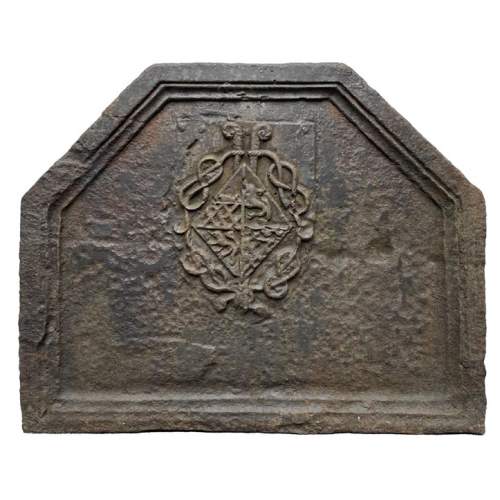
Antique cast iron fireback with coat of arms of Pénancoët de Kéroualle

Ref.11262
Antique cast iron fireback with coat of arms of Pénancoët de Kéroualle

This antique cast iron fireback, made after 1684, is decorated with the arms of Louise-Renée de Penancoët of Kéroualle, Baroness of Petersfield, Countess of Fareham, Duchess of Portsmouth. Two greyhounds flank a diamond ""fess argent and six coins azure"" topped with a ducal crown. The point of the diamond rests on a mascaron representing a bearded man wearing a crown among curlicue foliage. The carving illustrates a delicate and vigorous craftsmanship. The high relief of the sculpture, the manner in which the tails of the hounds and the volutes of foliage overflow their rightful frame, make for a very lively composition. Louis-Renée (1629-1734) was the mistress of Charles II of England for some 15 years and was equally a secret agent for King Louis XIV of France. Saint-Evremond said of her “the silk ribbon that she wore at her waist united France and England”. Born in Brittany she lived a simple life in the family Château of Kéroual en Guilders. Noticed by the Duke of Beaufort, grand master of navigation, who courted her in vain but promised to get her an appointment as lady-in-waiting to the Duchess of Orleans, the sister in law of King Louis XIV. He kept his promise post-mortem. Indeed in 1668, Louise Renée arrived in Versailles to serve Madame who was also the sister of Charles II of England. Louis XIV saw Louise Renée as a useful diplomatic asset. She set off to England as lady-in-waiting to Madame who was visiting her brother. Charles II had little sympathy for France and even less so for its King, but he loved women, of which Louis XIV was fully aware. The reception in Dover in honor of Madame was extravagant and Louise Renée attracted the eye of Charles II. The Treaty of Dover linked the two kingdoms: Charles II officially converted to Catholicism and receives the sum of two million crowns from Louis XIV. Both Kings would declare war on the United provinces and share the conquered provinces. Madame offered a jewel to her brother to thank him for his gifts and Louise-Renée was the messenger; as she handed him the gift, the King took her hand and is said to have declared : “This is the only real jewel I desire.” Upon her arrival in Versailles, Louis XIV sent her directly back to London where she was expected. She lived in a huge apartment in the palace of Whitehall where the King visited her every evening. She was officially made Lady-in-waiting to the Queen of England in 1671. In 1672 she gave birth to Charles Lennox, duke of Richmond and was granted an annuity of 138 000 pounds, the titles of Duchess of Fareham, Baroness of Petersfield and Duchess of Portsmouth. Her influence lasted 15 years until the death of the King in 1685. In 1684, on the request of Charles II, Louis XIV made her Duchess of Aubigny and Peer of France. This same year she acquired the Château of Trémazan (Finistère) which she linked to the lands of Kéroual. Louis-Renée died in Paris, rue des Saints Pères on November 14th 1734, having lost most of her fortune. Two similar models are preserved in the Musée d'Orléans and in the Musée du Berry in Bourges.

Dimensions:
Width: 85 cm
Height: 86 cm

VAL D’OSNE Foundry - Exceptional Renaissance style fountain  Model presented in the 1851 World Fair

Ref.12400
VAL D’OSNE Foundry - Exceptional Renaissance style fountain Model presented in the 1851 World Fair

This exceptional painted cast iron fountain in the Neo-Renaissance style was crafted at the Val d’Osne foundry for the inaugural Universal Exhibition of 1851 in London, where it was prominently displayed. Hubert Lavigne created the model for our monumental Neo-Renaissance-style fountain for the Val d’Osne foundry. Resting on an octagonal pedestal adorned with shells and reeds in slight relief, the fountain consists of a first broad basin with small lampposts encircling it, punctuated by fleurons with pierced openings from which water can flow and be adorned with arabesques. In the center of this basin, a beautiful decoration of reeds has been sculpted, where a heron, a turtle, a frog, and a duck flourish in a very realistic manner. It supports a second basin with undulating contours and exterior striations reminiscent of a seashell's characteristics. This last basin features a sculpture in its center representing a woman draped in ancient attire around her waist and brandishing a cup with her left arm. Children seated on dolphins, blowing into a conch shell, have been placed all around the base to animate it. The sculptor's artistry is particularly evident in their modeling, reminiscent of the children sculpted on the facade of the Louvre. In the context of the industrial revolution and the flourishing of free trade, industrial exhibitions, initially national in scope, provided a platform for sharing inventions that opened up future horizons. Thus, the first Universal Exhibition took place in London from May 1 to October 15, 1851, at the Crystal Palace. Queen Victoria's reign demonstrated its modernity and adherence to a liberal philosophy, where international trade would be a guarantor of peace and the flourishing of human genius. The Crystal Palace, conceived for the occasion by Joseph Paxton and executed by Owen Jones, was a giant structure of iron and glass covering 8 hectares, erected swiftly through modern prefabrication methods, showcasing the progress of industry. Unfortunately, this architectural masterpiece was permanently destroyed in a fire on November 30, 1936. Functioning as a demonstrative showcase of Great Britain's supremacy in the global economy and industry, the Exhibition was designed as a presentation of the products of art and industry on a grand scale from each country. The interior was segmented into four sections, later adopted for subsequent Universal Exhibitions: raw materials, machinery, manufactured goods, and works of art. For each section, national pavilions served as showcases for their best productions and innovations. The color illustrations by Dickinson and Matthew Digby Wyatt are valuable testimonies to this event, capturing the beauty of the venue and the precious art objects on display. Infused with pedagogical intent and national affirmation, the 1851 Universal Exhibition inaugurated a highly successful practice, creating an artistic and technical dialogue beyond borders. The participation of the Val d’Osne foundry in this first Universal Exhibition, notably featuring the presentation of our fountain in the vast glass nave, bestowed upon it international recognition. Its frequent participation in such events, coupled with the accolades it received each time, quickly elevated the foundry to the foremost position in France during the second half of the 19th century. Established in 1836 at the initiative of Jean-Pierre-Victor André, founder of the "J.-P.-V. André" house and considered the pioneer of ornamental cast iron in place of wrought iron, the foundry offered urban furniture and decorative cast iron. Thriving over the years, the establishment changed hands without compromising its quality until 1986, absorbing several competing establishments including Barbezat and Ducel, thus enriching its catalog with over 40,000 different models. This included balconies, urban furniture, lighting, as well as monumental fountains, animal groups, statues, and large cast iron groups inspired by ancient or classical models. To achieve this, the foundry collaborated with numerous significant artists such as Albert Ernest Carrier-Belleuse, Mathurin Moreau (a shareholder in the company), James Pradier, and Hubert Lavigne, the sculptor of our fountain. Hubert Lavigne, born in Moselle, specifically in Cons-la-Grandville, in 1818 and deceased in Paris in 1882, studied at the Beaux-Arts in Paris under the guidance of sculptors Ramey and M.A. Dumont. A remarkable sculptor, he won the Third Prize in Rome in 1843 with a plaster bas-relief depicting the Death of Epaminondas, now housed in the Museum of Fine Arts in Nancy. He also won two medals at the Salons of 1861 and 1863, to which he was a dedicated participant between 1849 and 1881. He received commissions for Parisian buildings, including the Palais Royal at the Louvre, where his sculptures adorn the facade of the Turgot wing, as well as the Sorbonne church and the Saint-Michel Fountain. He also created numerous works in cast iron for the Val d’Osne foundry, such as agricultural representations, eagles, tritons, children blowing into a conch shell, and more. A prolific and talented sculptor, Théodore Véron Hubert, lamented in his 1877 work, Dictionnaire Véron, ou mémorial de l'art et des artistes de mon temps, that our sculptor was not duly recognized for his merits: "And to think that after so much study and conscientiousness, so many superior productions marked by an aesthetic worthy of a Dumont, this eminent artist, and at the same time a noble character whom we have followed since 1841 when we drew together (at the Lapin Academy), and whose superior creations we see every year; to say that this truly distinguished sculptor is not yet decorated or recognized! Truly, it's enough to discourage modesty and conscience!" Featured in the foundry's catalog, our fountain was commissioned by numerous cities to adorn their squares. Notably, a model can be found in Cirey-sur-Vezouve in eastern France, another in Saint-Pierre de la Réunion, and yet another on the island of Sao-Miguel in Portugal.

Dimensions:
Width: 260 cm
Height: 430 cm

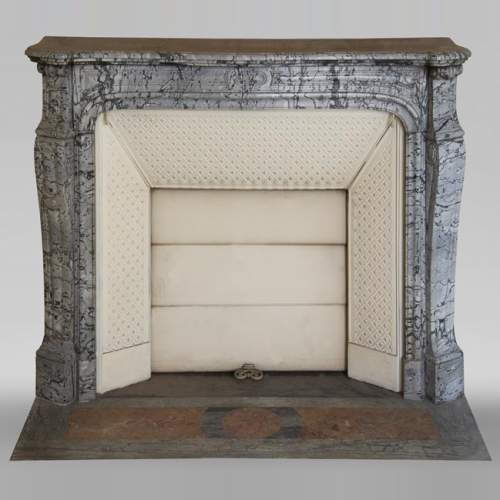
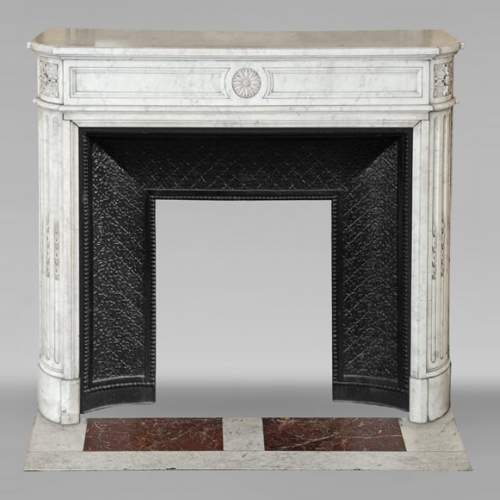
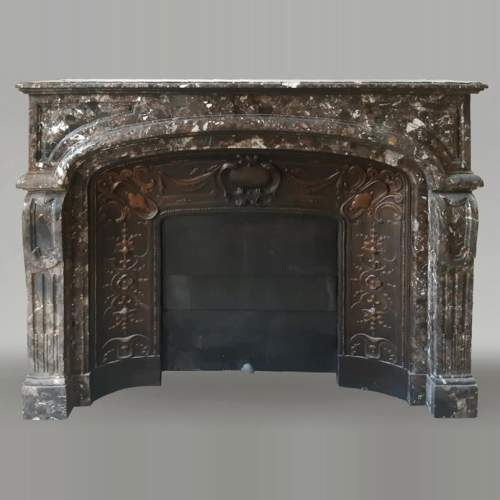
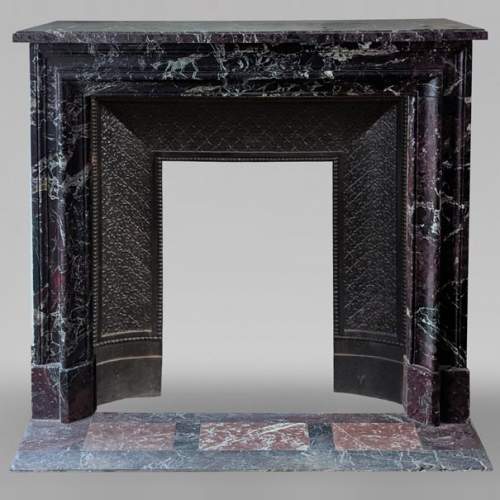
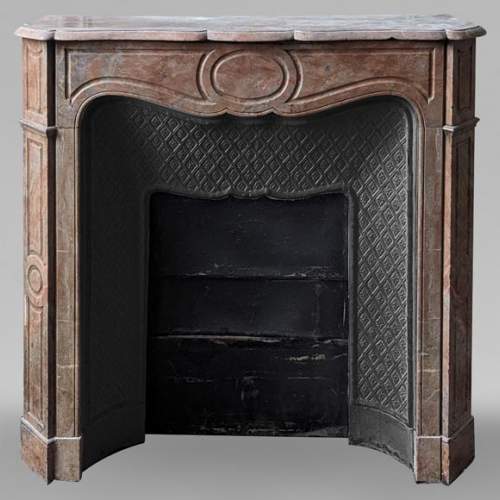
Louis XV style Pompadour mantel in Enjugerais marble

Dimensions:
Width: 109 cm
Height: 101 cm
Depth: 40 cm
Inner width: 73 cm
Inner height: 84 cm

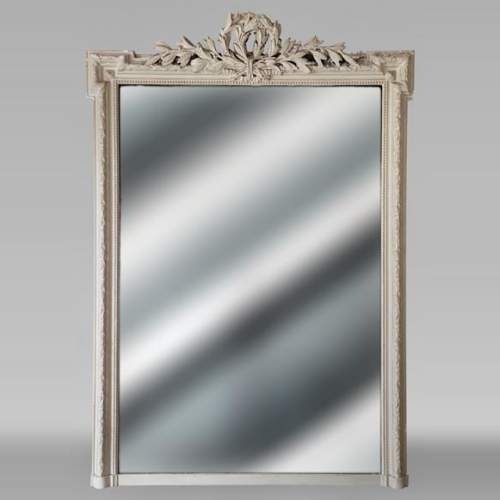
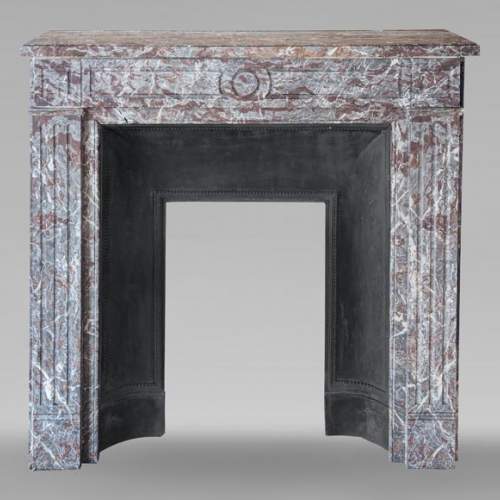
Louis XVI style trumeau decorated with a laurel wreath

Dimensions:
Width: 105 cm
Height: 178 cm
Depth: 6 cm

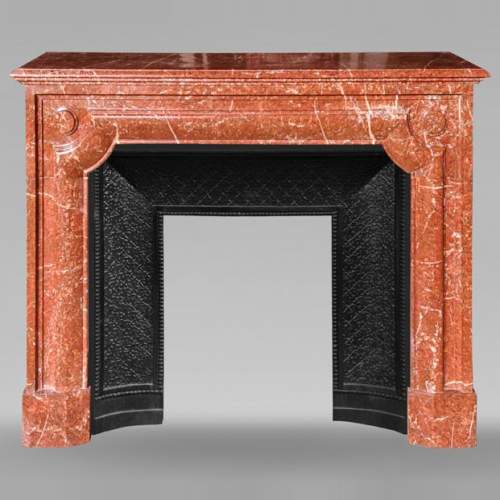
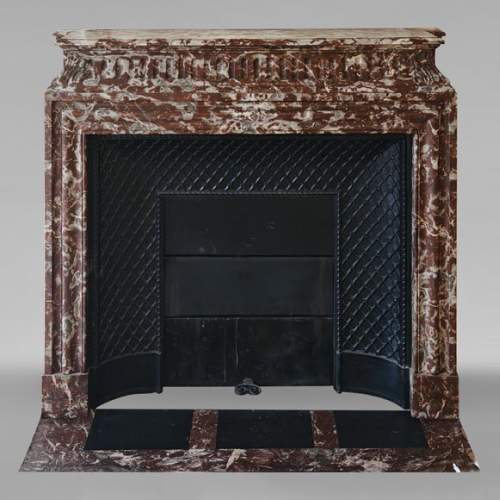
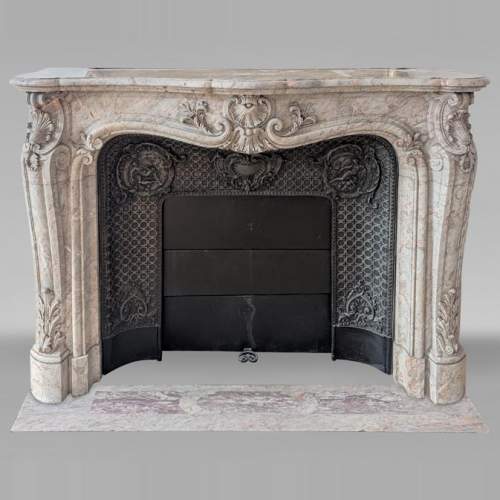
Louis XV style pompadour mantel carved in Bois Jourdan marble

Dimensions:
Width: 116 cm
Height: 104 cm
Depth: 35 cm
Inner width: 83 cm
Inner height: 82 cm

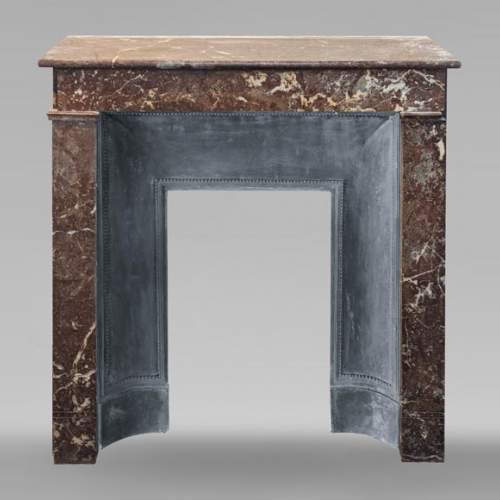
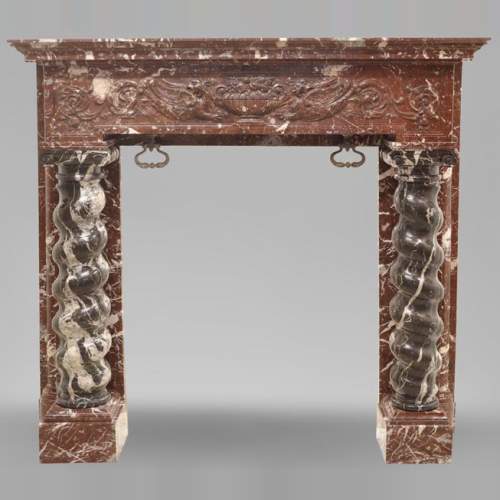
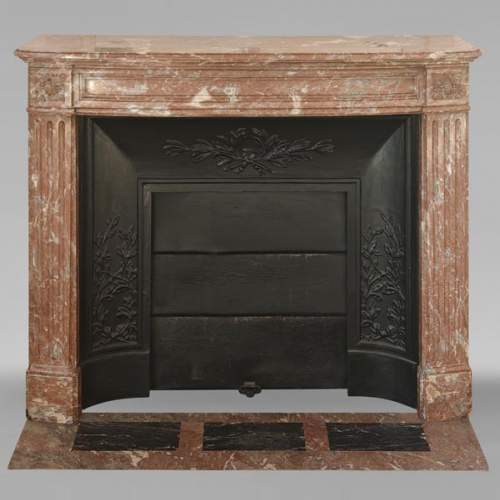
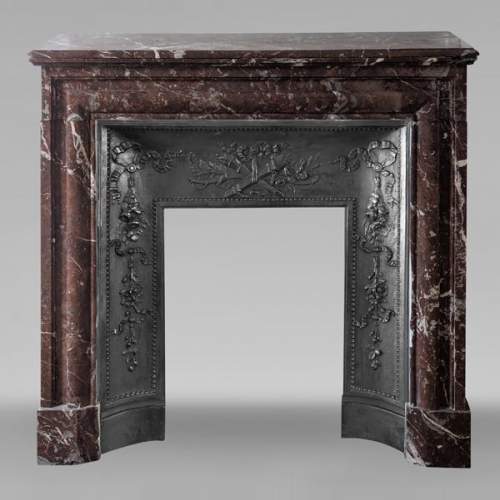
Slightly curved Louis XVI style fireplace, in Northern Red marble

Dimensions:
Width: 156 cm
Height: 112 cm
Depth: 36 cm
Inner width: 120 cm
Inner height: 94 cm