menu
Menu
account_box
Categories
Contact
email Send us a message

Contact

phone By phone

+33 (0)1 42 25 12 79
Tue.-Sat., from 10am to 6pm
+33 (0)6 60 62 61 90
Everyday from 9am to 7pm.

email by Email

Adress: contact@marcmaison.com

share Let's get social

Languages
And also...
My selection
(14 Objects)

My selection (14 Objects)


ZSOLNAY Manufacture - "Young woman at the source", vide poche in iridescent ceramic

Ref.18458
ZSOLNAY Manufacture - "Young woman at the source", vide poche in iridescent ceramic

This Art Nouveau style vide-poche (storage tray) made of iridescent ceramic is from approximately 1900 and signed “Zsolnay Pecs Made in Hungary.” A female figure is leaning down with a jar to collect water. The object's asymmetrical shape, curved outlines, and iridescent ceramic translate the movement, texture, and blueish-green colors of the water. This colorful and original vide-poche belongs to the Art Nouveau movement, an artistic movement from the beginning of the 20th century that wanted to break away from traditional forms and historicist styles from the 19th century. The defenders of the Art Nouveau movement wished to create an art form that included both modernity and a return to nature and its symbols. This vide-poche's modernity is brought by the shine and colors of the iridescent ceramic, and by the object's simple outlines. It also has a very organic, natural side to it, as every aspect helps to recreate the water that the female figure is collecting. As the stamp on the bottom says, this object is from the Zsolnay Factory, a Hungarian ceramics factory founded in 1851 by the merchant Miklos Zsolnay. It first produced simple, useful objects, and in 1865, when Vilmos Zsolnay, Miklos' brother, took over the company, it began creating decorative dishware. It exhibited faience at the World's Fair of 1878 in Paris and obtained a Grand Prize. From the 1890's, the factory also produced architectural ceramics.

Dimensions:
Width: 14 cm
Height: 14 cm
Depth: 9 cm

Maison GIROUX and Ferdinand DUVINAGE - Exceptional and rare cup with waders with iridescent glass and electroplated decor, circa 1870-1880

Ref.12893
Maison GIROUX and Ferdinand DUVINAGE - Exceptional and rare cup with waders with iridescent glass and electroplated decor, circa 1870-1880

This cup made in the 1870-1880’s by the maison Giroux, as indicates the signature on the mount, is a piece extremely rare because of the material used. Indeed, few models with iridescent glass are known today. The Japanese inspiration of the decor and the model of our cup indicate that it is a creation of Ferdinand Duvinage who takes the direction of the maison Giroux between 1867 and 1876, then taken by his widow when he dies. This store which was originally selling all kind of supplies and small objects such as paints, varnishes, albums, writing-papers, fans, toys, boxes and souvenirs, but also lithographs, drawings and watercolors, considerably developed in the first decades of the 19th century. First, because they count among the clients, important persons such as the Duchesse de Berry, Louis XVIII or even Charles X, then by the drive given by Alphonse Giroux’s sons who joined the firm in 1833. Thus, Alphonse-Gustave Giroux, the eldest son, had the idea to sell small furniture. Even though he was an artist himself, he worked like furniture dealers of the 18th century, with artists who did not have the right to put their signature and exerted a hold over the design of the creation that he chose. He also decided to move the store in the new Opera district on the corner of the 43 boulevard des Capucines and the 24 rue Neuve des Capucines in 1855. On this same year, the company which had already won medals for the quality of its production during previous events, sells during the World Fair, to the Impress Eugénie, a bonheur du jour, conserved today in the château de Compiègne. In 1867, the store direction is given to Ferdinand Duvinage, Harinkouck and Brune. Little things are known about Harinkouck and Brune who seem to have been associated for a short period of time as Duvinage remains the only one in 1874. Ferdinand Duvinage (1813-1876) who seems to be cousin with Alphonse-Gustave Giroux, joins the company during a few years before taking its direction, without changing the name. He files in 1874, 1876 and 1877 patents for a marquetry technique of mosaic with metallic partitioning for furniture and art objects. His method is really original because it involves the combined union of ivory as a base, wood for the designs or ornaments, and copper or other metal to partitioning the ivory fragments. The firm continues to participate to World Fairs where they win many medals, even though they are not that much mentioned by the critics, we know that the productions with the Japanese vocabulary created under the direction of Duvinage were also very appreciated and were a real commercial success.

Dimensions:
Width: 27 cm
Height: 17 cm
Depth: 23 cm

GUERET Frères - Splendid oak chest richly sculpted with a forest animal decoration

Ref.13660
GUERET Frères - Splendid oak chest richly sculpted with a forest animal decoration

This splendid chest was made of oak by the Guéret brothers in the 1870. The sculpture work is truly remarkable and shows the virtuosity of its creator who makes a decor on the forest theme in which we can see a fox, a pheasant or even a bird with its wings spread out on the top, in a rocks and tree decoration. Denis-Désiré (born in 1828) and Onésime Guéret (born in 1830) create a factory of sculpted furniture in 1852 or 1853 at 7 rue Buffault in Paris under the name "Guéret Frères". Ten years later, the store is moved at 5 boulevard de la Madeleine, then at 216 rue Lafayette where it stays until the definitive closure. From 1877, the factory is managed by the youngest brother and becomes "Guéret Jeune et Cie", its activity continues until the end of the 19 th century.The Guéret brothers participate to each exhibitions from 1855, win a lot of rewards and acritic always eulogistic,like the one published in the Art Journal, about the InternationalExhibition of 1878 : “M. Gueret, a renowned cabinet-maker of Paris, contributed to theExhibition a large number of admirable works, designed with rare Art power, and executed with refined delicacy, in various woods – generally in satin-wood inlaid – all possessing thorough artistic merit”. The excellency of their work for the sculpted furniture making,often rewarded, increases their orders book. Rich bourgeois but also renowned personalities such as the Duke of Aumale, Napoléon III or even Mr Bryce, buyers of these sumptuous furniture, made some orders. Mr Bryce, for instance, ordered the realization of his whole furniture for his mansion on avenue Gabriel in Paris.

Dimensions:
Width: 42 cm
Height: 33 cm
Depth: 32 cm

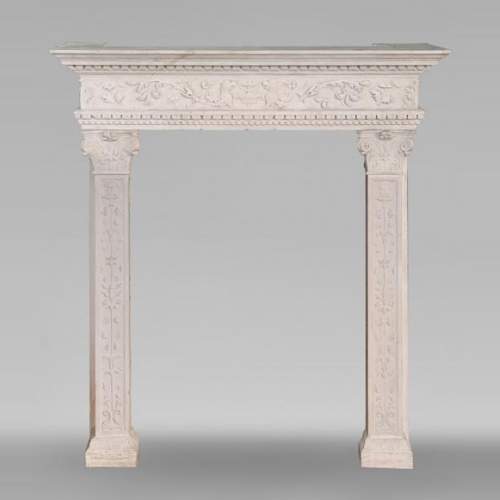
Louis XVI style mantel with curved flutes and carved capitals in highly veined Arabescato marble

Dimensions:
Width: 145 cm
Height: 111 cm
Depth: 40 cm
Inner width: 94 cm
Inner height: 86 cm

SÈVRES Manufacture, Josse-François-Joseph LERICHE (after), Le Billet doux, 1892

Ref.14809
SÈVRES Manufacture, Josse-François-Joseph LERICHE (after), Le Billet doux, 1892

This enameled porcelain statuette was executed at the Sèvres manufactory in 1892, based on a model by Josse-François-Joseph Leriche. Josse-François-Joseph Leriche (1738-1812) worked at the Sèvres manufactory between 1757 and 1801. He directed the sculpture workshop from 1780. He created the group called Le Billet doux, which was produced at the Sèvres manufactory in biscuit from 1751/1752. In this pair of statues, the man extends a note to the woman beside him, who is richly dressed in an imaginative orientalizing costume and holds a fan in her hand. Our sculpture corresponds to the figure of the man from this pair. The man, with black skin, is dressed in a brown tunic, the many folds of which are left in reserve. He is enveloped in a large mantle of a dark red shaded with blue and green. His turban presents the same shades. The fringe of the mantle and the details of the tunic demonstrate the sculptor and designer’s great attention to detail. The man was also reissued independently of his companion from 1881. This sculpture, titled “Kislar Agassi” (the chief of the eunuchs guarding the Ottoman sultans’ seraglio), depicts a character identical in every way to the original man, except that he does not hold a billet doux in his hand. A bronze edition of this version was sold at Tajan in 2020. From the first half of the 18th century, Europeans were fascinated by foreign cultures and were inspired by them in art, often in a fanciful manner. This interest in oriental, Far Eastern, or, as here, African cultures persisted throughout the 19th century. This enduring interest explains the longevity of Leriche’s model, which continued to be reissued from 1751 to at least 1892, the date of our sculpture. Under the base, the mark of the Sèvres manufactory indicates that the sculpture dates from 1892; it is crossed out, indicating that this piece was set aside due to a minor defect in its execution. The sculpture bears a second inscription: 51 st. Furthermore, part of the billet doux that the man was holding is now missing.

Dimensions:
Width: 16 cm
Height: 35 cm
Depth: 12 cm