menu
Menu
account_box
Categories
Contact
email Send us a message

Contact

phone By phone

+33 (0)1 42 25 12 79
Tue.-Sat., from 10am to 6pm
+33 (0)6 60 62 61 90
Everyday from 9am to 7pm.

email by Email

Adress: contact@marcmaison.com

share Let's get social

Languages
And also...
My selection
(37 Objects)

My selection (37 Objects)


Maison TAHAN and Julien-Nicolas RIVART (1802-1867) - Perfume box decorated  with porcelain marquetry

Ref.16684
Maison TAHAN and Julien-Nicolas RIVART (1802-1867) - Perfume box decorated with porcelain marquetry

Bibliography: Marc Maison and Emmanuelle Arnauld, Masterpices of Marquetry in the 19th century, Patents. Rivart, Cremer, Fourdinois, Kayser Sohn et Duvinage, Dijon, Faton, 2012, p. 45. This elegant perfume box, signed by the Maison Tahan , is a rare example of their collaboration with an artist outside the company. Decorated with gilt-bronze ornaments and porcelain marquetry panels, this piece is a fine example of the new technique of inlaid porcelain that Julien-Nicolas Rivart patented in 1849. In this process, each piece of porcelain is used as true marquetry where each element is independent. Rivart 's patent allowed him to retain exclusivity on this type of work and he was obviously closely involved with the box's fabrication. Rivart won awards for his porcelain marquetry on several occasions at international exhibitions, as this technique was highly esteemed for its great naturalism in reproducing flowers. In this example, the roses that decorate the lid of the box are executed in a range of elegant pastel tones that depict each petal with great precision while conveying the fragile quality of the flowers. The use of green-tinted resin for the delicate stems adds to the refinement and realistic look of the bouquet of flowers. The four small panels decorating the side panels continue the floral theme, a favorite device used by Rivart . Pansies, lilacs and rose leaves cover the surface of the wood, painted in delicate, monochrome tones of white and mauve. This technique, patented by Rivart in 1849, was described as a "delicious process" and won immediate and unanimous praise for the charming quality of these decorations in porcelain marquetry, as well as for the originality of his technique. Rivart was critically acclaimed at the World's Fairs where he won several medals, thus leading him to further develop this type of ornamentation until his death, in 1867. For more than twenty years, Rivart was the only one to create works using this technique, a fact that explains the rarity of this type of production. There is no signature of the painted inlaid flowers; however, it is possible to attribute the work to Pierre-Joseph Guérou , a painter who worked at the Sèvres factory in 1847 and 1848 and whose signature appears on several pieces of furniture made by Rivart , such as the jewel cabinet at the Château de Compiègne. When looking at the delicacy and naturalism of porcelain marquetry, we too can experience the feelings described by the commentators at the International Exhibition when they enthusiastically wrote: "one cannot help but admire the graceful richness of these inlaid painted porcelain flowers" (Paris en 1855, journal de l'exposition générale…, May 27, 1855). The origins of the Maison Tahan go back to Belgium at the beginning of the 19th century when Pierre Lambert Tahan founded a workshop that produced small tabletry objects using wood from the resort town of Spa, the small village in the Ardennes. Pierre Lambert decided to leave Spa shortly before 1806 to set up shop in the Temple area of Paris. He worked there as a cabinetmaker and also produced nécessaire boxes. In 1825, Pierre Lambert and his son, Jean Pierre Alexandre, ran two factories producing these same types of wares. In 1844, Pierre Lambert Tahan retired and left the direction of the company to his son who would completely reorganize the business by separating the factory from the shop, located at number 32 rue de la Paix. A year later, he was already known as a "Supplier to the King and Princes". In 1855, he held the title of "Supplier to the Emperor" which allows us to date this perfume box to after that time. The Court gave him a great number of commissions for bookcases, tables, pedestal tables and nécessaires. Pierre Alexandre Tahan participated in the great international exhibitions of his time. It was at the International Exhibition of 1855, in Paris, that he showed an extraordinary aviary in walnut sculpted with leaves and birds in flight.

Dimensions:
Width: 43 cm
Height: 24 cm
Depth: 33 cm

Maison KAYSER SOHN, Renaissance Personalities,  Pair of plates decorated in corviniello

Ref.16867
Maison KAYSER SOHN, Renaissance Personalities, Pair of plates decorated in corviniello

Copper, mother-of-pearl, tortoiseshell Signed “J. P. Kayser Sohn, Crefeld”; on the reverse “Corviniello Patent 82” (female figure) Signed “J. P. Kayser Sohn, Crefeld”; on the reverse “Corviniello Patent 83” (male figure) The house of Kayser Sohn, founded in 1862, in the area of Dusseldorf, originally specialized in the manufacture of metal objects. The company made a name for itself mainly in the production of Art Nouveau pewter ware that was manufactured in Krefeld based on highly finished models designed in their Cologne workshop. The Kayser Shon brothers reached the height of their careers between 1889 and 1902 and participated in various exhibitions at the beginning of the 20th century, notably in Paris, in 1900, where they won a gold medal, at the Exhibition of Decorative Arts in Turin, in 1902 (again winning a gold metal), and at the International Exhibition that took place in Saint Louis, in 1904.         The company was equally well known at the beginning of the 20th century for the very original inlay technique that used mother-of-pearl and tortoiseshell, a process that also involved electroplating, known as corviniello. This is a perfect example of the union of art and industrial technique, and this process was used to create the ornamentation in the central part of this plate.    One of the plates represents a young, elegant woman attired in a shimmering costume and wearing a feathered hat. The figure is finely engraved, giving an extremely realistic effect. The pendant plate represents a man with a belligerent look whose hand rests on the hilt of his sword. The artist has used the various materials to their best advantage in portraying his doublet. The close similarity in the treatment of the hands and the eyes allows us to attribute the design of the two personages to the same draughtsman. Executed mainly in mother-of-pearl and tortoiseshell, the two figures wear the Renaissance style costumes that were so fashionable at the end of the 19th century.    Perfected by Otto von Corvin, this technique required extreme precision in its execution and demanded both great concentration and expert knowledge of the materials used. The artisan first had to cut out the mother-of-pearl and tortoiseshell elements in the most meticulous manner and then temporarily glue the pieces onto a die mould. The die mould was then varnished with an insulating coating while the pieces that were to be inlaid were covered with a conducting substance. The deposit of the metallic layer was done by electrolysis and it covered the bottom of the die mould, surrounding the glued elements. The die mould was then detached, exposing a smooth surface where the joints are extremely precise, with metallic filaments filling in the cracks.    Certain parts of the figures have been left blank and were not inlaid, such as the rings or the edge of the book the woman carries, thus leaving the metal background of the plate exposed and demonstrating the technical virtuosity of the casting.    The border, made entirely of metal, emphasizes the contrast between the polished gilt copper and the delicate scrolls interspersed with foliage. The finely engraved decoration is identical to those produced on other plates made by the Kayser Sohn company, which indicates that such plates with the same border were likely produced in quantity, differing only in the decoration used for the center. The difference of the dating of the two pieces (1882 for the female figure and 1883 for the man) further supports this supposition. Neo-Renaissance style. 

Dimensions:
Width: 34 cm

Pair of Japenese Vases by Alphonse Giroux and Charles Ficquenet

Ref.15523
Pair of Japenese Vases by Alphonse Giroux and Charles Ficquenet

Signed “ALPH. GIROUX PARIS”, this pair of square base vases features a décor of flowers on a white background. These natural flowers, are made up of soft, pastel colours, the petals of each flower create a delicate gradation of pink, yellow, blue and white. The vase is outlined in bronze, and frames two parts of the vase. It frames the base, with feet featuring dragons' heads, and it frames the top of the vase. From Japanese inspiration, these vases come from the Japanese vogue, which became known in France during the 1860s-1870s, thanks to Japan opening foreign markets under the Meiji era. This vogue style is wonderfully illustrated by the famous “Service Rousseau” the name for the Parisian seller Eugène Rousseau, named so by the painter and engraver Félix Bracquemond. The Alphonse Giroux house was a famous marquetry and cabinet making store, situated at 7, rue du Coq-Saint-Honoré, in Paris, which expanded from 1799 to the end of the Second Empire. This house was created by François-Simon-Alphonse Giroux, and his two sons Alphonse-Gustave et André took over the business on the 19th May 1838. In his shop, Alphonse Giroux sold objects of curiosity, marquetry, stationary, but also pictures, paintings, and engravings, like an 18th century Marchand-mercier. Louis XVIII and Charles X chose gifts for the young princes in Alphonse-Giroux's shop. It was his son, in particular, who gave a real boost to the family business and made it enter the top ranking of luxury shops. The house was highly influenced by Japonism during the 1860s and 1870s, as can be seen by this pair of vases. In 1885, the Giroux house definitively closed its doors.

Dimensions:
Width: 15 cm
Height: 41 cm

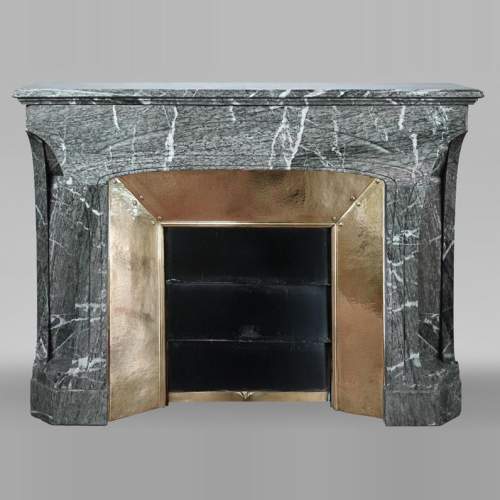
Louis XIV style mantel carved in Breche Sanguine

Dimensions:
Width: 136 cm
Height: 111 cm
Depth: 38 cm
Inner width: 98 cm
Inner height: 90 cm

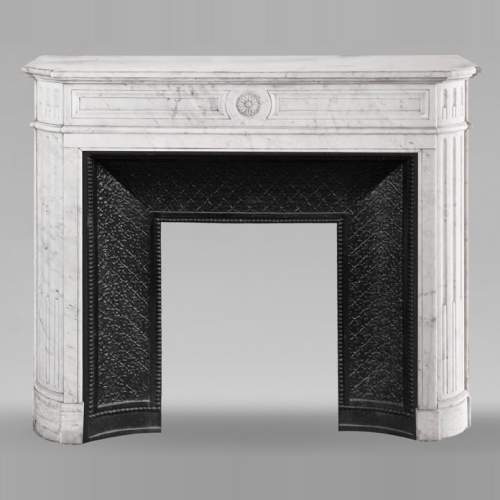
Louis XV style mantel in Rouge du Nord marble adorned with a shell motif

Dimensions:
Width: 147 cm
Height: 111 cm
Depth: 42 cm
Inner width: 106 cm
Inner height: 85 cm

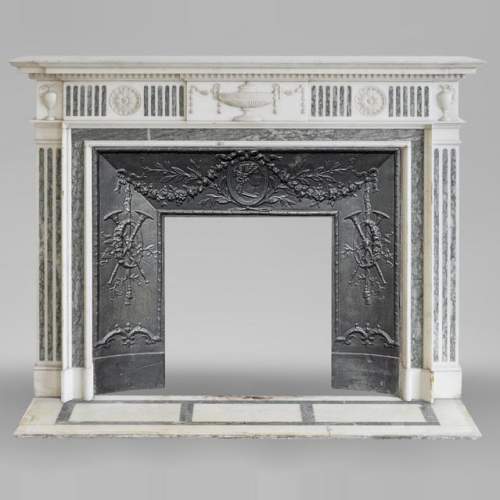
Louis XVI period two-tone Turquin marble mantel decorated with acanthus leaves

Dimensions:
Width: 24 cm
Height: 90 cm
Depth: 110 cm
Inner width: 74 cm
Inner height: 71 cm

 Louis XV period trumeau with pastoral scene

Dimensions:
Width: 129 cm
Height: 170 cm
Depth: 5 cm

Louis XVI style trumeau decorated with a floral wreath

Dimensions:
Width: 109 cm
Height: 168 cm
Depth: 5 cm

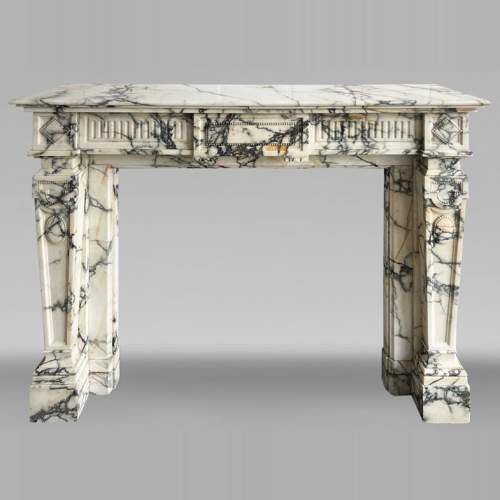
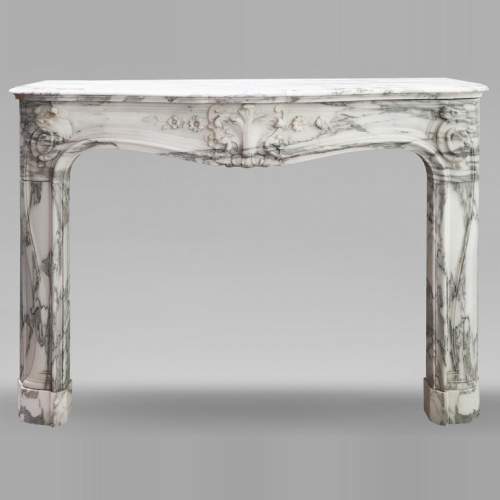
Louis XV style fireplace in Arabescato marble, decorated with an asymmetrical palmette

Dimensions:
Width: 155 cm
Height: 111 cm
Depth: 39 cm
Inner width: 112 cm
Inner height: 93 cm

Louis XVI style trumeau decorated with a floral garland

Dimensions:
Width: 101 cm
Height: 147 cm
Depth: 3 cm