menu
Menu
account_box
Categories
Contact
email Send us a message

Contact

phone By phone

+33 (0)1 42 25 12 79
Tue.-Sat., from 10am to 6pm
+33 (0)6 60 62 61 90
Everyday from 9am to 7pm.

email by Email

Adress: contact@marcmaison.com

share Let's get social

Languages
And also...
My selection
(9 Objects)

My selection (9 Objects)


Pair of Renaissance style vases in patinated bronze from the Mouchy-le-Châtel castle,  second half of the 19th century

Ref.13001
Pair of Renaissance style vases in patinated bronze from the Mouchy-le-Châtel castle, second half of the 19th century

This pair of patinated bronze vases were made during the second half of the 19th century to decorate a door on the facade of the Mouchy-le-Châtel Castle, in the Parisian region. This castle was built in the 16th century by the Maricourt Family, then it was taken during the second half of the 18th century by the first dukes de Noailles, before being occupied by the dukes of Mouchy, younger branch of the Noailles family. It's the dukes of Mouchy that started the work of restoration and extension during the Second Empire, entrusted to the architect Hyppolite Destailleur (1822 – 1893), to whom we also owe the restoration of Courances and Vaux le Vicomte castles. Helped by the sculptor and drawer Michel Lienard (1810 – 1870) and sculptor Mathurin Moreau (1822 – 1912), the three of theme redefined the castle Mouchy-le-Châtel keeping the Renaissance decorative repertoire of the first castle. Our pair of bronze vases is an example of the reinterpretation of the shapes inspired by the Renaissance. Put on a flaring fluted foot, they're adorned on the belly with four lion's heads in relief. The lid and the long neck are decorated with friezes of acanthus leaves and flowers. The long neck is joined to the belly by two handles in a S shape of which the scrolls are occupied by flowers. Our two vases were made during one the different restoration's phases of the castle during the second half of the 19th century to adorn the door of one of the castle's facades as show the archive picture.

Dimensions:
Height: 78 cm

Albert ANKER (painter), Théodore DECK (ceramist), Ornamental Dish “Cleopatra”, 1869

Ref.14204
Albert ANKER (painter), Théodore DECK (ceramist), Ornamental Dish “Cleopatra”, 1869

Biographies of Albert Anker and Théodore Deck The Swiss painter Albert Anker (1831-1910) joined the École des Beaux-Arts in Paris in 1855. Alongside his close collaboration with Théodore Deck, Anker distinguished himself in the genre of historical portraiture. Between 1866 and 1892, the two artists produced over 450 faience pieces together, combining their talents to create exceptional works. Théodore Deck (1823-1891) established himself in Paris in 1858. After manufacturing linings for heating systems, he turned to ceramics, a field in which he achieved rapid success. Constantly perfecting his technique, his production was highly acclaimed at the Universal Exhibitions. The ceramicist was made an Officer of the Legion of Honour in 1878 and directed the Sèvres Manufactory from 1887 until his death in 1891. His workshop frequently called upon renowned painters to design the decorations for his pieces. Description of the Work Executed in 1869, this Egyptian-style plate is the result of a long collaboration between Albert Anker and Théodore Deck. The center of the plate features a portrait of Cleopatra, depicted according to her image at the Temple of Hathor in Dendera. She wears the attributes of Egyptian nobility: the royal collar (ousekh) and the vulture, symbol of the goddess Nekhbet, protector of pharaohs and tutelary figure of Upper Egypt. Her posture and ornaments faithfully adopt the figurative codes of ancient Egyptian art. The decorations on the rim of the plate follow a precise archaeological style. Set against a yellow background characteristic of ancient Egyptian funerary objects, four scenes inspired by temple art stand out, punctuated by pseudo-hieroglyphs. These include a woman praying before a bearded god, the deity Seth carrying the was scepter, the god Anubis accompanied by a female worshiper, and a scene where Anubis is adored by a man. The subject and style of this decorative plate bear witness to Egyptomania, the fascination with ancient Egypt that spread through the 19th century and influenced European decorative arts. Deck and Anker produced several versions of this plate, examples of which are now held at the Gustav-Lübcke Museum in Hamm, the Kunstmuseum in Bern, and the Théodore Deck Museum in Guebwiller.

Dimensions:
Width: 33 cm
Height: 5 cm
Depth: 33 cm

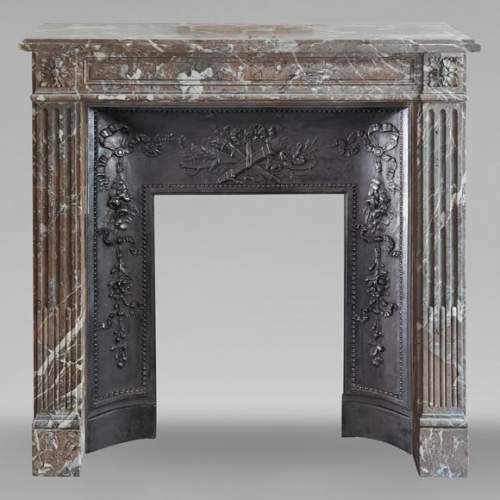
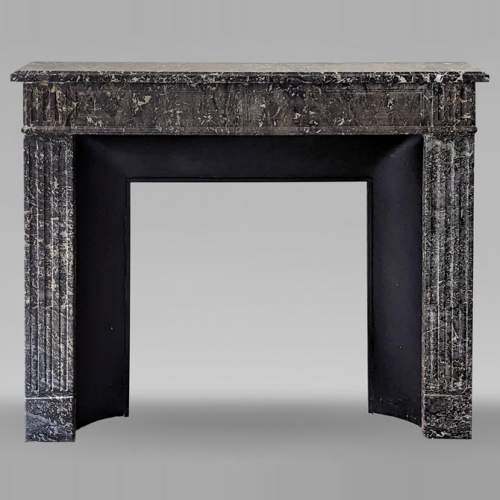
Louis XVI style mantel with curved flutes adorned with rosettes carved in Turquin marble

Dimensions:
Width: 146 cm
Height: 107 cm
Depth: 38 cm
Inner width: 81 cm
Inner height: 101 cm

DAUM, Émile ROBERT (attributed to), Lamp in delicately openwork wrought iron and glass, circa 1900

Ref.15113
DAUM, Émile ROBERT (attributed to), Lamp in delicately openwork wrought iron and glass, circa 1900

This lamp is the result of a collaboration between the Daum company, for the glass lampshade, and Émile Robert, for the wrought iron base. Founded in Nancy in 1878 by Jean Daum, the Daum glassworks was quickly taken over by his sons, Auguste and Antonin. From that moment on, increasingly complex creations from a technical point of view were designed there. Émile Robert (Mehun-sur-Yèvre, 1860-1924) quickly became skilled in artistic ironwork. When he arrived in Paris in 1878, he joined the workshop of locksmith Alphonse Gabriel Moreau, where his talent was quickly recognized, before becoming independent. At the 1900 Universal Exposition, he contributed to the decoration of the Metals Hall of the decorative arts pavilion, and even set up a workshop there to present the blacksmith's craft to visitors. In 1914, he founded a workshop in Enghien-les-Bains to undertake personal projects; in the same year, he was named a Knight of the Legion of Honor. This table lamp, with a base forming openwork wrought iron arms, is inspired by the Gothic style. It rests on an openwork circular base providing great stability. Four equidistant spheres topped by feet in the shape of stylized lion paws join to form a single base. Above, a slight bulge reflects Émile Robert’s interest in Art Nouveau and its vibrant vegetal vitality. The upper part, forming an arm, is decorated with delicate openwork scrolls and ends with a bird head from which the lamp is suspended. The lamp itself is conical, in orange glass tinged with yellow, held in place by four wrought iron scrolls also inspired by Art Nouveau forms. It is signed: “Daum Nancy ☨”.

Dimensions:
Width: 32 cm
Height: 63 cm
Depth: 22 cm

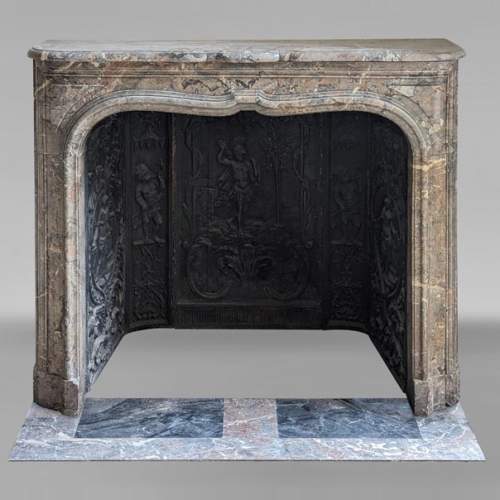
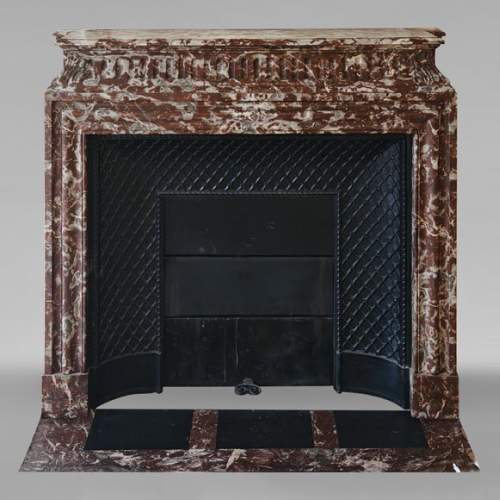
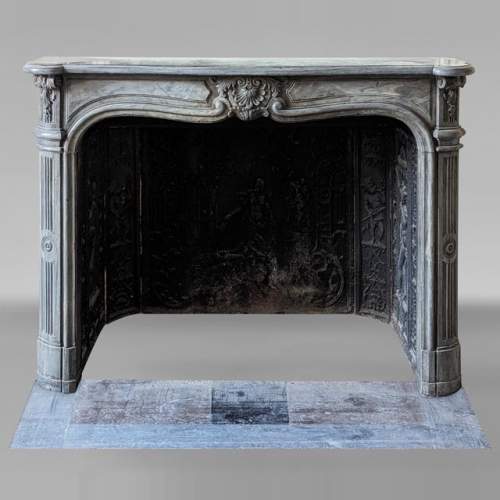
Louis XVI period fireplace in blue turquin marble, with molding decoration

Dimensions:
Width: 144 cm
Height: 106 cm
Depth: 77 cm
Inner width: 114 cm
Inner height: 90 cm

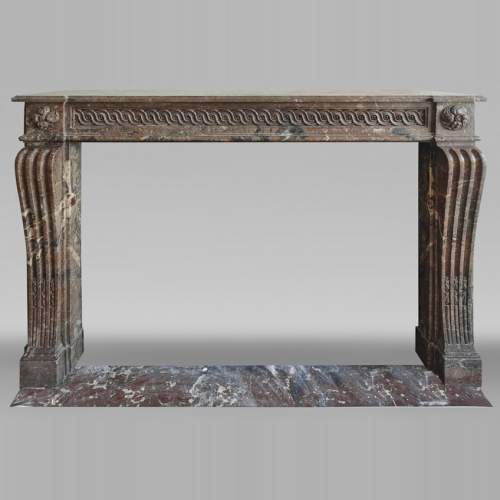
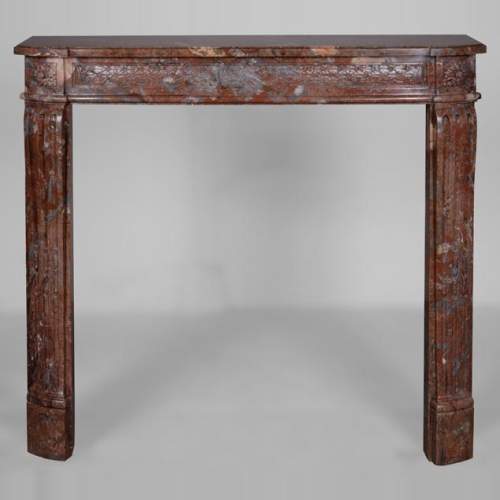
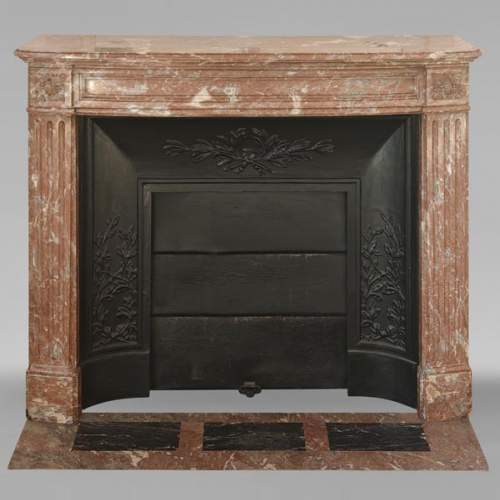
Louis XVI style fireplace with fluted feet, in pink Enjugerais marble

Dimensions:
Width: 125 cm
Height: 104 cm
Depth: 36 cm
Inner width: 89 cm
Inner height: 81 cm