menu
Menu
account_box
Categories
Contact
email Send us a message

Contact

phone By phone

+33 (0)1 42 25 12 79
Tue.-Sat., from 10am to 6pm
+33 (0)6 60 62 61 90
Everyday from 9am to 7pm.

email by Email

Adress: contact@marcmaison.com

share Let's get social

Languages
And also...
My selection
(6 Objects)

My selection (6 Objects)


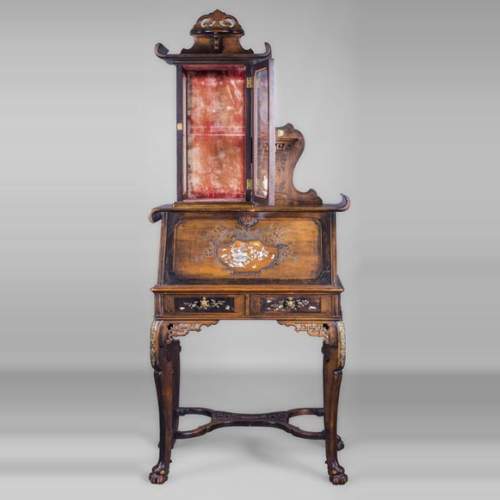
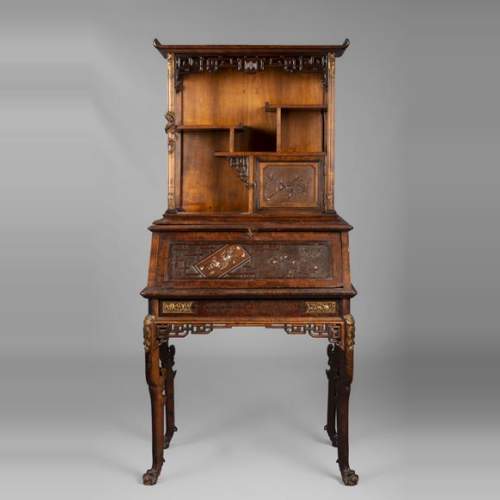
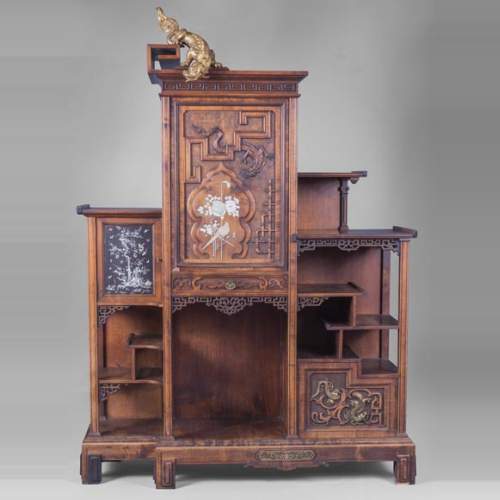
Gabriel VIARDOT (1830-1906) - Large Japanese cabinet with Foo dog

Ref.11321
Gabriel VIARDOT (1830-1906) - Large Japanese cabinet with Foo dog

This exceptional Foo dog cabinet is signed by Gabriel Viardot. Its asymmetrical construction is characteristic of the creations of the Parisian cabinetmaker. The composition alternates solid elements and empty spaces. The central door is decorated with a panel inlaid with ivory, tinted bone and wood composing a bouquet of flowers. This panel probably came from a Japanese furniture piece and was reused, a common practice by Gabriel Viardot, to make this piece. This was also the case for the element adorning the left panel. A frightening character, of a rare plastic quality, is produced in ivory and mother of pearl. The decorative element the most exceptional of this cabinet is a Fu dog crowning the piece. To the right of the piece, supported by a shelf, a crane resting on the back of a tortoise is also made in polished varnished bronze just like the sinuous dragon located in the lower part of the piece. One also finds small elements of latticed polished varnished bronze decorated in their center with a pinecone in this piece. These are, like the scrolled feet, elements frequently present on the pieces of Gabriel Viardot. Gabriel Viardot was a famous Parisian cabinetmaker specialized in the production of “Chinese-Japanese style” furniture in the last third of the 19th century. He started his wood-sculpting career in 1849, when he sent some furniture pieces in natural décor to the horticultural exhibition. He then became the head of a small team of sculptors when he was just 19 years old. In 1853, he had a factory and a store of furniture located at 36 and 38 Rambuteau Road. During this time, he worked with his brother, Louis Gustave, under the name “Viardot Brothers and Company.” In 1860, he created his own workshop, “G. Viardot” at 5 Grand-Chantier road, and became head of the family business that he kept until 1872. He decided to devote himself to “Chinese-Japanese style furniture,” which he was able to observe mainly at the 1867 World Exposition. At this same exposition, he was awarded four medals. It’s with this production that he was awarded at the 1878 World Exposition with a silver medal. Following that, he practiced consecutively at 15 Chaume road, 3 Archives road in 1878 and 36 Amelot road near the end of the century. His furniture was produced thanks to lacquered and carved panels sent directly from China or Japan and decorated with mother of pearl inlays from Tonkin. He enlivened his furniture with bronze decorations, of which he made all the designs by hand. Over the course of the years, the success only continued to grow, particularly at the expositions of Nice and the 8th exposition of the Central Union of Decorative Arts in 1884. In 1885, he participated in the World Exposition of Antwerp where he obtained a gold medal. At this time, the shop employed 90 – 100 workers, sculptors or cabinetmakers, a lot of who were educated directly by Gabriel Viardot. Following this exposition, he was promoted to the rank of Knight in the Legion of Honor (December 29 1885). In 1889, he was at the World Exposition that took place in Paris and awarded a gold medal. He obtained the same award at the 1900 World Exposition.

Dimensions:
Width: 131 cm
Height: 185 cm
Depth: 52 cm

Victor GEOFFROY-DECHAUME, Pair of incense burners made out of silvered bronze, adorned with dogs, circa 1840

Ref.12389
Victor GEOFFROY-DECHAUME, Pair of incense burners made out of silvered bronze, adorned with dogs, circa 1840

This pair of incense burners made out of silvered bronze and adorned with dogs is a work by the goldsmith and sculptor Victor Geoffroy-Dechaume (1816-1892), as indicated by the chiselled signature on the covert’s backs. This pair of incense burners is a testimony of the taste, combining references to the arabic and medieval arts, that develops itself during the 1840 decade, in every field of the decorative arts and in particular in the work of Victor Geoffroy-Dechaume, a prolific designer for civil and religious goldsmithing models. He entered the Beaux-Arts school of Paris in 1831, where he was the student of David d’Agners and James Pradier. His taste pushed him into dedicating himself to decorative arts, and in particular to model designs for goldsmithing, until 1848, when he discovered the medieval sculpture. He gave numerous designs for other artists to use as models, for example the bronzemaker Auguste-Maximilien Delafontaine (1813-1892) or the goldsmith François-Désiré Froment-Meurice (1801-1855). Then, circa 1850, he went for the study of monumental statuary and more accurately of medieval statuary. He became one of Viollet-le-Duc’s principal collaborators and participated thus at some of the biggest restoration sites, like the Chartres cathedral, Notre-Dame of Paris or the Sainte-Chapelle. A multiple and fecund artist, he was at the same time a restorator of religious buildings, a sculptor of monumental pieces, commemorative statues, a goldsmith for the princes and a prolific moulder. In 1855, Geoffroy-Dechaume is appointed director at the Museum for Comparative sculpture (actual Cité de l’Architecture et du Patrimoine). Our pair of incense burners is thus realised according to the main works of the first part of Geoffroy-Dechaume’s career. At this time he dedicated himself to decorative arts and to goldsmithing by producing models and works which ornamental references find their sources into arabic and medieval arts. We recognize these inspirations thanks to the polylobed and animated shapes of our incense burners. Made out of silvered bronze, they present on the top two small sculptures depicting dogs. Their bodies have been pounded with small, abstract patterns bringing them some texture and reminding of the oriental inspiration. The two scenes are different, since on the first one, we can see the dogs fighting, sitted, one biting the other’s neck, while on the other burner, a sitting female is nourishing her babies. These canine figures are set on a ring adorned with oriental patterns and pierced with holes in order for the incense to spread. On the four-feeted base, the sinuous lines and the decoration does form an hybridisation between oriental art and grotesque or even monstruous forms from gothic art, for example with the stylished paw-feet or the scale motif. Bibliography : Catalogue of the exhibition « De plâtre et d’or. Geoffroy-Dechaume sculpteur romantique de Viollet-le-Duc. » Musée d’art et d’Histoire Louis Senlecq, L’Isle-Adam, 1998.

Dimensions:
Width: 24 cm
Height: 37 cm
Depth: 24 cm

Manufacture de Sèvres - Pair of vases Delhi model with a polychrome floral decoration, 1875

Ref.13732
Manufacture de Sèvres - Pair of vases Delhi model with a polychrome floral decoration, 1875

This pair of vases was made in the Manufacture de Sèvres in 1875 as indicates the mark under the base "S75". It is the Delhi model created in 1851 by Jules-Constant-Jean-Baptiste PEYRE (1811-1871), designer in chief of the manufactory in 1845-1848 and in 1856-1871. With a belly shape on the lower part and resting on a more narrow feet, this model with a long neck which is spreading as it extended, marked by a ring. Our pair of vases depict a delicate polychrome floral decoration on a plain white background and of which each part is limited by a gold edging. Under the direction of Victor Regnault, the production of the Manufacture de Sèvres has pulled away from the Empire inspiration to explore a modern technologic potential. This is how the pasta on pasta, the cross-linked pasta or trompe-l'oeil decoration were created. However, after the resignation of Victor Regnault in 1870, the new Republic Parliament threatened to cut the manufactory budget if reforms were not set up. Thus, the direction of the manufactory was given to the chemist and painter Louis Robert until his retreat in 1879 and an improvement commission was created in 1871. It's the ceramist Théodore Deck – member of the commission and a few years later director of the manufactory between 1887 et 1891 – who settled in 1875 a program for the reorientation of the esthetic choices and the creation of new technics executed by Carrier‐Belleuse and the chief chemist Alphonse Louis Salvetat (1846‐1880) then Georges Vogt (1880‐1891). This program promised the creation of a china closer to the oriental pasta allowing colors better glazed, the use of Chinese type transparent and opaque enamels in limited numbers, and the research of the copper red. From 1880, technical progresses are noticed and new decoration styles are spotlighted. The manufactory production under the Third Republic mostly answers to orders for embassies, ministers and other public and prestigious buildings. Nevertheless, vases stay the masterpiece of the manufactory production which develops the highest creativity to constantly renew the sizes and the models. A pair of the same model vases is conserved in the Mobilier National and illustrated on Second Empire et IIIe République, de l'audace à la jubilation de Brigitte Ducrot, published in 2008 in the collection Sèvres, une histoire céramique.

Dimensions:
Height: 32 cm

SÈVRES Manufacture, Porcelain Tazza with Masks, 1846-1863

Ref.13730
SÈVRES Manufacture, Porcelain Tazza with Masks, 1846-1863

This splendid tazza in blue porcelain enhanced with gold was executed at the Sèvres manufactory between 1846 and 1863. The Vincennes manufactory, the ancestor of the Sèvres manufactory, was founded in 1740 by workers who had defected from the Chantilly manufactory. The Vincennes manufactory became royal in 1752, shortly before its transfer to Sèvres in 1756. It enjoyed growing popularity in the second half of the 18th century, and throughout the 19th and 20th centuries, continuing to the present day. This tazza features a highly elaborate shape and decoration. Its baluster stem alternates bands of deep blue with lighter shades embellished with gold filigree, and interlaced gold on a white background with an oriental motif. Three finely executed faun masks complete the decor. The cup itself is decorated with an alternation of more or less expressive male and female masks in relief, also enhanced with gold. Inside the tazza, numerous interlaced gold patterns, some more burnished than others, unfold on a white background. The manufactory stamps present under the base provide information about the creation of the piece: the tazza was crafted during the reign of Louis-Philippe (1830-1848), in 1846; the gold decoration was only completed in 1863, under Napoleon III (1852-1870). A pair of tazze of this model, dated 1854, were shown at the 1884 Union Centrale des Arts Décoratifs exhibition. This tazza is therefore a magnificent testimony to 19th-century decorative art, both in its form and its decoration.

Dimensions:
Height: 33 cm