menu
Menu
account_box
Categories
Contact
email Send us a message

Contact

phone By phone

+33 (0)1 42 25 12 79
Tue.-Sat., from 10am to 6pm
+33 (0)6 60 62 61 90
Everyday from 9am to 7pm.

email by Email

Adress: contact@marcmaison.com

share Let's get social

Languages
And also...
My selection
(32 Objects)

My selection (32 Objects)


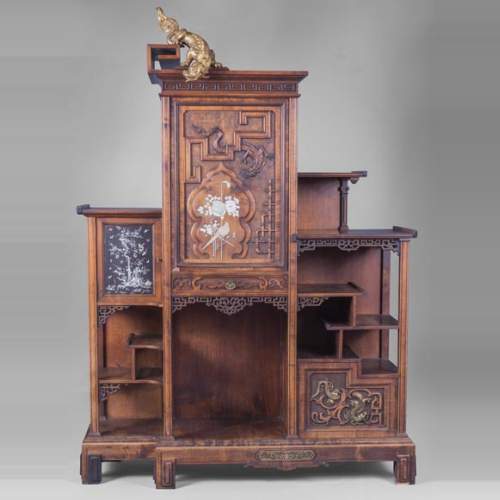
Gabriel VIARDOT (1830-1906) - Large Japanese cabinet with Foo dog

Ref.11321
Gabriel VIARDOT (1830-1906) - Large Japanese cabinet with Foo dog

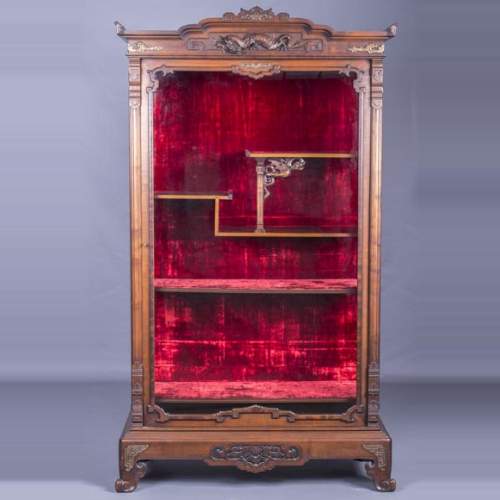
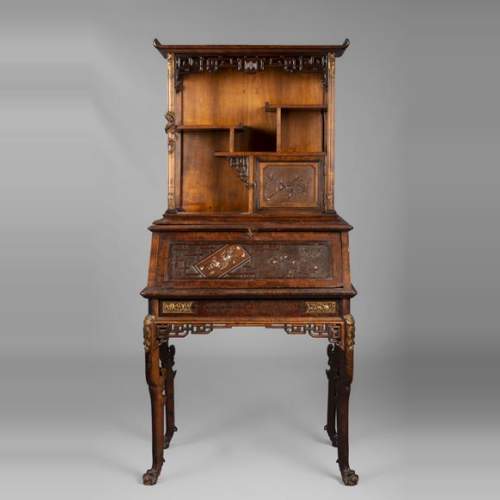
This exceptional Foo dog cabinet is signed by Gabriel Viardot. Its asymmetrical construction is characteristic of the creations of the Parisian cabinetmaker. The composition alternates solid elements and empty spaces. The central door is decorated with a panel inlaid with ivory, tinted bone and wood composing a bouquet of flowers. This panel probably came from a Japanese furniture piece and was reused, a common practice by Gabriel Viardot, to make this piece. This was also the case for the element adorning the left panel. A frightening character, of a rare plastic quality, is produced in ivory and mother of pearl. The decorative element the most exceptional of this cabinet is a Fu dog crowning the piece. To the right of the piece, supported by a shelf, a crane resting on the back of a tortoise is also made in polished varnished bronze just like the sinuous dragon located in the lower part of the piece. One also finds small elements of latticed polished varnished bronze decorated in their center with a pinecone in this piece. These are, like the scrolled feet, elements frequently present on the pieces of Gabriel Viardot. Gabriel Viardot was a famous Parisian cabinetmaker specialized in the production of “Chinese-Japanese style” furniture in the last third of the 19th century. He started his wood-sculpting career in 1849, when he sent some furniture pieces in natural décor to the horticultural exhibition. He then became the head of a small team of sculptors when he was just 19 years old. In 1853, he had a factory and a store of furniture located at 36 and 38 Rambuteau Road. During this time, he worked with his brother, Louis Gustave, under the name “Viardot Brothers and Company.” In 1860, he created his own workshop, “G. Viardot” at 5 Grand-Chantier road, and became head of the family business that he kept until 1872. He decided to devote himself to “Chinese-Japanese style furniture,” which he was able to observe mainly at the 1867 World Exposition. At this same exposition, he was awarded four medals. It’s with this production that he was awarded at the 1878 World Exposition with a silver medal. Following that, he practiced consecutively at 15 Chaume road, 3 Archives road in 1878 and 36 Amelot road near the end of the century. His furniture was produced thanks to lacquered and carved panels sent directly from China or Japan and decorated with mother of pearl inlays from Tonkin. He enlivened his furniture with bronze decorations, of which he made all the designs by hand. Over the course of the years, the success only continued to grow, particularly at the expositions of Nice and the 8th exposition of the Central Union of Decorative Arts in 1884. In 1885, he participated in the World Exposition of Antwerp where he obtained a gold medal. At this time, the shop employed 90 – 100 workers, sculptors or cabinetmakers, a lot of who were educated directly by Gabriel Viardot. Following this exposition, he was promoted to the rank of Knight in the Legion of Honor (December 29 1885). In 1889, he was at the World Exposition that took place in Paris and awarded a gold medal. He obtained the same award at the 1900 World Exposition.

Dimensions:
Width: 131 cm
Height: 185 cm
Depth: 52 cm

Edmond Anne Antoine TAPISSIER « Les sirènes » Salon of 1896

Ref.13600
Edmond Anne Antoine TAPISSIER « Les sirènes » Salon of 1896

This large painting was made by the painter Edmond Tapissier between 1893 et 1896. The artist depicts here a scene on a bank where three naked young women watch a boat far away. The composition is astonishing as the whole balance of the painting, which was tipping to the left, is re-established by the monkey and the parrot. The harmony of the colors is brought by the strength of the peacock and the parrot. Also, the pine branch which is going down the sea breaks the monotony of a too important stretch of water.Edmond is the second son of the silk merchant Antoine Tapissier and Benoite-Angélique Towex-Comte. Antoine Tapissier who stayed widower put his sons in the Collège des Chartreux in Lyon. In 1879, Edmond was 18 years old, he’s an elegant and cultured young man who is seeking for his path. He starts by following classes with the painter Chatigny who was the student of Picot and Chenavard. Chatigny knew Ingres, and was friend with Henner, Bertrand, Courbet and Manet. 1882 was the year of the drawing from nature learning and the first mural decorations. The following year he leaves for Paris and dedicates himself to the copies of the Italian and Flemish old masters. From 1883, the newspaper started to speak about him and recognize that “there is hope”. During the Autumn 1887, he integrated the Ecole des Beaux Arts and entered Cabanel and Cormon’s workshops. Tapissier made his first exhibition in the Salon in the same year. It’s in the period of the portraits tainted with symbolism that he’s making his debuts. He’s received by Puvis de Chavanne to the Society des Artistes Français in 1891. In the same year he decorated the chapel in Saint Étienne and composed there three large scenes of 3 meters, giving him appetite and knowledge for the large compositions.

Dimensions:
Width: 420 cm
Height: 253 cm
Depth: 3 cm

SÈVRES Manufacture, Pair of Chameleon Vases of the Persian Bottle Model, 1874

Ref.15033
SÈVRES Manufacture, Pair of Chameleon Vases of the Persian Bottle Model, 1874

This pair of porcelain vases of the Persian bottle model was made at the Sèvres manufactory in 1874. The “Persian bottle vase” model, created at the Sèvres manufactory in 1874 based on a Persian metal prototype, exists in several versions that vary in color and decoration. It is among the most characteristic of the manufactory’s production under the Third Republic. One can perceive the direct influence of Albert-Ernest Carrier-Belleuse (1824-1887) in the design of these vases. A sculptor and student of David d’Angers, Carrier-Belleuse exhibited at the Salon starting in 1851. He worked in all genres with remarkable inventiveness. He provided several form models to English and Limoges ceramic factories and was the director of art works at Sèvres from 1875 until his death in 1887, completely renewing forms and decorations by introducing a new range of vases that achieved great success at the 1884 Exposition of the Union Centrale des Arts Décoratifs. These two examples, forming a pair, are ovoid in shape with a long tapered neck with a quarter-round median ring. They feature an elaborate decor of Persian motifs in gold powder, with interlacing and arabesques on the body and decorated fillets on the neck. The lavender color is unique, changing depending on the light it is exposed to, from purple/grey in daylight to pale pink in artificial light. This is due to the use of the so-called “chameleon” paste invented in 1848 by the Sèvres manufactory chemist Alphonse Louis Salvetat for the 1862 Universal Exhibition. A mixture of vanadium oxide and cerium oxide allows this change of color according to its exposure to light. Exceptionally, these vases are neither signed nor bear any mark of the manufactory. However, they have an inscription that leaves no doubt as to their origin or date: “EXPOSITION DES BEAUX-ARTS. / F. BUON / INSPECTOR OF FINE ARTS / Head of the Exhibitions Service / 1874”. Frédéric Buon was already an inspector of Fine Arts in 1870-1871 and later remained an honorary inspector. Therefore, these are commemorative vases, made especially for the 1874 Fine Arts Exhibition. Similar vases to ours, although without an inscription, are referenced in a book published in 2012 by the Brian Haughton gallery, A Sense of Pleasure. A similar model, kept at the Musée des Arts et Métiers in Paris, is referenced in Second Empire and Third Republic, from Audacity to Jubilation by Brigitte Ducrot, published in 2008 in the Sèvres, a Ceramic History collection. Another pair of vases, of the same model and with the same glaze, listed by the British Antique Dealers’ Association, bears an inscription similar to the one of interest to us: “EXPOSITION DES BEAUX-ARTS / ROUSSEAU (PH) / Member of the Jury, Painting Section / 1874”. The painter Philippe Rousseau was a painter of landscapes, still-lifes, and animals, who had been awarded several medals at the Salon. In 1874, he was an accomplished and recognized painter, and thus was appointed to the painting jury for the Fine Arts Exhibition. Moreover, a different pair of vases, of a different model but bearing a similar inscription, was sold in 2023: these are Sèvres pedestal vases in blue kiln porcelain enhanced with gold, bearing the inscription “EXPOSITION DES BEAUX-ARTS. / VTE DELABORDE / OF THE INSTITUTE / Member of the Jury. Engraving Section. / 1873”. These vases are signed and dated. The Viscount Henri Delaborde (1811-1899) was first a history painter, then, when he had to give up painting, he became a renowned art historian. For a long time a curator in the Prints Department of the Imperial Library (now the National Library of France), he was naturally asked to be part of the engraving jury in 1873, an event commemorated by these vases and their inscription. These numerous examples of commemorative vases suggest that on the occasion of at least two Fine Arts Exhibitions, in 1873 and 1874, the jury members and other organizers of the event were given a vase from the Sèvres manufactory, probably as a token of appreciation for their involvement in the event. It is even possible that, since the two vases dated 1874 are of the same model, a different model was selected each year for this purpose.

Dimensions:
Height: 55 cm

BOCH Brothers (ceramic), Th. FUMIETE (?), Portrait of a Japanese Lady in Earthenware, 1890

Ref.14790
BOCH Brothers (ceramic), Th. FUMIETE (?), Portrait of a Japanese Lady in Earthenware, 1890

This portrait of a Japanese lady dated 1890 bears the signature, possibly apocryphal, of a certain Th. Fumiete, whom our research has not been able to trace. He worked for Boch frères, whose mark is visible on the reverse of the tiles. The Boch family began producing ceramics in 1748. However, the “Boch Frères” company was only founded in 1844, after many moves, by Eugène and Victor Boch and their brother-in-law Jean-Baptiste Nothomb. Between then and 1881, Victor Boch was at the helm, with engineer Charles Tock taking over until 1904. The assembled ceramic tiles form a large decorative panel. The woman, with her long black hair held back by several sticks behind her head, looks ahead, her head slightly tilted to the side. She is dressed in a kimono with a rich and colorful floral design over a tunic that closes tightly at the neck. She places her right hand on the wide belt (“obi”) that wraps around her. The decorative background is sprinkled with Japanese maple leaves. A primary decorative border adorned with stylized plant motifs (some resembling papyrus leaves) highlights the central figure. The entire piece is set in a wooden frame carved in bas-relief with similarly stylized plant motifs forming scrolls. The enthusiasm that arose in the second half of the 19th century, notably following Japan’s reopening to international trade and its participation in the 1867 Universal Exposition, became known as “Japonism”. This sparked a revolution in Western art, strongly inspiring many artists across all fields. This piece demonstrates the strong influence of Japanese art on Western creations at the end of the 19th century, both in subject and execution (the deliberate absence of depth and the use of flat colors are characteristic of Japanese prints). This work, beyond its intrinsic aesthetic qualities, is emblematic of this movement and reflects the enthusiasm aroused by Japanese works, objects, and even lifestyle among Westerners at the end of the 19th century. The ceramic is original. The design on three tiles has undergone a previous high-quality restoration. The signature has also been restored, suggesting it may be inaccurate.

Dimensions:
Width: 93 cm
Height: 123 cm
Depth: 5 cm

E. BRUN after Jules-Claude ZIEGLER, Portrait of Louis de Champagne, Count of Sancerre, 1920

Ref.15499
E. BRUN after Jules-Claude ZIEGLER, Portrait of Louis de Champagne, Count of Sancerre, 1920

This portrait of the Count of Sancerre was made by E. Brun in 1920. It is a copy of the work by Jules-Claude Ziegler preserved at the Château de Versailles, as indicated by the inscription placed at the bottom left of the canvas. The original portrait was commissioned for the Galerie Militaire at Versailles in 1834; upon its delivery, it was placed in the Hall of the Constables. Under the reign and initiative of Louis-Philippe (1773-1850), the former residence of the kings of France was transformed into a museum dedicated to “all the glories of France”. In this context, numerous works were commissioned to illustrate the political and military history of France, including this portrait. The copy of the Versailles portrait was likely commissioned by the Sancerre family for their personal residence, the Château de Sancerre, where it was displayed. The constable and his mount occupy the center of the composition. Very dignified, he turns his head to the left, as if his attention has been drawn there – a way for the painter to partially conceal his strabismus, as noted in the Chronicle of the Monk of Saint-Denis. He guides his horse with his left hand while holding a staff of office in his right. He is dressed in armor and chain mail, over which he wears a large red cape and a yellow tunic bearing his family’s coat of arms. The crest is also present on the barding covering the horse’s upper body, surmounted by a comital crown. The horse is shown in motion, its tail in the wind, imparting a sense of movement to the portrait. The scene unfolds against a rocky landscape extending to the horizon. The sky is heavy with clouds at the lower part, transitioning from dark gray to a lighter tone, culminating in a blue sky in the upper third of the canvas. The copy is rigorously identical to the original, with two exceptions: the absence of the artist’s signature on the rock, replaced by the inscription, and the inclusion of a castle in the background. This was likely an express request by the commissioners of this painting: as it was intended to adorn the walls of the Château de Sancerre, it seemed fitting to depict the structure as an integral part of the count’s history. Louis de Champagne, Count of Sancerre (1341/42–1402), was Lord of Charenton, Beaumetz (or Bommiers?), Menetou-Salon, and later Ambrault (1391). Having fought in numerous battles during the Hundred Years’ War, he was named Marshal of France in 1368 and distinguished himself in combat on many occasions. The chronicler Jean Froissart (c. 1337-c. 1410) described him as “a valiant man and a boldly steadfast knight” and “the finest ornament of French chivalry”. He also served as an ambassador to England in 1385, governor of Languedoc from 1390 to 1401, and finally Constable of France in 1397. The Count of Sancerre was buried at the Basilica of Saint-Denis, where his effigy can still be seen today. This effigy, the closest temporal likeness of Louis de Champagne, was likely a source of inspiration for Jules-Claude Ziegler’s portrait. He is depicted here as constable, a title denoting the supreme commander of the king’s armies from the late 12th century, and as Lord of Sancerre, with the château in the background and his coat of arms included in the imagery. This representation aligns with the 19th century’s documentary interest in French history, particularly in the depiction of armor. This historical passion extended into the 20th century, as seen in the creation of this copy, which was accompanied by a frame adorned with neo-Gothic cabbage-leaf moldings.

Dimensions:
Width: 227 cm
Height: 298 cm
Depth: 9 cm

Carlo BUGATTI, Pair of Moorish style wall console sconces, circa 1888

Ref.12564
Carlo BUGATTI, Pair of Moorish style wall console sconces, circa 1888

This false pair of wall sconces is quintessentially characteristic of Carlo Bugatti’s art, designed by him around 1888. Carlo Bugatti (1856-1940) trained at the Brera Academy in Milan and later at the École des Beaux-Arts in Paris before turning his focus to furniture design. He exhibited his works at the Italian Exhibition at Earl’s Court in 1888, at the 1900 Paris Exhibition – where he won a silver medal – and in Turin in 1904, where he received an honorary diploma. Bugatti later moved to France and decided to focus on silverwork. These wall sconces perfectly embody his unique style. The geometric influence is evident in his use of circles, a recurring motif in his work. Hammered and perforated, the circular element supports a small square-topped cedarwood console adorned with triangular patterns and bone inlays inspired by Islamic art. The console is mounted on a stand resting on a base decorated with stylized rosettes. Suspended beneath is a small dome holding three chains, which are attached to a perforated copper bowl. The two sconces feature slight variations in their decorative details. This model was presented at the Italian Exhibition in London in 1888, where Carlo Bugatti was awarded an honorary diploma. On this occasion, a page featuring his works was published in the journal The Queen, The Lady’s Newspaper & Court Chronicle on July 7, 1888. The ensemble was described as “quaint”, meaning “picturesque”, a term that aptly reflects the variety of influences in Bugatti’s work. While he primarily drew inspiration from Moorish art, he also incorporated elements from other styles, eras, and cultures. The Musée d’Orsay in Paris holds a photograph of this same model, published between 1888 and 1898, likely for commercial purposes. Additionally, the Kunstgewerbemuseum in Berlin houses another version of this wall sconce. This pair of wall sconces is thus a concentrated expression of Carlo Bugatti’s decorative vocabulary, showcasing both his creativity and the importance of Moorish influences in his work, though he cultivated a distinct and unique style throughout his work.

Dimensions:
Width: 50 cm
Height: 104 cm

Louis MALARD, Unique “Ramses-Style” Bedroom in Walnut With Gold Leaf Embellishment, 1889 World’s Fair

Ref.11700
Louis MALARD, Unique “Ramses-Style” Bedroom in Walnut With Gold Leaf Embellishment, 1889 World’s Fair

H. 271 cm / 106” 11/16; W. 260 cm / 102” 3/8; D. 232 cm / 91” 5/16 (bed without canopy) H. 74 cm / 29” 1/8; W. 231 cm / 90” 15/16; D. 148 cm / 58” 1/4 (canopy) H. 73 cm / 28” 3/4; W. 212 cm / 83” 7/16; D. 74 cm / 29” 1/8 (bench) H. 101 cm / 39” 3/4; W. 45 cm / 17” 3/4; D. 42 cm / 16” 9/16 (chairs) This extraordinary neo-Egyptian set bedroom crafted in carved solid walnut and enhanced with gold leaves (yellow, green, and red), was created by Louis Malard for display at the 1889 Paris Exhibition, where it earned him a silver medal. The cabinetmaker Louis Malard operated a workshop and furniture store located at 9 bis, rue Maubeuge in Paris. The establishment produced and sold furniture in various styles, particularly historical ones. It exhibited different furniture ensembles at the 1889 and 1900 World’s Fairs. Various reports and advertisements published in Le Figaro allow us to date his activity to between 1886 and 1903. The centerpiece of this bedroom set is the bed. While it does not resemble Egyptian beds as depicted in archaeological findings from the 19th century, it incorporates the architectural and artistic codes of ancient Egyptian art to create a monumental, unique work that aligns with the requirements of modern comfort. The canopy is adorned with an Egyptian temple pylon at its center, flanked by vultures with outstretched wings – symbols of the goddess Nekhbet – and lotus flowers. The headboard features sphinx figures, various hieroglyphs, and scenes inspired by ancient monuments, including Ramses II on his chariot at the Battle of Kadesh (circa 1274 B.C.E.). The artist drew inspiration for this from a low-relief in the Great Temple of Abu Simbel, as documented by Jean-François Champollion in his work Monuments de l’Égypte et de la Nubie (Monuments of Egypt and Nubia). On either side of the headboard, the bedside tables are decorated with life-size seated figures whose poses mimic the monumental statues of ancient Egypt. Their garments reflect the iconographic codes of feminine fashion visible in the low-reliefs of ancient art. The foot of the bed is guarded by two lion-sphinxes in a hieratic posture, while the frame combines hieroglyphic signs, worshipper figures, and representations of the god Anubis. The bed is accompanied by a bench whose decoration mirrors that of the bed frame, along with the motif of sphinxes, and a pair of chairs adorned with scarabs – sacred animals to the Egyptians symbolizing the god Khepri, the rising sun. The presentation of this bedroom furniture at the 1889 Paris Exhibition was a resounding success: in addition to the silver medal awarded to its creator, it received widespread critical acclaim, including a highly favorable article in Le Figaro. It also achieved commercial success, being purchased by Countess Bathilde Ducos (1851-1927), daughter of a former Minister of the Navy under Emperor Napoleon III. It was sold as part of a theatrical yet less elaborate furniture ensemble forming a bedroom: a wardrobe, a fireplace, and a pair of draperies. This bedroom set was auctioned in 1896, probably to Charles Henri Duquesne, whose family kept it until 2019, when it was acquired by the Galerie Marc Maison. Today, this bed serves as a reminder of the fascination that 19th century artists and their contemporaries had for ancient Egyptian art, which inspired rich creations and reinterpretations. Literature: Le Figaro, July 1, 1889, 35th year, 3rd series, no. 182, p. 2, in the “Courrier de l’Expostion” section. Charles Oudart (dir.), Gazette de l’hôtel Drouot, Saturday, June 30, Sunday, June 31, and Monday, June 1, 1896. Jean-François Champollion, Monuments de l’Égypte et de la Nubie…, volume I, Paris, Firmin Didot Frères, 1835, plate XIII.

Dimensions:
Width: 260 cm
Height: 345 cm
Depth: 232 cm

Carved softwood high relief of an animal scene, 19th century

Ref.15804
Carved softwood high relief of an animal scene, 19th century

This softwood panel, almost certainly limewood, illustrating an animal scene is remarkable for the finesse of its ornamental details. In the foreground, a dog stands still at the edge of a pond. He has just spotted three ducks, two of which take flight to escape the hunter, who will soon rejoin his dog. The effect of perspective is particularly effective in this piece: the dog and the nearest reeds are sculpted in high relief, while the plants further away and the birds in flight are barely visible. This scene is completed by a frame that simulates wooden planks nailed together; the only reference to a human presence. An interlacing of aquatic plants, including lotuses, completes the composition, symbolising the perfect harmony between man and nature. The roughness of the planks is counterbalanced by the delicate stems and leaves that surround them. Part of the scene (the reeds, the ground, the dog's right hind leg and tail) emerges from the frame, giving the piece a particular liveliness and dynamism. Even though this beautiful sculpted panel dates back to the 19th century, it is Aubert-Henri-Joseph Parent (1753-1835) who established the reputation of this type of fine creation during the 18th century. Many artists followed in Aubert Parent's footsteps by creating panels of this kind. The Château de Versailles, for example, still has one of his high reliefs, which the sculptor gave to Louis XVI in 1777 and which was on display in the Retours de chasse dining room at Versailles.

Dimensions:
Width: 20 cm
Height: 18 cm