menu
Menu
account_box
Categories
Contact
email Send us a message

Contact us

phone By phone

+33 (0)1 42 25 12 79
Tue.-Sat., from 10am to 6pm
+33 (0)6 60 62 61 90
Everyday from 9am to 7pm.

email by Email

Adress: contact@marcmaison.com

share Let's get social

Languages
And also...
My selection
(40 Objects)

My selection (40 Objects)

Louis-Constant SÉVIN (1821-1888) and Ferdinand BARBEDIENNE (1810-1892), Exceptional Pair of Ornamental Vases in Bronze and Enamel, model presented during the International Exhibition of London in 1862
Ref.12600
Louis-Constant SÉVIN (1821-1888) and Ferdinand BARBEDIENNE (1810-1892), Exceptional Pair of Ornamental Vases in Bronze and Enamel, model presented during the International Exhibition of London in 1862

This exceptional pair of vases is the result of the collaboration between Louis Constant Sevin, drawer and designer, and Ferdinand Barbedienne, bronze maker and founder of the famous 19th century foundry of the same name. These vases are the same than a model presented on the Barbedienne's stand during the International Exhibition of London in 1862. We owe to the associations of the two men – which has lasted for more than thirty years, between 1855 and 1888 – an important collection of works of art and especially vases, showing the same colors and technical. Our ornament vases were made in bronze and show an outstanding and abundant decoration of champlevé enamel. The gilt bronze on the blue background and the polychromatic richness of the motif reminds of an imaginary and an inspiration coming from the East. The vases are adjoined with three gilt bronze handles with cat's heads, finished with claws on which they lean. The tie is adorned with amethyst cabochons. We notice in the shape and the decoration an eastern inspiration but above all an eclectic one, characteristic of the artistic tendency in France under the Second Empire. Indeed, Constant Sevin was inspired by the Greek style for the shape in amphora and by patterns belonging to the Arabic, or Persian decorative repertoires for the decoration. While the handles with cat's heads tend toward reminding Egypt, the technic of champlevé enamel dates back to Middle Ages. Thus, although critics spoke about a Byzantine style in 1862 for the inspiration of those vases, it seems more appropriate to talk today about eclecticism. Louis Constant Sevin having drew in visual references different by their styles, their periods of time or their geographic areas. With the creation of this pair of vases Ferdinand Barbedienne and Constant Sevin participate to the reborn of champleve enamel in the middle of the 19th century. The first technical tries of Barbedienne were made near 1858 and four years after he presents in the Great Exhibition of London a stand mainly composed of works of art inlaid of enamels – like the model of our vase – which does not leave the critic indifferent. Successful, these vases were republished, maybe for private orders, sometimes with some changes, such as the cat's ears orientation, the feet shapes or the replacement of cabochons by palms, nevertheless the pattern stayed the same. We can find for instance, two similar vases, forming a pair in the collections of the Orsay Museum in Paris.

Dimensions:
Width: 28 cm
Height: 78 cm

BACCARAT CRISTALLERIE and Eugène ROUSSEAU (model by), Pair of vases « Clair de Lune » in blue crystal and gilt bronze mount, circa 1875-1890

Ref.13481
BACCARAT CRISTALLERIE and Eugène ROUSSEAU (model by), Pair of vases « Clair de Lune » in blue crystal and gilt bronze mount, circa 1875-1890

This pair of blue crystal vases with hot-enamelled decoration is mounted in a gilt bronze base representing branches of cherry blossom. These vases were produced by the Baccarat crystal works between 1875 and 1890 after a design by Eugène Rousseau (1827-1890). This is the « Clair de lune » (Moonlight) model, whose Japonisant decoration depicts a weeping willow set within a full moon. The neck and the base are highlighted with a fine gilded line. The two vases are presented on a gilt bronze mount with four feet representing branches of cherry blossom. François-Eugène Rousseau (1827-1890), known as Eugène Rousseau, was a master glassmaker established from 1855 as a dealer specialising in porcelain and faience in Paris. In 1867, having developed an interest in Japonisant motifs, Eugène Rousseau commissioned Félix Bracquemond to produce a porcelain service intended for display at the Universal Exhibition in Paris, where for the first time a European artist directly copied a Japanese artist, reproducing animal figures from Hokusai's Manga. His Japonisant glassware, produced with the probable collaboration of the Appert brothers at Clichy and the Baccarat crystal works, was presented in 1874 in Paris at the fourth Exhibition of the Union centrale des Beaux-arts appliqués à l'industrie. A member of the Union centrale des Arts décoratifs from its foundation in 1862, Eugène Rousseau was awarded the cross of the Légion d'honneur. The Baccarat crystal works owes its international renown to its participation throughout the nineteenth century and up to 1937 in the Universal Exhibitions. It was during the nineteenth century that the manufactory distinguished itself in the eyes of the world through the excellence of its production and its constant pursuit of innovation. Its creations long influenced European glass and crystal manufactories and set the standard in terms of technique of execution and stylistic models. The works of the crystal manufactory were very rarely signed before 1860, the year in which the first labels appeared sporadically, and fifteen years later the stamp bearing the name of the crystal works on certain blown models and bronze parts.

Dimensions:
Width: 13 cm
Height: 23 cm
Depth: 13 cm

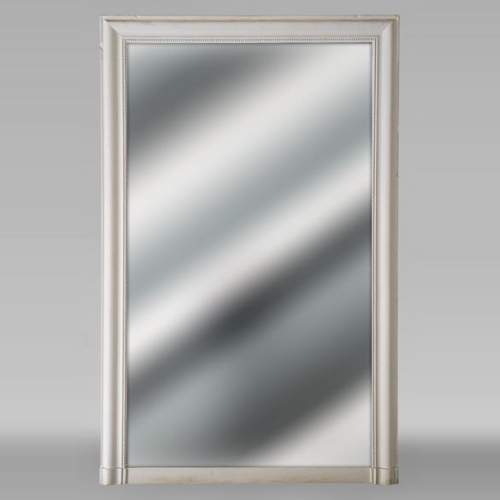
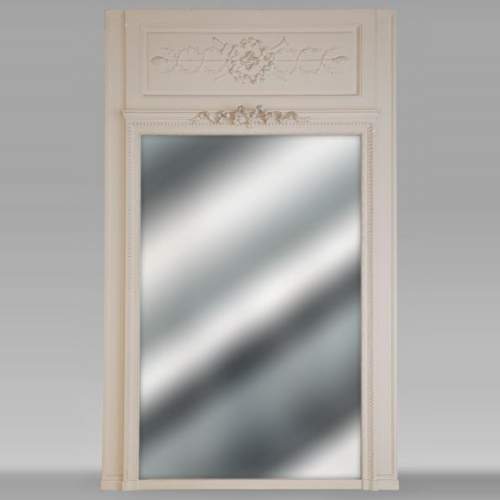
Trumeau in the Louix XVI style with pearl frieze

Dimensions:
Width: 105 cm
Height: 163 cm
Depth: 5 cm

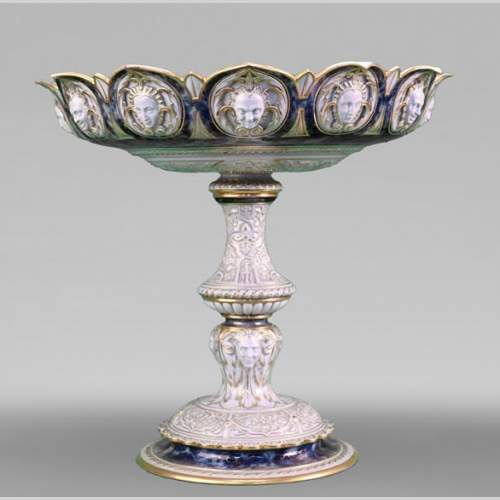
SÈVRES Manufacture, Porcelain Tazza with Masks, 1846-1863

Ref.13730
SÈVRES Manufacture, Porcelain Tazza with Masks, 1846-1863

This splendid tazza in blue porcelain enhanced with gold was executed at the Sèvres manufactory between 1846 and 1863. The Vincennes manufactory, the ancestor of the Sèvres manufactory, was founded in 1740 by workers who had defected from the Chantilly manufactory. The Vincennes manufactory became royal in 1752, shortly before its transfer to Sèvres in 1756. It enjoyed growing popularity in the second half of the 18th century, and throughout the 19th and 20th centuries, continuing to the present day. This tazza features a highly elaborate shape and decoration. Its baluster stem alternates bands of deep blue with lighter shades embellished with gold filigree, and interlaced gold on a white background with an oriental motif. Three finely executed faun masks complete the decor. The cup itself is decorated with an alternation of more or less expressive male and female masks in relief, also enhanced with gold. Inside the tazza, numerous interlaced gold patterns, some more burnished than others, unfold on a white background. The manufactory stamps present under the base provide information about the creation of the piece: the tazza was crafted during the reign of Louis-Philippe (1830-1848), in 1846; the gold decoration was only completed in 1863, under Napoleon III (1852-1870). A pair of tazze of this model, dated 1854, were shown at the 1884 Union Centrale des Arts Décoratifs exhibition. This tazza is therefore a magnificent testimony to 19th-century decorative art, both in its form and its decoration.

Dimensions:
Height: 33 cm

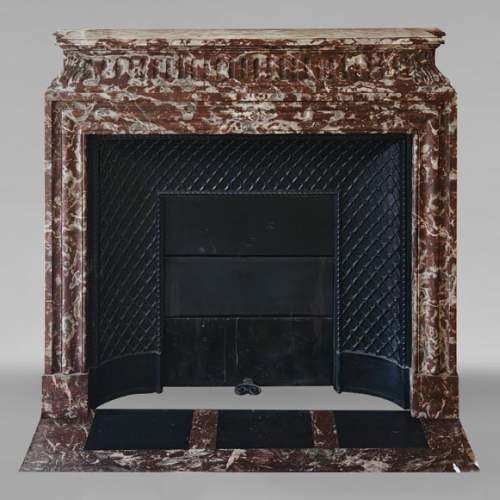
Louis XIV style mantel with acroterion in Rouge du Nord marble

Dimensions:
Width: 159 cm
Height: 142 cm
Depth: 39 cm
Inner width: 114 cm
Inner height: 103 cm

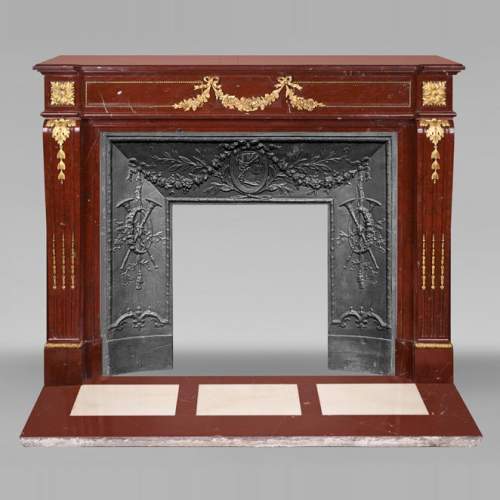
Louis XIV style mantel in Rouge de Rance marble adorned with bronze ornaments

Dimensions:
Width: 135 cm
Height: 120 cm
Depth: 36 cm
Inner width: 93 cm
Inner height: 85 cm

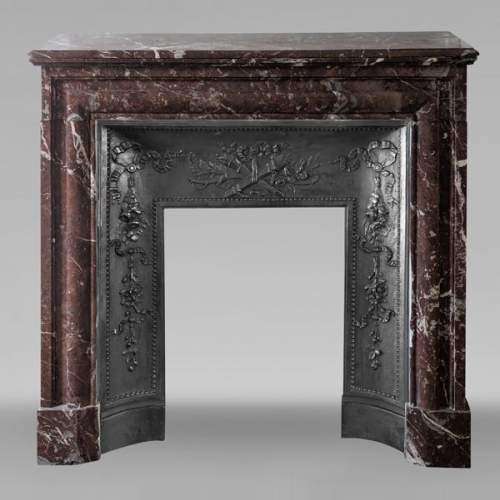
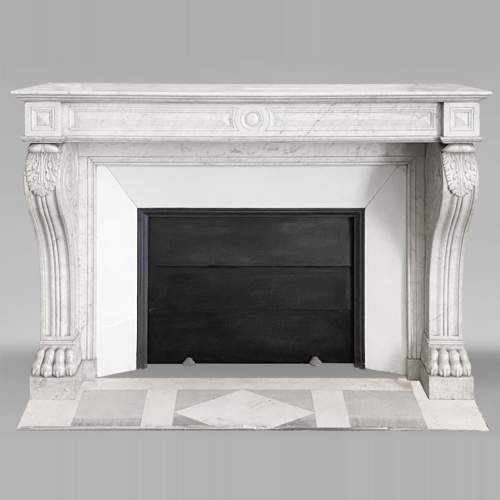
Napoleon III period fireplace with lion's paw feet, in Carrara marble

Dimensions:
Width: 158 cm
Height: 110 cm
Depth: 50 cm
Inner width: 116 cm
Inner height: 81 cm

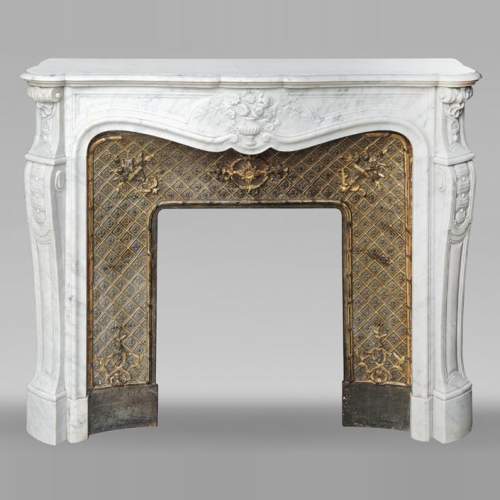
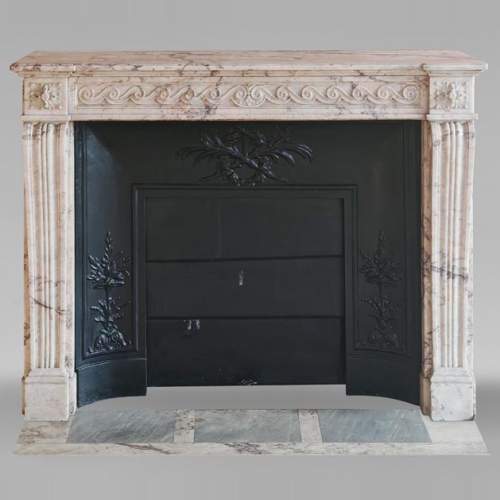
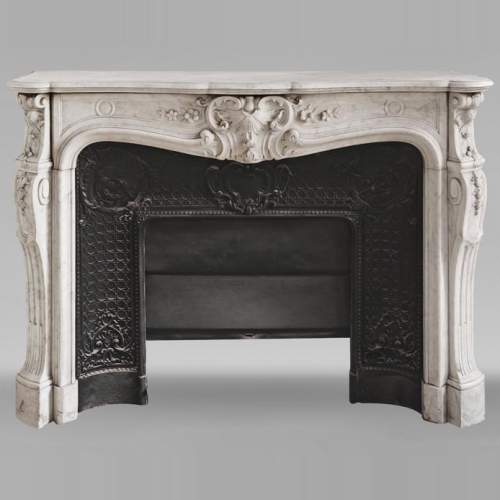
Louis XV style fireplace in Carrara marble, decorated with a vase of flowers

Dimensions:
Width: 133 cm
Height: 106 cm
Depth: 38 cm
Inner width: 94 cm
Inner height: 90 cm