menu
Menu
account_box
Categories
Contact
email Send us a message

Contact

phone By phone

+33 (0)1 42 25 12 79
Tue.-Sat., from 10am to 6pm
+33 (0)6 60 62 61 90
Everyday from 9am to 7pm.

email by Email

Adress: contact@marcmaison.com

share Let's get social

Languages
And also...
My selection
(14 Objects)

My selection (14 Objects)


Exceptional large clock with the Fô dogs

Ref.03222
Exceptional large clock with the Fô dogs

Brown patina bronze, the base in Red Griotte marble. This magnificent clock was made in France around 1880 out of authentically Chinese bronzes. Two large Foo Dogs, made in China at the start of the 19th century, stand on their hind legs, and support the pendulum with their forelimbs. The pendulum mechanism sits inside a Chinese bronze vase that was specifically cut at its base and reused to make up the body of this clock. It is decorated all over its surface with engraved ornaments. Two dragons carved in relief are placed on the front of this vase and surround the clock's dial. On the back, there is a cockerel with its wings spread, with its head carved in relief. The extremely high quality bronze and the very skilful use of composition makes this clock very original. This clock is typical of a technique that was popular towards the end of the 19th century, which derived from a profound taste in the Far East. This technique involved reusing authentically Chinese elements on European designed objects, which were intended to be used on the most luxurious interiors. The clock's magnificence makes us reflect on the fact that it was made by a true amateur of Chinese Art. The dial's numerals are made out of enamel and are true Chinese numerals. The clock hands feature a dragon which is the result of excellent chiselling skill. These different elements are of French craftsmanship, as is the pendulum featuring an animal with tentacles. The pendulum is signed “ L.M et Cie, Médaille de bronze” (L.M and Cie, Bronze Medal), which confirms that it is off French craftsmanship and was made around 1880.

Dimensions:
Width: 81 cm
Height: 72 cm
Depth: 17 cm

CHRISTOFLE - Exceptional planter in electroplated copper, partially copper colored, gilt, silvered and burnished on a silver background, circa 1878

Ref.13653
CHRISTOFLE - Exceptional planter in electroplated copper, partially copper colored, gilt, silvered and burnished on a silver background, circa 1878

This exceptional planter was produced by the silver company Christofle from a model by the architect and theorist Emile Reiber (1826-1893), then chief of the house’s drawing workshop since 1865. Strongly marked by the Japanese or Chinese bronzes, Emile Reiber is one of the Japonisme leader in the decorative arts in France. He is especially inspired by the Japanese mixed-metal objects called Mokume, for his tries on the polychromatic research. Thus, he composed colored models for the Christofle company made thanks to the electroplated technique, of which the French rights of the Elkington’s patent were bought by Charles Christofle (1805-1863), founder of the house, in 1842, then really developed by Henri Bouilhet in the workshops. It’s this way that Emile Reiber permits the company to renew its production in the 1870’s, by creating a collection of original decorative pieces mainly Japan inspired. They were particularly noticed during their presentation in the World Fairs of Vienna in 1873 and Paris 1878, making of Christofle, the silversmith of the colored bronze. Since its origins, Christofle has followed the tastes of its time, reflecting the artistic movements in vogue. From the Monarchy of July to the late 19th century, prevail the eclecticism and the naturalism, while the East favors the research for new decors. On the Orientalism and Japonism momentum, nature inspires the production of objects and places progressively on the market objects with various shapes and decorations. Thus, the plants theme in the decor is generalized in the 1880’s. To always better renew its decorative vocabulary, the most important French Silver house of the second half of the 19th century, occasionally asks famous artists to work for them. It’s this way that Emile Reiber draws the model of our planter edited in diverse colors, on black or red backgrounds. Presenting a decor in the Japanese taste, the silver colored body of our gardener shows a decor composed of copper colored quince flowers with burnished leaves and also burnished cherry tree branches. It rests on gilt bronze feet taking the shape of pine cones that we also find on the handles. The different metallic shades are obtained thanks to the electroplated technique. Similar in its principle to the gilding or the silver plating, the electroplating is a fabrication proceed which is a ruthless competitor to the different cast iron techniques. The aim is to allow the metal reproduction of any object, whatever its nature. The huge advantage of this technique compared to the cast iron is to make an object immediately perfect, without mending or carving it.

Dimensions:
Width: 45 cm
Height: 14 cm
Depth: 29 cm

Miguel Fernandez LOPEZ, known as MILO, The Diver, contemporary era

Ref.15276
Miguel Fernandez LOPEZ, known as MILO, The Diver, contemporary era

The Diver was executed by Milo at the end of the 20th or the beginning of the 21st century. Miguel Fernando López, known as Milo (born in Lisbon in 1955), is a Portuguese post-war and contemporary sculptor of international renown. He works for many renowned foundries and primarily creates small bronze sculptures. With The Diver, he is as interested in representing a sport as in depicting the human body. The sculpture portrays a naked man, crouching as if about to dive forward; this effect is enhanced by the height of the Portoro marble base and by the position of his hands, below the top level of the base. In his work, the sculptor is interested in the flexibility that the body can achieve and the twists it can undergo. In the case of The Diver, his position is not rigorous: a diver would point his hands towards the water, while here they are intertwined in a harmonious curve. Similarly, the man is not wearing a swimsuit, which elevates the work to the level of a representation of the nude, an academic exercise, and not merely a depiction of a sport. The artist does not neglect any detail and, although hidden at first glance, the face is of great delicacy. Milo also created an Athlete in a similar vein. Again, the sport is a pretext for the representation of the nude. The man is also crouched, but it is more difficult to determine what he is about to do; perhaps the artist has depicted the stage preceding the dive.

Dimensions:
Width: 8 cm
Height: 23 cm
Depth: 14 cm

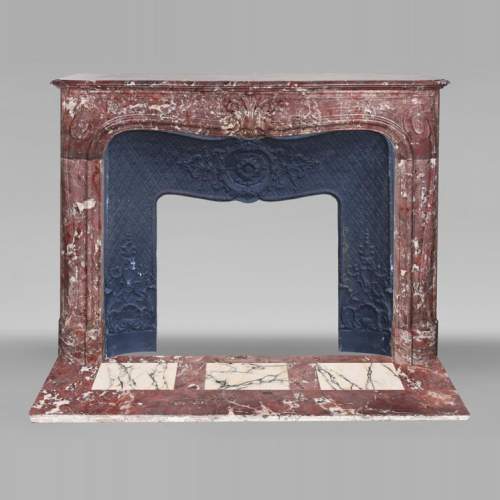
Louis XV style Pompadour mantel in Enjugerais marble

Dimensions:
Width: 115 cm
Height: 103 cm
Depth: 36 cm
Inner width: 83 cm
Inner height: 74 cm

Tony SELMERSHEIM, Art Nouveau Mantelpiece in Green Campan Marble, 1910

Ref.4747
Tony SELMERSHEIM, Art Nouveau Mantelpiece in Green Campan Marble, 1910

This highly original mantelpiece was carved in the Art Nouveau style in1910 by tony Selmersheim, in Campan green marble. The lintel is adorned with a vast curve imitating a pediment, ending at the corners in two curves echoing the shape of the upper part of the jambs. The interior of the mantel is highlighted by slightly mushroom-shaped curves, typical of Art Nouveau. The mantels are recessed at right angles to the inside, and follow two arcs on the outside. The ornamentation on the narrow sides is meticulous, echoing the curves underlining the cut-out jambs and featuring a beautiful “whiplash” line. This 1910 mantel was realized in Campan vert, a green marble with white veins. Green Campan is one of several varieties of Campan marble, including Ribbon Campan marble, Pink Campan and Campan Grand Mélange. It is quarried at the Campan site on the Payolle plateau (hamlet Espiadet) in the upper Adour valley in the Hautes-Pyrénées. In the late 19th and early 21st centuries, the green Campan variety became fashionable for cladding interiors, buildings and other edifices abroad, such as the cathedrals of Westminster, Peterborough and Bristol in the United Kingdom. Joseph Paul Tony Selmersheim (1871-1971) was the designer of this mantel. He was a 20th-century French architect, decorator, furniture designer and cabinetmaker. In 1890, he enrolled at the Ecole Nationale Supérieure des Arts Décoratifs. To complement his courses, he enrolled in Eugène Grasset's classes at the Ecole Guérin and attended the “Atelier des Epinettes”, which trained art workers. In 1895, he founded and chaired the Société des cinq, which in 1895 became the Société des six with Charles Plumet, and finally became L'Art dans tout in 1897. This movement challenged the hierarchies between major and minor arts, the compartmentalization between artistic, craft, and industrial production, and sought to create a “social art”. In August 1903, Plumet and Selmersheim created the Ch. Plumet et Tony Selmersheim company, which produced and sold furniture and decorative items. Tony took over the business alone in 1904 and continued until 1938-39. Throughout his career, Tony Selmersheim took part in numerous Salons. It was at the Salon de l'Automne in 1910 that he exhibited this fireplace carved from his drawings. This fireplace is exhibited as part of a bedroom. It was presented with a slightly curved decorated by painter Charles Guérin, reminiscent of the Art Nouveau style. This style is reflected both in the absence of any clear demarcation between the lintel and the legs (on the contrary, the ornamentation is continuous) and in the plant-inspired lines running through the marble. This fireplace could be appreciated for its “very personal” character, says Amédée Marandet in the “Chronique artistique” section of the L'Aurore newspaper of May 13, 1911. Next to our fireplace, another was exhibited designed by Tony Selmersheim for the dining room, sculpted by Mr. Huve from a model by the sculptor Camille Lefèvre. After the 1910 Salon, these two Tony Selmersheim’s rooms, including our fireplace, were exhibited again at the 1911 Salon des Artistes Décorateurs.

Dimensions:
Width: 148 cm
Height: 104 cm
Depth: 39 cm
Inner width: 89 cm
Inner height: 80 cm

Gustave VANAISE, Innocence, 1884

Ref.15551
Gustave VANAISE, Innocence, 1884

This painting titled Innocence was created by Gustave Vanaise in 1884. Gustave Vanaise (Ghent, 1854-Saint-Gilles, 1902) studied at the Royal Academy of Fine Arts in Ghent under Théodore Canneel, and later in Brussels. He notably produced historical paintings, portraits, and intimate scenes; many of his works are preserved at the Museum of Fine Arts in Ghent. Vanaise participated regularly in the Paris Salon from 1879 to 1888; in 1884, he exhibited a Young Boy with a Pigeon, which may be this very piece. This work is an allegory of Innocence. Against a backdrop of a luminous yellow cloth stands the figure of a young boy lying on the ground, propped up on his elbows; his youth and nudity, both symbols of innocence, are further emphasized by the dove he holds in his left hand, a symbol of purity. The boy seems about to kiss the bird on the beak. The scene is completed on the right by a low-relief representing a gentle Madonna and Child, set against the background. The artist’s choice of subject and treatment place this work at the boundary between allegory and intimate scene, a genre in which the painter excelled: the presence of the yellow sheet in the background, intended to close the scene, adds to the composition’s closed, intimate character, while the use of symbols and the presence of the Virgin and Child tend to place the work in allegorical painting. In a similar spirit, Vanaise painted The Bacchante, a piece housed at the Royal Museums of Fine Arts of Belgium. It depicts a woman crowned with ivy lying sensually on the ground, while a young boy resembling the one in Innocence – though likely a young satyr here – plays the flute.

Dimensions:
Width: 178 cm
Height: 129 cm
Depth: 14 cm

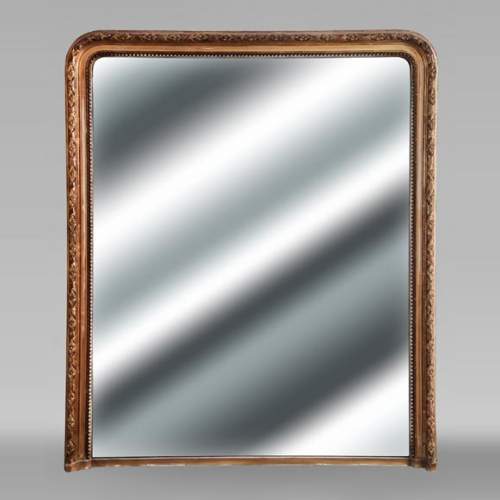
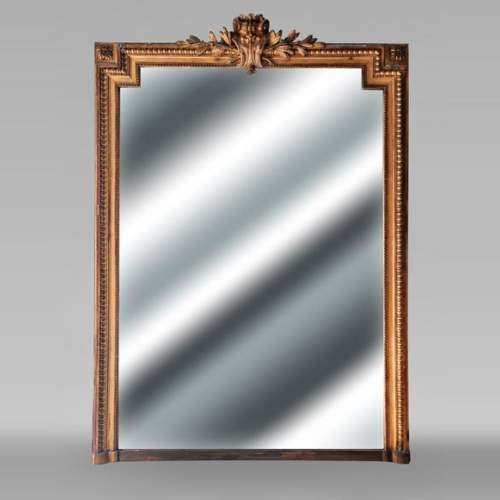
Napoleon III style trumeau with palmette motif

Dimensions:
Width: 131 cm
Height: 155 cm
Depth: 6 cm